


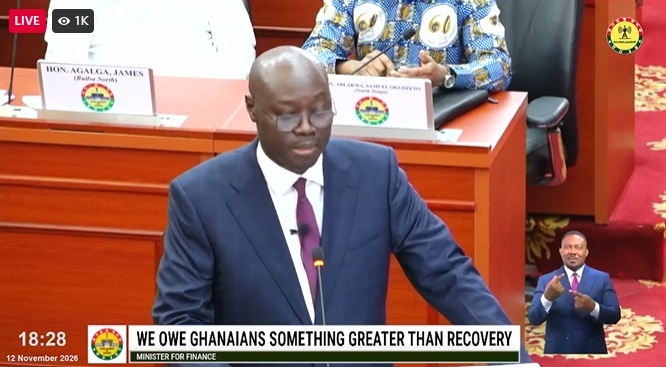
Finance Minister Dr Cassiel Ato Forson is currently unveiling an ambitious $10 billion, four-year New Economy programme, anchored in the 2027 Budget, aimed at fundamentally transforming the structure of the Ghanaian economy and shifting the nation away from its dependence on raw material exports.
Presenting the budget to Parliament on November 12, 2026, Dr Forson stated that the programme, which will run from 2027 to 2030, seeks to create a modern Ghanaian economy for jobs and prosperity.
The announcement comes as Ghana prepares to mark 70 years of independence in 2027, with the Minister stressing that the anniversary must mark a decisive turning point.
"Yet, the economic transformation envisioned by Osagyefo Dr Kwame Nkrumah has not been realized. Our economy continues to carry the burden of long-standing structural weakness. We depend too heavily on raw material export, add too little value at home, and create too few productive jobs for our people," he said.
Reflecting on the 2022 economic crisis, Dr Forson described the severe hardships inflicted on households, including high inflation, expensive debt, and the painful domestic debt exchange programme. He noted that while stability had been restored by the end of 2025, with inflation falling from 23.8 per cent to 5.4 per cent and the primary balance improving from a deficit of 4.1 per cent to a surplus of 2.5 per cent, the government owed Ghanaians more than just recovery. "No statistic can refund the years families lost to instability. Their sacrifices will be honoured when restored stability becomes production, jobs, rising income, and opportunities," he stated.
The Minister outlined that the New Economy programme is built on eight interconnected pillars: macroeconomic stability and affordable finance, commercial agriculture, energy infrastructure, critical minerals value addition, tourism, culture and creative arts, textiles and garments, pharmaceuticals and biomanufacturing, and the technology economy.
He emphasised that these pillars form one productive system, where agriculture supplies food and industrial raw materials, reliable energy supports a 24-hour economy, and minerals gain value before export.
Dr Forson stated that while the government will preserve stability, provide strategic infrastructure, and create predictable conditions for enterprise, the private sector will carry the principal responsibility for investment, innovation, production, and sustainable employment. He added that government support would be transparent, time-bound, and linked to verifiable results.
To protect the recovery, the Minister announced that from 2027, the government will maintain a positive primary surplus of at least 0.5 per cent of GDP, keep public debt consistent with 45 per cent of GDP, and preserve single-digit inflation.
"We choose production. We choose jobs with dignity, and we choose a national purpose that can survive electoral cycles and outlast government," he declared.