


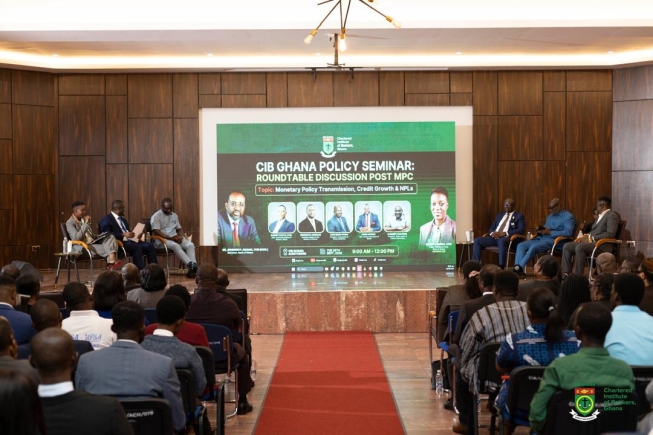
Lower interest rates are reaching borrowers of Ghana's universal banks faster than customers of community and microfinance banks, according to a survey of banks presented at the third Post-Monetary Policy Committee Policy Seminar of the Chartered Institute of Bankers, Ghana.
The seminar, held at the CIB Ghana Auditorium and streamed on the Institute's social media platforms, brought together the Bank of Ghana, the Ministry of Finance, banks, traders and industry. Discussions centred on monetary policy transmission, credit growth and non-performing loans.
It followed the 132nd meeting of the Bank of Ghana's Monetary Policy Committee, which voted unanimously on September 24, 2026, to keep the policy rate unchanged at 14.0 per cent.
Credit growth and credit quality
Opening the seminar, the President of the CIB Ghana Governing Council, Dr Mrs Ellen Ohene-Afoakwa, said monetary policy had implications beyond economists and central bankers, as its effects were transmitted through financial markets, lending conditions, businesses and households.
She said the effectiveness of monetary policy depended not only on changes in the policy rate but also on the extent to which those changes were transmitted to the wider economy.
"As an institute, we recognise that credit growth and credit quality must move together," she said.
She added that Ghana needed a banking sector capable of providing adequate credit to productive sectors while maintaining strong risk management and responsible lending practices. On non-performing loans, she said greater attention should be placed on preventing bad loans than on recovering them after they had deteriorated.
Central bank perspective
In remarks read on his behalf by the Bank of Ghana's Director of Research, Dr Simon Harvey, the Governor of the Bank of Ghana, Dr Johnson P. Asiama, said changes in the policy rate do not pass through to borrowers at once, because banks also weigh funding costs, credit risk, operating costs and expected losses when pricing loans.
"This transmission is neither automatic nor instantaneous," the Governor said.
He said the aim of monetary policy was not simply to achieve lower interest rates but to maintain anchored inflation expectations, a stable currency and sound financial institutions. He also called for a stronger focus on preventing non-performing loans.
"The objective is not simply to achieve lower interest rates," he said.
The Governor said the committee found CIB Ghana's Pre-MPC survey, which is presented to the committee ahead of each meeting, insightful, helpful and complementary to its own analytical models.
Industry survey
The Chief Executive Officer of CIB Ghana, Mr Robert Dzato, presented findings from the Institute's September Pre-MPC sentiment survey, which the CIB Ghana research team conducts among banks ahead of each committee meeting to gather industry insights.
Mr Dzato said the survey showed strong appetite among banks to lend, although the impact of monetary policy transmission varied across market segments.
"We see appetite to lend is quite high," he said, noting that "the real impact of the transmission of monetary policy varies across the various segments."
Lending rates differed widely by type of bank. Most universal banks surveyed reported lending at 10 to 15 per cent. Among community banks, 46 per cent reported lending at 21 to 25 per cent, up from 36 per cent in the July survey, while microfinance banks reported rates of roughly 31 to 40 per cent.
Other findings showed that about 65 per cent of respondents expressed high confidence in the macroeconomic environment, about 80 per cent considered the current policy stance effective in containing inflation, and 86 per cent expected the committee to hold the policy rate, as it did. Seventy per cent expected inflation to rise over the next three months, while 71 per cent of the banks were confident of meeting the 10 per cent non-performing loan directive by the end of 2026.
Although most banks were confident about the wider economy, a majority expected inflation to rise in the coming months, an upside risk that also featured in the panel's discussion of the decision to hold. On asset quality, Mr Dzato described banks' confidence in meeting the non-performing loan target as encouraging but warned that faster credit growth had to be matched by stronger monitoring, recovery and risk mitigation.
"We are driving credit growth for obvious reasons," he said, adding that loans that were not repaid on time could create another problem for the sector.
Panel discussion
The panel was moderated by Mrs Ellen Gyamera, Head of the Petroleum Fund at the Bank of Ghana. It comprised Dr Simon Harvey, Director of Research at the Bank of Ghana; Mr Frederick Amissah, a Technical Advisor to the Ministry of Finance; Dr Charles Atuahene, Executive Member of the Finance and Administration Committee of the Association of Ghana Industries; Mr John Awuah, Chief Executive Officer of the Ghana Association of Banks; and Mr Clement Boateng, President of the Ghana Union of Traders Association.
Dr Harvey set out the basis for the committee's decision to hold the policy rate, including upside risks to inflation. Mr Amissah spoke on coordination between fiscal and monetary authorities, and on the role of fiscal discipline in keeping prices stable and bringing down government borrowing costs.
Panellists noted that loan pricing had fallen from its past highs and discussed the scope for further declines over time. Mr Awuah addressed access to credit, the documentation and record-keeping borrowers need to qualify, and the role of collateral enforcement and the courts in recovering bad loans, drawing comparisons with non-performing loan levels elsewhere in the region. Mr Boateng called for repayment terms, including grace periods, that reflect traders' import cycles and shipping delays. Dr Atuahene discussed how exchange rate movements affect exporters' competitiveness, input costs and businesses' appetite to borrow.
Institute update
Dr Ohene-Afoakwa highlighted the Institute's growth in professional education, certification and ethics, including its Non-Interest Banking Certification, Branch CEO Programme, digital and ESG certifications and Ethics 2.0 class.
She also noted Ghana's success in winning the right to host the World Conference of Banking Institutes in 2028. She appealed for support for the Institute's planned modern bankers' house and business complex, describing the project as an investment in the future of the banking profession.
The seminar forms part of events leading up to the annual Bankers Week.
The Chartered Institute of Bankers, Ghana is the statutory professional body established under the Chartered Institute of Bankers, Ghana Act, 2019 (Act 991) to promote the study of banking and regulate the practice of the banking profession in Ghana. Since its establishment in 1963, the Institute has played a central role in developing trusted professionals for the financial sector.