
Every person has an origin.
We carry inherited memories, values, rich cultures, and distinct identities.
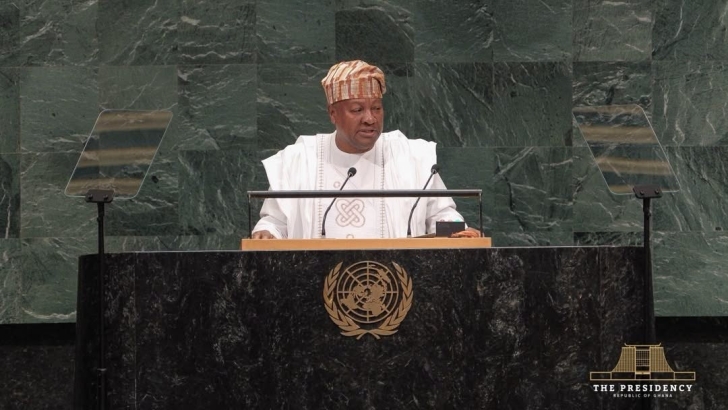
With that reflection on belonging, President John Dramani Mahama began his address to the United Nations General Assembly.
He chose not to start with economics or politics, but with what it means to belong.
Belonging, he argued, is what anchors us.
It reminds us that we are part of a human story far larger than ourselves.
It is a vital wellspring of dignity and pride.
Yet belonging also has a dark side.
When weaponised by political expediency, it turns into nativism, chauvinism, xenophobia and prejudice against those deemed different.
It becomes a pretext for discrimination, displacement, persecution and war.
For the United Nations, he reminded the chamber that the founding principle remains immutable: every human being belongs to the human family.
No race is superior.
No nation is inferior.
No child’s life is worth less because of language, faith, colour of skin or land of birth.
That unyielding moral foundation must be the ground upon which the UN stands.
It was that foundation that framed everything that followed.
Last year, from the same podium, President Mahama had made a solemn pledge on behalf of Ghana, Africa and the global African diaspora to secure full international recognition of the transatlantic trafficking and racialised chattel enslavement of Africans as the gravest crime against humanity in human history.
Some had cautioned that Ghana was reopening old wounds.
In New York, he answered that concern directly.
The purpose was not to provoke division or to render empty judgment, but to seek healing.
True healing requires truth; truth requires acknowledgement, and acknowledgement must lead to meaningful repair.
For centuries, this tragedy was rendered in the passive voice, as if millions of African men, women and children simply vanished into the shadows of time.
They did not vanish.
They were hunted, captured, trafficked, bought, sold, exploited and exchanged for profit.
They were ripped from the families and communities they belonged to.
Their unpaid labour built the cities, industries, banking institutions and empires of the modern Western world, while Africa was left depopulated, with split families, structural disruption and generational trauma.
On March 25, 2026, the International Day of Remembrance of the Victims of Slavery and the Transatlantic Slave Trade, Ghana tabled Resolution A/RES/80/250.
One hundred and 23 nations voted to affirm the fundamental truth that the transatlantic slave trade and chattel enslavement were the gravest crimes against humanity.
That same structural injustice is visible in global governance itself. Africa is home to 1.5 billion people, over 18 per cent of humanity, and constitutes the largest regional voting bloc in the General Assembly.
Yet the continent remains without a single permanent seat on the United Nations Security Council.
That is fundamentally unacceptable in the 21st century.
Africa must be granted permanent representation on the Council with all the rights, responsibilities and veto powers of such membership.
The world cannot credibly champion sovereign equality while preserving a governance structure designed for post-war geopolitical realities.
Security Council reform is not a favour to Africa, but an imperative for the legitimacy, credibility and survival of the United Nations.
The same systemic inequality permeates the international financial architecture.
Developing nations borrow at interest rates up to eight times higher than industrialised nations.
African and Caribbean nations, struck by climate disasters they did not cause, are forced to take on crippling debt to rebuild from floods and droughts.
Governments are forced into a tragic choice between servicing predatory debt and serving their people.
What is needed, and we agree with the President, is long-term, affordable and accessible concessionary financing that enables developing economies to invest in human capital, industrialisation and climate adaptation.
Moral standards cannot be selective.
Across every conflict, whether in Europe, the Middle East or Africa, the standard must remain uniform: respect sovereign integrity, protect civilians, ensure unhindered humanitarian access and hold perpetrators of war crimes accountable.
After all is said, we must also turn inward.
Even as Africa demands a place at the table and calls for a more equitable global order, African leaders must put their own houses in order.
Citing the legal maxim that whoever comes into equity must come with clean hands, he said African leadership must be transparent and accountable, fight corruption and ensure that every dollar of the people’s money is used efficiently in their interest.
That is the full circle of belonging President Mahama traced: from the human family, to historical truth, to present repair, to future partnership, and back to responsibility at home.
