
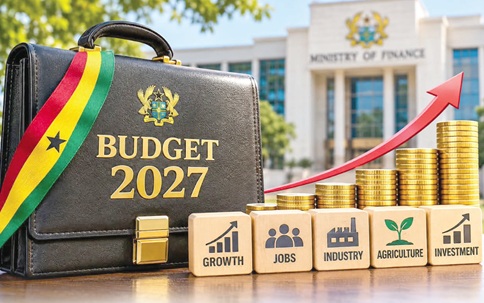
When the Minister of Finance, Dr Cassiel Ato Forson, presents the 2027 Budget Statement and Economic Policy to Parliament today, he will be presenting the third budget of the Mahama administration, and the most important one so far.
The first two budgets had a clear job: stop the bleeding and stabilise the economy.
By most measures, they succeeded. Inflation has fallen.
The cedi has steadied.
The economy is growing at about 5.5 per cent.
The debt restructuring has given the country breathing space.
The 2027 Budget, to be titled The New Economy, has a different and harder job: to turn stability into prosperity.
Stability achieved by not spending is not sustainable.
A government that cuts spending to balance the books will stabilise prices, but it will also starve the economy of the investment it needs to grow.
Roads are not built.
The challenge for Dr Forson is therefore not to spend less.
It is to spend more — but to spend efficiently.
That distinction is crucial, and it should be the guiding principle of the 2027 Budget.
With about GH¢268.8 billion earmarked for expenditure in 2025 and GH¢302.5 billion in 2026, the government must be able to spend more next year than it did in previous years, but that spending must be efficient and directed at sectors that will stimulate growth.
Ghana has seen too much spending that delivered little.
White elephant projects.
Roads that wash away after one rainy season.
Subsidies that benefit the rich more than the poor.
Contracts awarded without value for money.
If the 2027 Budget simply increases spending without changing how we spend, it will waste the stability we have fought so hard to achieve.
So where should the investments go? This is where the government’s $10 billion New Economy Programme, covering 2027 to 2030, becomes central.
The programme seeks to expand domestic production, promote local processing and value addition, strengthen Ghanaian businesses and create employment.
Ghana’s problem has never been a lack of programmes.
We have had Planting for Food and Jobs, One District One Factory, the 24-Hour Economy, and many others.
The problem has been focus, continuity, and efficient deployment of funds.
Too often, programmes are launched with fanfare, funded for a year, then abandoned or diluted.
The New Economy Programme must be different. It must be a catalyst for private sector-led growth, not a substitute for it.
That means government spending must crowd in private investment, not crowd it out.
There can never be a conversation about the budget without mentioning taxation.
There are yawning gaps. For instance, agriculture, which contributes 21 per cent of GDP and employs a third of Ghanaians, accounts for only 0.05 per cent of the country’s tax revenue.
That is a shocking disparity, and it tells a story about our economy: most of our most important sector is informal, unrecorded and untaxed.
The solution is not to increase tax rates or introduce new tax handles. It is to widen the net.
This is the right approach. Local businesses are already over-taxed and over-levied.
That will not happen overnight. It requires patience, trust, and a tax system that is seen as fair.
But a business that sees waste and corruption will evade.
Efficient spending is therefore not just about growth. It is about revenue too.
We need double-digit growth.
Although Ghana’s current growth of about 5.5 per cent is encouraging, we need sustained double-digit growth to achieve meaningful transformation.
He notes that the economy’s ability to grow at five to six per cent despite reduced government spending and tight monetary policy demonstrates its potential to expand further.
Is double-digit growth realistic? For a country with Ghana’s resources, youth, and entrepreneurial energy, it should be.
Countries in Asia achieved it for decades by investing in agriculture, manufacturing, and exports.
Ghana can too, but only if we stop relying on gold prices to do the work for us.
That is the real test of the 2027 Budget. Dr Forson must present a budget that spends more, but spends efficiently.
A budget that invests in agriculture, manufacturing, textiles, and tourism.
A budget that widens the tax net without punishing businesses.
A budget that makes the New Economy Programme a catalyst for private sector growth, not just another government spending plan.
If he does that, 2027 can be the year the country moves from stabilisation to transformation.
If he does not — if the budget is just about more spending, more borrowing, and more promises without discipline — then we will have wasted a rare moment of stability.
The choice is his.
The consequences are ours.
