
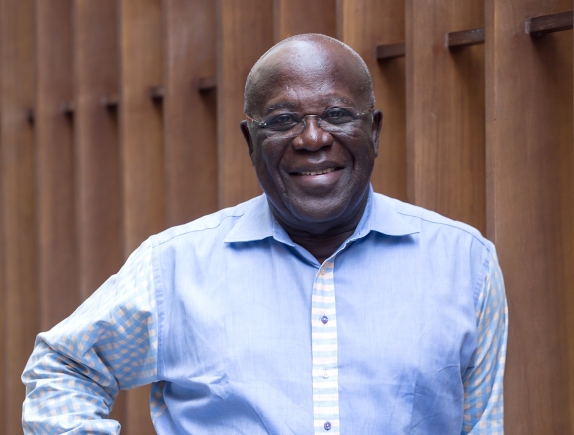
The second General I. K. Acheampong memorial lecture was held on Friday, November 13, 2026 and it was addressed by Sam Jonah, Chancellor of the University of Cape Coast and Executive Chairman of Jonah Capital Limited.
The topic for the lecture was Breaking the Silence - The Human and Political Complexities Behind the Leadership of General Kutu Acheampong.
Below is the full copy of what Sam Jonah said.
Se wo were fi na wosankofa a yenkyi.
“It is not wrong to go back for what you have forgotten.”
AKAN PROVERB
Delivered by
Sam Jonah, KBE, OSG
Chancellor, University of Cape Coast
Executive Chairman, Jonah Capital Limited
Friday, 13 November 2026
Chairman; members of the Acheampong family, and in particular Madam Faustina Acheampong and Mr Anthony Acheampong; Chief of the Defence Staff and Service Commanders; Nananom; Members of the Diplomatic Corps; distinguished guests; ladies and gentlemen.
Good evening.
Before I begin, let me thank Engineers and Planners, the sole sponsors of tonight's lecture, for making this evening possible.
Our forebears left us a saying for an evening such as this: Se wo were fi na wosankofa a yenkyi. It is not wrong to go back for what you have forgotten. That is what we shall do tonight. We shall break the silence that has settled over the name and the years of General Ignatius Kutu Acheampong, and we shall do so by examining, with as much honesty as we can muster, the human and political complexities behind his leadership.
WHY I AM HERE
When the invitation to deliver this lecture arrived, I accepted before I had finished reading it. That is not something I recommend to the young people in this hall. In business, one reads the fine print. But there are a few things in life about which one does not need to be persuaded, and this was one of them.
I should declare an interest at the outset, because a speaker who conceals his interest is not to be trusted. I am a beneficiary of this man. In 1972 his government took control of the Ashanti Goldfields Corporation and opened its senior management to Ghanaians. I had joined Ashanti three years earlier as an underground miner at Obuasi. The chairs I would one day occupy were built on policies General Acheampong signed into law. I never knew him. I never sat across a table from him. But my life bears his fingerprints, and I would be a fraud to pretend otherwise. Having declared my interest, I will try to treat the subject with the detachment it deserves.
I have spent most of my working life underground, or thinking about what lies underground. A miner learns early that the things of greatest value are rarely lying on the surface. They are buried, and they must be brought up and cleaned before anyone can see what they are worth. But a miner also learns that not everything that glitters in the dark is gold. The assayer's job is not to admire the ore. It is to test it. The record of General Ignatius Kutu Acheampong is just such an ore body: rich, largely unworked, mixed with some worthless rock, and buried under nearly half a century of silence, rumour and political convenience. Tonight I intend to assay it.
So I come neither to build a shrine nor to erect a scaffold. Ghana has already done both to this man, and neither has served us well. Tonight, I intend to examine the leadership of General Acheampong, the vision and the blindness, the triumph and the disappointment, the man and the system he led, and to let you judge it whole.
Some of you queued for sugar and soap in the late seventies. Some remember intimidation, detention or a referendum in which you felt your vote counted for very little. Those memories belong in this room. So do the memories of Ghanaians who, for a time, felt their country could feed itself, build its own industries and run its own mines. I ask you to hear me out with an open mind.
THE SILENCE
Before we weigh the record, we must confront the silence around it, because the silence is part of the story.
For most of my adult life, the name Kutu Acheampong has drawn a reflex rather than a reflection. Mention it and you hear of Kalabule, Unigov, and jokes about Volkswagen Golfs. Sadly, that has largely been the sum of our national conversation about a man who shaped this country for six and a half years.
The silence has a scholarly history too. In his celebrated J.B. Danquah Lectures of 1988, the eminent historian Albert Adu Boahen declared the Acheampong years the worst this country had ever known. It was a brave verdict, delivered in a dangerous season, and I applaud his courage in breaking the culture of silence of that time. Sadly, our histories have mostly repeated it, or skipped the period altogether. Professor Emmanuel Akyeampong of Harvard notes that one recent six-hundred-page volume on Ghana's economy since independence mentions the Acheampong regime exactly once. Once.
I will go a little further, and I do so with the greatest respect, because Professor Boahen was a patriot and a scholar of the first rank. But he is no longer here to defend or revise his own verdict, so permit me to ask: would he say the same today? He could not have known that we would hold vote after peaceful vote and still struggle with the challenges Acheampong faced in his time. I do not raise this to excuse General Acheampong. I raise it because a verdict on leadership is always a child of its moment, and a verdict, however brave, can become a substitute for inquiry. Our moment has had thirty more years than his to decide what we should actually be measuring a leader against.
Why has the silence lasted so long? Baffour Agyeman-Duah, whose highly acclaimed biography of the General I commend to every one of you, gives the answer. Acheampong overthrew the Progress Party, ancestor of one of our two political traditions. He was executed by the Armed Forces Revolutionary Council, ancestor of the other. He is an orphan of our politics. Neither family that has governed Ghana since 1993 has had any reason to claim him, and both have had reason to leave him buried in his village.
Whatever your views are of the man, his tenure cannot be consigned to the dustbin of history. In my view, a nation that will not look honestly at its past is like a company that will not audit its books. It may feel comfortable for a while. Trust me, it will not stay solvent.
THE ROOM HE WALKED INTO
No leader can be understood outside his time, so let me take you back to the room Colonel Acheampong walked into in January 1972: a young republic, barely fifteen years from independence, already interrupted once by the military, facing economic strain in an ideological climate that favoured state-led development.
At home, the Busia government, elected in 1969 with real hope, was in serious trouble. Cocoa prices had fallen sharply. The country was still servicing expensive suppliers' credits, many of them for projects that never performed. Reserves were thin. And on 27 December 1971 the cedi was devalued by nearly half overnight. Prices soared, salaries stood still, and in the barracks, cuts to officers' allowances added a grievance of their own.
Across the continent, this was the age of the soldier. When he struck, Nigeria, Togo, Upper Volta and Mali were already under military rule, and competitive democracy was the exception in Africa, not the rule.
It was also the age of state-led development. Import licences, price controls and public enterprises were used by governments across the world and defended by respectable economists. When Acheampong took stakes in the mines and protected Ghanaian businesses, he was no eccentric.
He was moving with the main current of his time, and in several respects, as we shall see, he swam it more skilfully than his peers. None of this made the coup legitimate. Context explains; it does not excuse. But it is against his inheritance, not ours, that his record must be judged.
THE MAN
Leadership is never separable from character, so let me introduce the man.
He was born in Kumasi in 1931, and went to school in Trabuom, his family's home village. His grandfather was a farmer and a chief. He was born not to privilege but to cocoa and catechism, and both stayed with him all his life. He trained at Teshie and Aldershot, served with the United Nations in the chaos of the Congo, and studied at the United States Army Command and General Staff College. Whatever else he was, he was no provincial.
Those who worked with him describe a man of unusual warmth. As head of state he did not move out of his officer's quarters at Burma Camp. He was humble in a way that is hard to fake. Early in his rule, his young press secretary, James Anaman, braced himself and suggested that the Head of State's elocution would benefit from lessons with John Hammond, the country's best-known broadcaster. Acheampong was delighted, took the lessons and thanked the young man. I have sat in enough boardrooms to know how rare that is. Power insulates a man from correction long before it insulates him from consequence. Acheampong, at that stage, could still be corrected, and that is no small leadership attribute.
His other well-known attributes were his empathy and his kindness. We are told he found it almost impossible to refuse a request. Hold on to that thought. In leadership, our greatest strength and our greatest weakness are very often the same quality, seen from two sides.
THE COUP
On 13 January 1972, Colonel Acheampong overthrew an elected government. I did not believe then, and I do not believe now, that soldiers should overthrow governments. Ghanaians had chosen Dr Busia. The decision to remove him was theirs. Every successful coup taught the next group of officers that power was there for whoever was bold enough to seize it. Acheampong himself would pay for that lesson at the highest possible price.
So I do not ask you to admire how he came to power. I ask you to look at what he did with it. And there the record is far richer than we have allowed ourselves to remember.
YENTUA: THE COURAGE TO SAY NO
Within weeks of taking office, the National Redemption Council did something very few governments anywhere had dared to do. On 5 February 1972, Colonel Acheampong announced that Ghana would repudiate some ninety million dollars of suppliers' credits on the grounds that they were tainted by corruption, fraud or inflated contracts. The rest, Ghana would reschedule on terms it could live with.
The Daily Graphic put it in one Akan word, in a headline this country has never forgotten: Yentua. We will not pay.
I have spent a good part of my life among bankers, and I can tell you this is not how they like to be addressed. The creditors were furious. Credit lines were cut, new lending dried up, and ordinary Ghanaians paid part of the price in shortages.
But look at what it achieved. It forced the creditors back to the table, and in Rome in 1974 they agreed to a long-term rescheduling at two and a half per cent interest, with a long grace period. The economist Joan Robinson observed that the creditors settled so generously because they were afraid of giving other debtors ideas.
Set that beside our own recent experience. In December 2022, fifty years after Yentua, our government again announced that it would stop paying most of its external debt. But this was no choice made from strength, to the applause of the nation. It was a default forced upon us, and it reached into the savings of pensioners and ordinary depositors. In 1972 the slogan was Yentua: we will not pay. In 2022 the honest slogan would have been Yentumi: we cannot.
Anyone who has negotiated with a creditor knows the difference between those two sentences.
That is the lesson. Debt is not an abstraction. It is a claim on the future of children not yet born. A leader who will not challenge a bad bargain because the other side is powerful and the consequences are uncomfortable is not a leader. Acheampong understood that the willingness to walk away from the table is the only thing that makes anyone at the table take you seriously. He was prepared to absorb short-term pain for long-term dignity. That is not recklessness. That is negotiation.
OPERATION FEED YOURSELF: THE CLARION CALL
If debt was the boldest answer his government gave, food was the most beloved.
The story is told that at a meeting to review his first budget, the new head of state reached the line for rice imports and stopped. Then he asked a question I wish every Minister of Finance since had asked: Don't we have the land? Don't we have the rain? Don't we have the water bodies? What is wrong with us?
It was a farmer's grandson's question, and out of it came Operation Feed Yourself.
It was a national mobilisation. Colonel Frank Bernasko, who led it, enlisted the chiefs and carried the message by radio and information van into every village. Cutlasses, hoes, fertiliser and seed were sold at heavily subsidised prices. Feeder roads carried produce to market. Above all, the government invested in water, from Dawhenya and Asutsuare to the great Tono dam in the north.
The results were not rhetoric. Rice imports fell to zero in 1975, and again in 1976. Zero. Farmers in the North exported rice and tomatoes to Upper Volta, and Tamale earned a nickname, The Rice City.
But the numbers were the smaller part. The larger part was what it did to us. Secondary schools grew their own food and competed to show it off. Students at the University of Cape Coast volunteered to harvest sugar cane for the Komenda factory. Bank managers farmed at weekends. Backyard gardens sprang up in Cantonments and the Airport Residential Area. For perhaps the only time in our history, the educated Ghanaian was proud to call himself a farmer. The British High Commissioner reported home, with some astonishment, that food was plentiful and affordable.
People who were children then still remember the message. They were too young to understand the economics of import substitution. They understood perfectly well that the country was asking them to help grow what it ate. The campaign made us feel the dignity the nation placed on growing what we eat.
Let's face it, a nation that cannot feed its people will struggle to realise the full promise of independence. Operation Feed Yourself gave that truth a practical, popular form.
The most powerful instrument a leader possesses is neither a budget nor a decree. It is a call that ordinary citizens can answer with their own two hands. Acheampong found that call, and the nation answered. Every president since, of every party, has at some point promised to bring Operation Feed Yourself back. There is no sincerer tribute one leader can pay another.
Good rains helped in the early years, and when the economy weakened after 1975 the momentum drained away. Today we spend some two billion dollars a year importing food, with rice and chicken near the top of the bill. The tragedy of Operation Feed Yourself is not that it failed. It is that it worked, and we let it go.
OWNERSHIP: OUR WEALTH, OUR DECISIONS
From the food on our tables, let me turn to the wealth beneath our soil. This is the subject closest to my own life, and I will try not to abuse the privilege.
In 1961 a commission under Kweku Boateng recommended that the state hold at least fifty-one per cent of the mining companies. Three governments left it on the shelf. Acheampong went to the archives and took it down from the shelf.
In 1972 his government took controlling stakes in Ashanti Goldfields, in the Consolidated African Selection Trust, and in the great foreign timber houses. For the first time since the Portuguese landed at Elmina, the majority of the wealth beneath Ghanaian soil belonged to Ghanaians.
Notice how he did it, because this is where he was decades ahead of his time. He did not send soldiers to seize the mines. He kept the foreign partners, their capital and their expertise, under management agreements. But he insisted on three things: that the head office be in Accra, so that the decisions that mattered were taken by people who had to look Ghanaians in the eye; that the state hold the controlling voice; and that a Ghanaian be trained and placed in the deputy managing director's chair, with the clear expectation that the top chair would follow.
In due course, I was that Ghanaian. So were many others, in many companies. A whole generation of Ghanaian engineers, geologists and accountants came up through the door that decree opened. When I later stood on the floor of the New York Stock Exchange as chief executive of the first African operating company to list there, I was standing on a foundation laid in Accra in 1972 by a colonel who had never run a company in his life.
He even warned that too much state control, too fast, could overstretch the nation's managerial capacity. That is the voice of a pragmatist, not an ideologue.
Under structural adjustment, the state's stake in Ashanti was sold down, and today the Republic holds zero per cent of the company that succeeded it, AngloGold Ashanti. Yes, you heard me right: zero. The decision to take Ashanti public was, in my view, the correct one. We needed the capital and we needed to open up the capital structure to access funding for our ambitious expansion plans. But none of us anticipated what has happened. We gave away not just a shareholding but a principle. The lesson of Acheampong is not that the state should own everything. It is that a nation must never surrender the decisive voice over its own patrimony. Of course ownership alone will not bring prosperity to the communities around a mine; that takes competent management, transparent returns and reinvestment. But the principle stands.
Recent developments in the mining sector would have made him proud. Local content laws are bringing Ghanaian businesses into the heart of our mining industry. We have world-class Ghanaian mining contractors, among them tonight's sponsors, Engineers and Planners, and Ghanaian-owned mines are becoming commonplace. Every one of them is a child of Acheampong's "we can do it" philosophy, and the foundation for all of it was laid in 1972.
BUILDING A GHANAIAN ENTERPRISE CLASS AND PRACTICAL REFORMS
Owning the mines was one thing. Building a class of Ghanaian industrialists was another, and it is the part of his record that most surprised me. Here the political ambition met practical achievement.
Acheampong looked at Japan and asked why Honda and Toyota carried the names of men their governments had helped to greatness, and why Ghana could not do the same. He explained his conviction with an Akan proverb: poverty visible at the chief's palace signals the poverty of the whole community, and wealth at the palace reflects a wealthy community.
So he backed Ghanaians. His government midwifed a generation of indigenous industrialists whose like we have not seen since. Joshua Kwabena Siaw, refused a brewery licence by one government and told by the next that he could only be a junior partner to Germans, opened Tata Brewery in 1973, the largest in West Africa. Kofi Owusu built KOWUS Motors, the first wholly Ghanaian-owned car assembly plant. And in December 1974 Neoplan Ghana rolled out the first bus ever built in West Africa.
He extended credit to women traders too, after one of his aides showed that women repaid their loans more reliably than men and did more with the money: a finding the global microfinance industry would rediscover twenty years later. Anyone discussing finance for women-owned businesses in Ghana is revisiting a question his government took seriously half a century ago.
A leader is measured not only by what he does, but by what he enables others to do. Acheampong multiplied himself. The tragedy is what followed. After 1979 almost every one of those businesses was destroyed, and their founders hunted, imprisoned or driven into exile. Siaw died in London. The humiliation of that generation chilled Ghana's appetite for enterprise for a very long time. A country that wants its citizens to take risks on its behalf has to give them rules and institutions they can count on when the government changes. I believe Acheampong failed to achieve that.
Nevertheless, his government also gave us practical national reforms that remain with us. His administration invested heavily in housing through the State Housing Corporation and other bodies: Dansoman, North Kaneshie and the Teshie-Nungua estates in Accra, and low-cost housing in Tema, Kumasi and across the country.
On 4 August 1974, Ghana changed from driving on the left to driving on the right. It required extensive public education and changes to road infrastructure, and it aligned Ghana's traffic system with those of its neighbours. It remains one of his administration's clearest and most enduring achievements. When you drive home tonight on the right-hand side of the road, remember that morning: an entire nation changed sides, and the sky did not fall.
And he got the Kpong hydroelectric project into construction in 1977. It was completed in 1982, after he had left office, but the credit for starting it is his.
INTEGRITY: THE MAN AND THE SYSTEM
There is a word we have yet to reckon with. Kalabule. It leads us to a question people still ask. Was Kutu Acheampong corrupt? Let me set out the evidence, and let you judge.
On 4 July 1972, six months into his rule, he became the first member of his Council to declare his assets. His cabinet secretary, Ambassador E.M. Debrah, one of the most distinguished public servants this country has produced, recalled that whenever the head of state wanted to write a cheque, he first telephoned the bank to check his balance. He threw out a man who came to his office with money for a contract. James Anaman, who served him for five years, said he never once saw him put his hand in the national kitty.
Accounts of the investigations after his fall say that no foreign bank account or fortune was uncovered. There is a story that, when an officer offered to smuggle him across the border for a hundred thousand dollars, Acheampong replied that if he had that kind of money he would not have stayed so long in the army. His widow spent years in exile in London, sharing a flat with a friend.
What, then, of Kalabule? Here fairness requires us to credit the weather as well as the pilot. In October 1973, war broke out in the Middle East, the Arab oil producers imposed an embargo, and within months the world price of oil had quadrupled. Ghana produced no oil, yet it still had to keep its trucks moving and its factories running. I do not believe any government, however competent, could have come through a shock of that size unmarked. Acheampong's response was a kind one. Out of a genuine wish to spare ordinary households, he refused to pass the full cost on, and reached instead for price controls. Price control produced what it always produces: shortages, hoarding, a black market, and a chit system that became a great engine of the corruption of that era.
Inflation passed one hundred per cent in 1977. Kalabule, as Elizabeth Ohene observed, became a noun, an adjective and an interjection.
People who knew him said he found it hard to turn away someone who came to him for help. That can be a fine quality in a friend. In the office that decides who gets scarce goods and scarce foreign exchange, it can become a privilege for those who know which door to knock on.
I believe Acheampong was personally honest. I also believe he was too slow to restrain the people who profited from the system he presided over. For the woman who spent half a day queueing for goods that someone else had secured with a chit, the personal honesty of the Head of State was of little practical comfort. She was entitled to a government whose rules worked for her too.
A leader carries both his personal virtue and his country's rot, and history is entitled to weigh both. But let us at least weigh them honestly. Too many who grew rich in those years have been content to let one honest man carry the whole name of Kalabule to his grave.
THE REGIONS: THE MEANS TO ACT, AND A NATIONAL RESPONSIBILITY
Before I come to the most controversial idea of his rule, let me dwell on two initiatives that are rarely discussed, and that belong together. He gave Ghana's regions institutions that could invest in their own economies. And he treated the leadership of those regions as a national responsibility.
Begin with the means to act. Under the Regional Development Corporations Decree, NRCD 140, every region was to have a development corporation of its own, empowered to run agricultural, industrial and commercial ventures, to partner private firms and cooperatives, and to borrow within limits set by the centre. Each board was chaired by the Regional Commissioner and included a chief nominated by the Regional House of Chiefs.
But I promised to assay, not to admire. A World Bank appraisal found the Upper Region corporation stretched too thin, and his own government admitted that the corporations had chased quick profits. The record was uneven. Yet fifty years on, we are still asking how to give our regions and districts the means to build their own economies. He asked that question early, and he gave it an institutional answer.
The second idea is best told through a man. Colonel George Minyila came from Navrongo, in what was then the Upper Region. He served first as Regional Commissioner in his home region, and in 1973 he was posted to the Eastern Region. Consider that for a moment: a son of Navrongo sent to govern Koforidua.
The clearest significance of his appointment is the assumption it challenged: that a region must be governed by someone who shares the origins of the people he serves. It said that a Ghanaian from Navrongo is a Ghanaian in Koforidua, and that public service is owed to the nation, not to the tribe. It was part of a wider effort by his government to promote regional balance and reduce ethnic division.
The corporations put practical tools in the hands of the regions. Minyila's posting said that a region could draw on leadership from anywhere in Ghana. And the regional boards joined the two, with a chief sitting alongside a nationally appointed commissioner. Local voice, national leadership. Keep that pairing in mind, because it leads directly to the most controversial idea he ever put to this nation.
UNION GOVERNMENT: THE RIGHT QUESTION, THE WRONG METHOD
By September 1976, an economic crisis had become a political one. The Ghana Bar Association publicly called on Acheampong to hand over to constitutional rule. His answer was Union Government.
The problem he was reaching for had been with us since before independence. Could Ghana organise its politics in a way that gave different communities a stake in government, even when their party lost?
Within months of the 1954 election, the National Liberation Movement had emerged in Kumasi. The Northern People's Party spoke for the North, and the Togoland Congress for the Trans-Volta. In Kumasi, party rivalry turned deadly. In a country where the state is the largest employer and contractor and the gatekeeper of licences and foreign exchange, winning an election can mean winning almost everything. Once parties map onto communities, an election can begin to feel like a census. You count your people. You fear the other side's numbers.
Acheampong had seen the First Republic harden into a one-party state. He had also seen the Second Republic dismiss hundreds of public officers, a decision many read as a purge. His proposal would bring soldiers, police and civilians into government, with candidates standing as individuals. A timetable eventually envisaged a handover in July 1979.
The idea of government by consensus has deep roots here. The philosopher Kwasi Wiredu described how a traditional Akan council sought agreement through deliberation. Otumfuo Opoku Ware II, who backed the proposal, wanted a system that drew support from more than one section of society. The impulse behind that argument deserves to be taken seriously.
Take that question into our Fourth Republic. After an election changes the government, how many public boards change hands? How many projects stop halfway because the sign at the gate bears the name of the previous administration? I have spent a lifetime in business. If a board changed direction every time a new chairman arrived, there would soon be very little left to chair. A nation is no different. Every four or eight years we pull up the seedlings to see whether the roots have grown, and then we wonder why the harvest never comes.
So let me say plainly what I actually think. I do not believe Kutu Acheampong was wrong to ask whether a young, ethnically plural nation, fifteen years into self-rule, could really afford a politics in which the loser gets nothing and owes the winner nothing in return. That remains one of the most serious unresolved questions in African governance, and our own experience of the Fourth Republic, nearly fifty years later, suggests we still have not answered it. Where he went wrong was not the question. It was almost everything about how he tried to answer it.
I am not making the case for soldiers. This continent has had its fill of strongmen, and most of them delivered neither bread nor freedom. I am saying that the form of our democracy should be judged by what it delivers, and designed for the society in front of us: one that includes rather than excludes, rewards competence over loyalty, and holds the nation together long enough to build. That was Acheampong's question.
Here is my argument, as simply as I can put it. Look at the nations that have made the climb from poverty to prosperity, and you will find that at the decisive stage almost every one of them had a long period of political stability: a settled national direction, held long enough for investment to mature, for institutions to take root and for a generation to be educated. There changes of Government since his exit, we are still waiting for a single transformative national vision that will outlive whichever party wins power. Sometimes that stability came from autocrats, sometimes from standing coalitions, sometimes from a constitution built to rise above party. But it came. Let me take you through the evidence.
Look east. In 1980 China was, if anything, poorer than India. India chose the world's largest democracy, and deserves our respect for it; it has made great strides and is growing fast today. China chose discipline and a single-minded focus on development. By the World Bank's count, China has since lifted close to eight hundred million people out of extreme poverty and all but eliminated it, while India still has more than seventy million below the line. China's income per head is now about five times India's.
But notice what China's own history teaches. In its first three decades of one-party rule it had control without direction, and it suffered famine and upheaval. Stability on its own builds nothing. Stability harnessed to a national purpose, and kept there long enough, builds almost everything.
Nor does stability require us to abandon the ballot box. Look at Malaysia, which began where we began. In 1957 it became independent in the same year as Ghana, at much the same level of income. Today Malaysians are about five times richer than Ghanaians. For more than sixty years Malaysia was governed by a standing coalition, first the Alliance and then the Barisan Nasional, that brought its Malay, Chinese and Indian communities into government together. Next door, Singapore elects most of its members of parliament in Group Representation Constituencies that must include a candidate from a minority race. Both held regular elections. Neither allowed the contest for the state to become a war between communities. Ladies and gentlemen, that is Union Government by another name. It did not abolish competition or accountability. It channelled them, so that no community was permanently shut out of the benefits of the state, and the energy of politics went into delivery rather than into total victory or total opposition.
Ghanaians understand this better than their governments do. In Afrobarometer's 2024 survey, three in four of us still said democracy is the best form of government. But fewer than half were satisfied with the democracy we actually have, and the share willing to consider a non-democratic alternative had doubled since 1999. That is not a people rejecting democracy. It is a people asking why their democracy does not deliver.
Let me be careful, because I know how easily this argument is misheard. I am not persuaded that liberal democracy, in the pure adversarial, winner-takes-all form we imported, is fit for purpose in most African countries at our present stage of development. I do not ask for less democracy. Elections, accountability and a free press must stay. I ask for a democracy designed for the society in front of us. Winner-takes-all assumes a voter who can weigh competing programmes, a middle class with something to lose, and institutions strong enough to referee. Where too many voters are poor, a vote is too easily bought with a bag of rice and a T-shirt, and the money that buys it is recovered afterwards through contracts and appointments. Where schooling and opportunity are unequal, campaigns are fought on tribe and region, because identity needs no manifesto. I say all this as a man who has spent his life among democracy's institutions, and I say it with respect and without rancour.
What Ghana needs, I believe, is a period of stability long enough to build: a generation in which the energy we now spend on capturing the state is spent on developing it. A national direction that does not lurch with every change of government. There changes of Government since his exit, we are still waiting for a single transformative national vision that will outlive whichever party wins power. Institutions led on merit rather than loyalty. Every region and every community with a seat at the table, so that no one has to win everything for fear of losing everything. All of this with the ballot box, and without the four-yearly war that turns our public service into spoils and our projects into ruins. That, at its heart, was the promise of Union Government, and it is a promise worth revisiting.
But a promise is only as good as the way it is kept, and here we must be honest about what happened next.
On 30 March 1978 the proposal went to a referendum. The campaign turned a question about how Ghana should be governed into a question about one man. There were T-shirts that said, "Vote Union Government, Vote Acheampong." Justice Isaac Abban, the Electoral Commissioner, went into hiding amid pressure over the count. The government announced a narrow victory. Opponents were harassed and some were detained. A proposal presented as a way to bring Ghanaians together had become a test of what could happen to those who disagreed.
A reform intended to widen participation has to begin by respecting the participation of people who will vote against it. They must be free to make their case. Their votes must be counted fairly. And when the result comes in, those in power must be prepared to live with it.
KNOWING WHEN TO LEAVE
Which brings me to the failure from which much of the rest flowed. He stayed too long.
His biographer divides his rule in two, and I think rightly. From 1972 to 1975 he was a constructive, dynamic and popular leader. From 1975 he was a man holding on, convinced, I believe sincerely, that the work was unfinished and that he was needed to finish it. He replaced the National Redemption Council with the Supreme Military Council and became a General, but he did not give the people the one thing they wanted: a date for his departure. When he finally gave one, after the professional bodies struck in 1977, the trust had gone.
Legitimacy is a wasting asset. A leader without a mandate can borrow it by delivering results, but results are not consent, and when the results faltered the loan was called. By 1975 he had done enough to hand over with honour. He could have been remembered as the soldier who fed his country and went home.
The end was delivered by the men he had raised. On the morning of 5 July 1978, resting at home with a tennis injury, he was summoned to Burma Camp to review what he was told was a corruption report. The door opened without a knock, and in walked his Chief of Defence Staff, Lieutenant General Fred Akuffo, with the heads of the services, every one of them an officer he had promoted. A single sheet of paper was placed before him: a letter of resignation. He refused. They insisted. He signed, and within the hour he was driven away under guard. Akuffo accused him of running a one-man show. The colonel who once thanked a junior aide for correcting his diction had become a general his own Council could no longer correct.
We see it all the time in business: the founder who cannot let go. Acheampong did not build something that could outlive his hold on it, and both he and Ghana paid.
THE END
I will speak of the end briefly.
In 1978, as he watched his project collapse, he said something more self-aware than anything his critics ever wrote about him: "I can go today, and the SMC Government can go, but the problems of the nation will still remain, unless the people as a whole change from their greed, avarice and other social evils that afflict us." Hold on to those words.
Eleven months after that morning at Burma Camp, on 16 June 1979, General Acheampong was driven to the Teshie firing range. Three days earlier he had been paraded before the cameras and had refused to read a prepared confession. No charge had been proved. No court had heard his case. The young captain who drove him there had once commanded his guard, and he had treated him almost as a son. He was shot, without trial, alongside General Utuka. Ten days later, six more senior officers followed, among them two other former heads of state. He was buried without ceremony at Nsawam, his family kept away.
And he went to that range not as General Acheampong but as Mr Acheampong. Weeks earlier, the Council that removed him had stripped him by decree of his rank, his honours and his pension. I shall return to that before I sit down.
He had been offered chances to escape. He refused them. He had done nothing, he said, that should make him run from his own country.
It took twenty-two years before his remains were returned to his family.
When the graves at Nsawam were opened in 2001, his wedding ring was found still on his hand. The man who had supervised the burial had ordered it left there, with a premonition that one day it would be returned to its rightful owner. It was placed in the hands of Madam Faustina Acheampong, who wept.
They searched for Swiss accounts, and found none. They searched for houses in London, and found none. What they found, in the earth at Nsawam, was a ring.
WHAT WE OWE HIM, AND WHAT WE OWE OURSELVES
Let me draw the threads together.
The record is now before you, and I hope you will agree that the record is far richer than the slogans allowed. On one side stand Yentua, Operation Feed Yourself, Ghanaian ownership of Ghanaian wealth, a generation of Ghanaian industrialists, regions given the means to invest in their own economies, practical reforms in housing, traffic and measurement, the advance of Kpong, a brave question about how a divided nation should govern itself, and a head of state who left office as poor as he entered it. On the other stand the coup, Kalabule, the detentions, the referendum, and the years he stayed after his time. That is not the record of a villain. It is the record of a patriot who did great things, made grave mistakes, and paid for them as few leaders ever have.
His life writes three lessons in capital letters. Deliver, but never without consent. Be honest, but build honest systems, because a clean man cannot clean a country alone. And lead, but know when to leave, because the manner of your leaving decides whether anything you built survives you.
And here is the uncomfortable truth he named himself in 1978: removing a leader is not the same as curing a nation. Every problem he confronted is still with us. We are still arguing about our debt. We are still importing our rice. We are still bargaining over who benefits from what lies beneath our soil. We still ask why Ghana has no Honda. Nearly half a century and many changes of government after his exit, we are still waiting for a single transformative national vision that outlives whichever party happens to win elections. And when we look in the mirror, our greatest obstacle is still not the outsider but our own reluctance to believe that we can do it ourselves.
Kutu Acheampong believed we could. For three remarkable years he made a whole nation believe it too.
A DEBT OF HONOUR
One injustice from those years lies entirely within our power to put right, and I cannot in conscience end without naming it.
Recently a petition was addressed to His Excellency the President by the Ambassadors for Reconciliation, Justice and Peace – Africa, a movement born on the campus of the University of Cape Coast. The petitioners ask the President to correct a grave injustice.
The facts are simple. He was stripped of his rank by decree. He was shot without trial. No court convicted him of anything. A man who had worn his country's uniform for more than twenty years went to his death as Mister.
I am not asking anyone to pretend those years were without fault; those who suffered in them are entitled to their memory. But the case for restoring his rank does not rest on whether he was a good ruler. It rests on something simpler. In a nation of laws, a soldier's rank, earned over a lifetime of service, is not removed by decree and settled by a firing squad. Due process is not a reward for the virtuous. It is a protection for everyone, and above all for those we have decided we dislike. Every other soldier who has led this Republic, including the two who faced the same firing squad ten days after him, is remembered by his title. Only one is Mister. That is not history. It is an unhealed wound with a filing number.
In 2019 the Ghana Armed Forces did something that took real institutional courage. Under the words Never Again, they acknowledged that what was done in 1979 was an aberration. I honour that. But the sentence begun at Burma Camp that day is not yet finished. If the execution was an aberration, then so was the decree that sent him to it stripped of his rank.
So I add my voice, respectfully, to those who ask His Excellency the President, the Armed Forces Council and, where the law requires it, Parliament, to do three things: restore the rank of General to Ignatius Kutu Acheampong; restore his name to the rolls of the Ghana Military Academy; and restore to his family the honours that belong with that rank. As Ghana approaches seventy years of independence, I can think of no better proof that this Republic is confident enough to tell its whole story. Restoring a rank does not rewrite history. It completes it.
Ladies and gentlemen, let me leave you not with his faults, which we have weighed honestly tonight, but with what he left us.
When a farmer in the North brings rice to market, remember Operation Feed Yourself, a Tamale once called Rice City, and the conviction that a nation that cannot feed itself cannot truly call itself free.
When you hear the word Yentua, remember a head of state who told the creditors of the world that Ghana would not honour a corrupt bargain, and came home with the best terms this country had ever won.
When a Ghanaian sits at the head of the table in a company that mines our gold, remember the decree of 1972 that said the head office would be in Accra and the deputy's chair would go to one of us. I know. I sat in it.
When you visit Nkroful, where Osagyefo was first laid to rest, remember who brought him home. Kwame Nkrumah died in exile in 1972, and that same year it was this man's government that brought him back and laid him to rest, with dignity, in the soil of his birth. He gave Nkrumah back to Ghana. Is it too much to ask that Ghana give him back his name?
And when a young cadet receives a commission at the Military Academy in Teshie, let us resolve that the name Teshie will stand in our history for commissioning, and not for execution.
He was the grandson of a farmer made chief because his neighbours trusted his judgement. Ghana gave him his rank, and Ghana can give it back.
Madam Acheampong, in 2001 they placed his ring back in your hands. It is time this nation placed his rank back beside his name.
Let us give him in death the one thing he was denied in life: a fair hearing before the conscience of his country. And let the verdict be his name, restored in full: General Ignatius Kutu Acheampong.
Damirifa due, General. May your soul, and the souls of all who died with you, and of all who suffered in those years, rest in peace.
Thank you.
About Sam Jonah
Sir Samuel Jonah, KBE, is a business magnate, educator, and philanthropist whose visionary leadership transformed Ashanti Goldfields into a multinational corporation and secured its place as the first African company listed on the New York Stock Exchange.
