
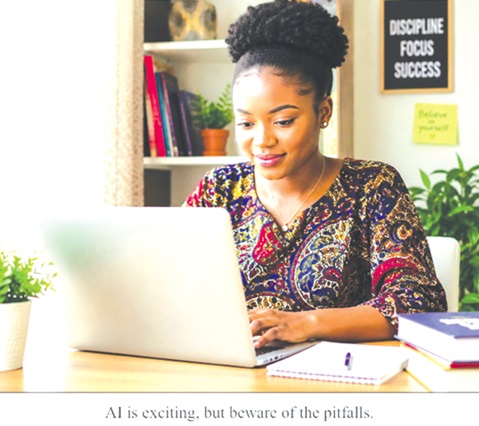
Just like every coin has two sides, Artificial Intelligence and other new technologies have their advantages and disadvantages.
Our discourse on this subject, therefore, seeks to highlight some of these pros and cons to assist writers in navigating the massive flow of information from AI or ChatGPT.
Writers’ companion
AI is definitely a great tool for writers, and we can safely refer to it as a writer’s companion.
For example, while writing this article, I asked Google, powered by AI, several questions, and I checked spellings and sought synonyms.
ChatGPT can suggest ideas when prompted. It can help you edit your work, check your grammar, vary your vocabulary, and endow your content with relevant information.
Thus, writing today is made easier for the determined, creative and hardworking writer.
Combining God’s natural intelligence with artificial intelligence can create more balanced and deeper content. Remember, however, that ChatGPT can make mistakes, including providing misleading information!
Ghostwriting
In our earlier discussion, we mentioned that using ChatGPT to produce a literary work was like ghostwriting.
Simply put, a ghostwriter is someone who writes for another person to publish under their own name.
ChatGPT assists in producing literary content, but it becomes a ghostwriter if all we do is prompt it to produce the content for us to just append our name as the author.
The writer who desires to be the true owner of a literary work will not swallow the prompt results of ChatGPT line, hook, and sinker but will professionally and creatively manage the information provided.
Copyright issues
On the copyright page of a book, the caveat states, “The author wishes to assert their right as the true owner of the content of this book.”
Now this caveat is weakened if AI’s footprint is all over the author’s content.
This confirms the point we made in our earlier submission that it is all about who the writer is and how they value their integrity and own their content.
Prompting AI to write for you and using the results verbatim raises serious questions about true authorship.
Our publishing ministry built a library and commissioned it as the Sakogu Community Library under the auspices of the North East regional minister and other dignitaries.
Then we published the speeches, a brief history, and other information on the library online.
One day, for fun, I asked ChatGPT to produce for me an article on the Sakogu Community Library.
Within minutes, ChatGPT had pulled together a well-organised article on the library from our own sources, and I could easily recognise my own write-up.
What was that? To say it mildly, that was plagiarism.
So the writer should remember that, for all the great things that AI does, it is “artificial” and has no intelligence of its own—unlike the God-endowed natural intelligence of the human being.
In response to prompts, AI simply collates information scattered about on the worldwide web. Using that information verbatim is unprofessional and can land the writer in a copyright violation.
Summary writing
This is where summary writing skill becomes more useful to every writer.
When you prompt AI for information, you are likely to have a truckload of all kinds of stuff.
While some of the information would be more relevant and closely related to your quest, other information would be miles away.
Rather than produce the information verbatim, summarise it using your own words and expressions, applying synonyms and antonyms to revise your thought. By all means, infuse your own creativity, voice, and nuance into what you write.
I like what Chief Moomen, a Ghanaian poet, playwright and creative entrepreneur, says about this: “While AI may be able to replicate certain technical aspects of writing, the technology lacks the depth, nuance and humanity that defines true artistry.”
Every writer must work towards developing their unique nuances, voice and creativity that define their craft.
Chief Moomen believes that creativity is “something spiritual,” and he does not think a machine or technology will ever replace that.
This is precisely why AI must be used as a tool that augments human effort, and not as a flawless generator of information.
AI should be used as we use the computer and not just as a typewriter or the combine harvester and not just the sickle.
The fact that humanity created AI and that AI did not create itself makes God’s image in the human being superior.
That is akin to the “something spiritual” that Moomen mentioned.
As humanity continues to delve into God’s image in us, a time may come when, in comparison to our modern AI, the future invention would render AI archaic!
Next week: We shall draw the curtain on our discussion on AI and the writer next week, the Good Lord willing, when we tie the loose ends on the subject.
The writer is a publisher, author, writer-trainer/CEO of Step Publishers.
E-mail:
