

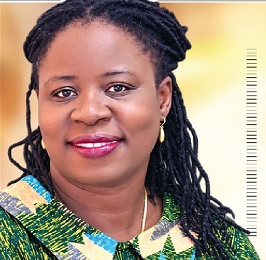
Long before she became Professor Abena Animwaa Yeboah-Banin, “Prof.” was already a name people used for her.
From her days as a junior high school student, her father called her “me Professor” (my professor) for reasons she still cannot explain.
Later, her university classmates adopted the name because of the ease with which she understood issues and explained them during group discussions.
Today, the name has become a title she has earned through years of study, research and sacrifice.
Yet, despite sitting in the professor’s chair and among the country’s distinguished decision-makers, she remains anchored to the memory of a wooden house in Kaneshie where her story began.
From a welder’s daughter and the child of a Makola cloth seller to an academic leader and GBC Board member, Professor Abena Animwaa Yeboah-Banin’s journey has been shaped by setbacks, sacrifice and an unwavering determination to succeed.
Academic journey
The Dean of Information Studies at the University of Ghana (UG) and newly appointed member of the Ghana Broadcasting Corporation (GBC) Board grew up in a large family. Her mother sold cloth (ntoma) at Makola, while her father was a welder.
The family was modest but comfortable, and young Abena was a serious student who loved reading.
At Abetifi Presbyterian Senior High School, she was nominated for head girl but declined. Although leadership appealed to her, she feared that disciplining other students would distract her from the studies she was determined to pursue.
Sharing her story with The Mirror last Wednesday, she said she was determined not to become a remedial student.

With limited family resources for repeated examination attempts, she studied hard and passed the West African Senior School Certificate Examination (WASSCE). Yet university did not come immediately.
At the time, prospective students had to write university entrance examinations, and Mathematics was one subject she dreaded.
So, when she learned that the Ghana Institute of Journalism (GIJ) required English and General Knowledge for its entrance examination, she opted for a two-year diploma programme there.
After her national service at the Ghanaian Times, the university entrance examinations were cancelled.
With her grades already in place, she quickly applied to the University of Ghana.
She was admitted to study English and Psychology and graduated with first-class honours. She was also active in student leadership, serving, among other roles, as Vice-President of Akuafo Hall. But her academic journey was not without setbacks.
When she applied for a master’s programme at UG and was not called for the entrance examination, she was shocked. “I considered myself a strong student and could not understand what went wrong,” she said.
She sought help from her hall master, Rt. Rev. Prof. Cephas Omenyo who took her to Prof. Audrey Gadzekpo, then Director of the School of Communication Studies.
Prof. Gadzekpo examined her application and was unimpressed by the way she had completed the forms.
She “really blasted” her, Prof. Yeboah-Banin recalled, for presenting her qualifications in a manner that did not reflect her academic ability.
Fortunately, the entrance examination had not yet been held.
Prof. Gadzekpo allowed her to write it but cautioned that admission would be strictly on merit. Prof. Yeboah-Banin passed exceptionally well and was among the top students upgraded to the Master of Philosophy (MPhil) programme.
It was during this period that another important chapter began.
She became a teaching assistant to Mr Kwaku Mensah Bonsu, a part-time lecturer and owner of Primetime, producers of the National Maths and Science Quiz.
“I understudied him in advertising, a field I enjoyed. I worked at Primetime for nearly four years while continuing as a teaching assistant at UG,” she said.
She later earned a PhD in Marketing from the University of Leeds in 2016. After returning to Ghana, she was promoted to lecturer, became a senior lecturer in 2018 and an associate professor in 2024.

Behind the titles, however, is a demanding career that goes far beyond teaching.
“Academia is very heavy, extremely heavy,” she said.
Teaching, she explained, was only one aspect of a lecturer’s work. Academics are also expected to conduct research, generate knowledge, attend conferences, present to international audiences, serve on committees and contribute their expertise to communities locally and internationally.
For her, one of the biggest challenges is managing the many demands within the 24 hours of a day.
“Sometimes, I bite more than I can chew. I let myself be way more,” she said.
Making Prof. a reality.
Interestingly, “Prof.” had followed her long before she earned the title.
Her father, who named her after his father’s sister, called her “Agya Abena”, in keeping with Kwahu naming traditions. At some point, however, he began calling her “Prof.”, although she does not know exactly why.
Her university classmates also called her “Prof.”, apparently because of how quickly she understood issues and explained them during group discussions.
Today, the title is official, but the road to it required hard work.
The most difficult moment of her career was leaving Ghana to pursue her doctoral degree when her son was only 11 months old.
She recalled the morning of her departure, when the child cried so much that even his sibling had to hold him for a photograph.
She wept during the flight as she experienced separation anxiety, but the pain strengthened her determination to succeed.
“I can’t fail; otherwise, I would have sacrificed my son for nothing,” she recalled thinking. She credits her husband, in-laws and mother for caring for her son while she was away.
“Something inside me said, ‘Abena, you must succeed,’ and I think I didn’t disappoint them.”
Despite her achievements, Prof. Yeboah-Banin is uncomfortable with publicity. She describes herself not as an introvert, but as “action-oriented”.
She believes in branding but prefers to let her work speak for itself.
Board duties
Her appointment to the GBC Board extends that work. The National Media Commission recently named her among the board members, alongside Chairman Francis Mills Robertson and other appointees.
She sees the role as an opportunity to bring academic knowledge into Ghana’s wider media space, help sanitise the media environment and contribute to shaping GBC’s next phase.
She is particularly concerned about the future of the media in an increasingly digital environment, where organisations such as GBC and the Daily Graphic struggle to retain skilled workers because better-paying opportunities exist elsewhere.
She hopes that, by the end of her tenure, GBC will be stronger and better positioned for the future.
Beyond academia, she invests time in young people. Since 2009, she has served as a Presbyterian and Junior Youth leader, working with young people aged 12 to 18.
She believes character is formed early and finds fulfilment in answering young people’s questions, challenging them and helping them prepare for the next stages of their lives. She is married to Mr Kwadwo Banin.
Looking back, she remains humbled.
“When I look at today, I am a professor; it is shocking. When I look back, I am humbled at what God has done in my life. Hard work is key.”
And whenever she needs a reminder of how far she has come, she thinks of the wooden house in Kaneshie.
“That wooden house in Kaneshie that I grew up in — whenever I remember where I came from, especially when I am called into distinguished meetings — it is a humbling experience, especially because I did not have an example of who I am today while growing up.”
Writer’s email address:
