

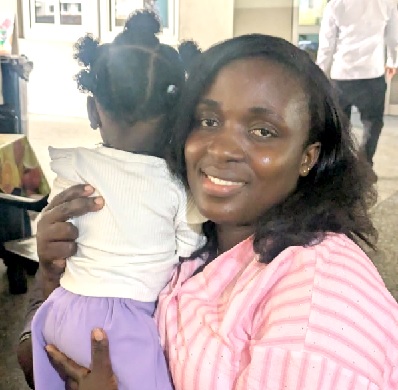
For 34-year-old Juliet Boakye, holding her eight-month-old daughter is a reminder of hope, faith, and a journey she once feared might end differently.
After undergoing chemotherapy and a mastectomy for breast cancer, the resident of Koforidua in the Eastern Region welcomed a healthy baby girl, whom she named Nyame Ye, meaning “God is good”.
In an interview with The Mirror in Accra last Wednesday, Juliet said the name reflects her gratitude to God for the opportunity to conceive, carry a pregnancy and deliver a healthy child after going through cancer treatment.
She said her pregnancy was relatively smooth, with only the usual pregnancy symptoms she had experienced during her first pregnancy before her diagnosis.
The difference this time was that she had to inform the antenatal team about her medical history. She said the team at the 37 Military Hospital in Accra, where she underwent her cancer treatment, advised her to take only the antenatal medications prescribed for her.
Hope after a tough journey
Juliet's journey to motherhood, however, came after a difficult battle with breast cancer.
In 2022, she experienced liquid-like discharge and small, hard boils beneath her breast.
Initially, she thought they were ordinary boils or a skin condition and did not immediately suspect anything serious.
She later began noticing drops of blood coming from her nipple, which raised further concern.
Juliet said her husband encouraged her to seek medical attention after noticing the changes.
She reported to the Eastern Regional Hospital, where an ultrasound scan revealed three lesions in her left breast.

“Initially, I was treating it as a normal condition until my husband encouraged me to go for screening. When the cancer was confirmed, he told me he had read about the changes and suspected it could be cancer, but he did not want to scare me,” she said.
She was subsequently referred to the 37 Military Hospital in Accra for further management.
At the hospital, the medical team explained her condition and the available treatment options.
She underwent eight cycles of chemotherapy, followed by a mastectomy, the surgical removal of the affected breast.
The journey was far from easy. Juliet said she experienced considerable pain, financial difficulties and emotional stress throughout the treatment process.
Living in Koforidua also meant she had to find accommodation in Accra to enable her to attend hospital appointments and undergo treatment. This came with additional financial demands on her and her family.
She expressed gratitude to her husband, her family, in-laws, other loved ones and church for standing by her during the difficult period.
She said they raised money to support her treatment.
Beyond the financial assistance, the family also helped ease the burden of caring for her first child. Her sister-in-law took responsibility for looking after her first child, who was then five years old, while Juliet focused on her treatment.
Although she experienced pain and distress, Juliet said seeing other women on admission with more advanced conditions and severe symptoms made her realise how differently the disease could affect people.
Today, she is doing well and continues to visit the hospital for scheduled reviews. She is currently not on medication and has also made some lifestyle adjustments following her experience.

Despite having undergone a mastectomy, Juliet can breastfeed her eight-month-old daughter using her unaffected breast. She supplements the baby's feeding with age-appropriate foods.
Being able to breastfeed her daughter after her cancer treatment is another blessing Juliet does not take for granted.
Her advice
Reflecting on her journey, Juliet believes that seeking medical attention, following the recommended treatment and maintaining a positive attitude, alongside God's grace, contributed to her recovery.
She recalled receiving frightening comments from people who told her about the possible dangers of cancer treatment, with some even predicting that she would die during the process.
“Many people told me stories about all the bad things that could happen, including telling me that I would die during the treatment.
To them, it was a death sentence. But my husband's family and the team at the unit encouraged me to keep hope alive,” she said.
She, therefore, encouraged women to pay attention to changes in their breasts and seek medical attention rather than dismissing unusual symptoms.
