

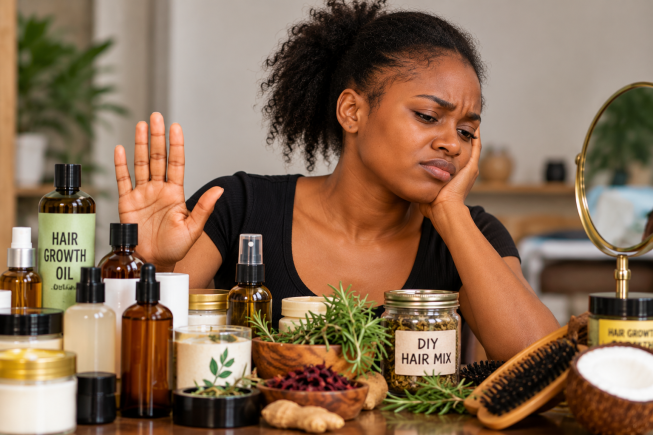
Every few weeks, a new hair growth product seems to take over social media. One person claims an oil helped her hair grow within months, while another shares before-and-after pictures showing how her thinning edges have become fuller. Then come the videos from influencers of bald patches filling in and short hair growing noticeably longer.
These products come in different forms, including oils, sprays, serums, creams, butters and herbal mixtures, each promising something different. Some claim to promote length, others promise thicker hair, stronger roots or the return of lost edges.
With so many products flooding the market, one thing is clear: many of us want longer, fuller and healthier hair, and we are willing to spend money in the hope of achieving it.
But behind the attractive packaging, glowing testimonials and impressive transformations lies a question worth asking: how much of what we see is backed by results, and how much is simply clever marketing?
It makes me wonder: Are we buying hair growth products, or are we buying hope in a bottle?
I am not suggesting that hair products do not work or that every hair growth claim is false. There are products that can support healthy hair and scalp care. My concern is the belief that the answer to every hair problem must be found inside another bottle.
What are we doing to the hair?
Sometimes, while searching for a product to make our hair grow, we forget to look at how we are treating the hair we already have.
We buy oils but continue to wear hairstyles that put too much pressure and pull tightly on our hairlines such as ponytails, knotless braids and frontal wigs. We complain about thickness, but repeatedly chase trendy hairstyles and refuse to let our hair breath.
We want long hair but pay little attention to what happens underneath our wigs for weeks at a time. Cornrows left in for long without any scalp treatments.
We move from one hairstyle to another without giving much thought to handling, moisture, strand strength and general hair care.
Then, when we notice breakage, the first question is often, “Which hair growth product should I buy?” Perhaps another question should come first: “What am I doing to my hair?” There is an important difference between wanting hair to grow and taking care of it in a way that allows us to see and maintain progress. If the hair keeps breaking, changing products every month will not solve the real problem.
Why ‘hair growth’ sells
From a business point of view, the “hair growth” market sells because they speak directly to a desire. A person who is unhappy with the state of her hair does not only see a bottle of oil. She sees the possibility of fuller edges, longer hair or the confidence to wear her natural hair out.
That is why before-and-after pictures are so effective. We see the first picture, then the second and we want the same result. What we may not always know is what else happened between those two photographs.
Did the person change her hair-care routine? Did she stop wearing tight hairstyles? Was she more consistent with caring for her hair? How long did the process actually take?
This is where beauty businesses also have a responsibility. There is nothing wrong with selling a good product and talking about its benefits. However, the industry must be careful not to create the impression that healthy hair is an overnight achievement.
What does the science say?
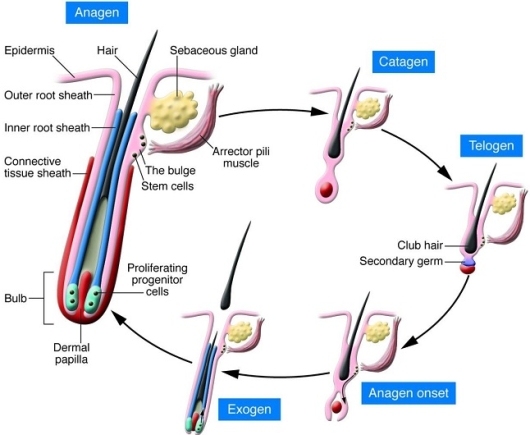
Perhaps part of the problem is that we do not always understand how hair grows in the first place. A 2023 scientific review titled Integrative and Mechanistic Approach to the Hair Growth Cycle and Hair Loss, published in the Journal of Clinical Medicine, explains that hair growth follows a cycle and that several factors can affect this process.
The cycle includes the anagen phase, when hair is actively growing; catagen, the transition phase; telogen, the resting phase; and exogen, when the hair is shed.
This means that hair growth is a biological process, not simply the result of applying a product to the scalp. The review also notes that a variety of factors can affect the hair cycle, which is why hair concerns cannot always be reduced to finding the right oil or serum.
The review also explains that hair growth and hair loss are influenced by several factors, including genetics, hormones, age, nutrition and environmental factors. This is important because genetics can influence characteristics of our hair and aspects of its growth cycle. In simple terms, two people can follow similar hair-care routines and use the same products but may not necessarily achieve identical results.
What will make your hair grow
Hair growth requires patience, consistency and realistic expectations. That message may not sell as quickly as “grow your hair fast”, but it is a conversation the industry needs to have.
The truth is, there is no single product that will make everyone’s hair grow faster.
Good hair care, however, can help reduce damage and breakage. Keeping the scalp clean and moisturised, handling the hair gently, avoiding very tight hairstyles and following a consistent hair-care routine can help you grow and retain length. Sometimes, the problem is not that the hair is not growing, but that it keeps breaking before we notice the growth.
The writer is a comms and beauty professional
Founder and CEO, Hairlegance Beauty Studio
Adentan-Commandos
Email:

