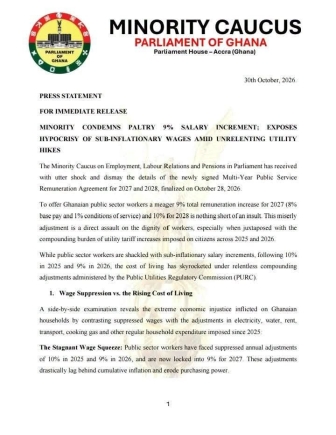
The Minority Caucus on Employment, Labour Relations, and Pensions in Parliament has condemned the newly signed Multi-Year Public Service Remuneration Agreement for 2027 and 2028, describing the nine per cent total remuneration increase for public sector workers as an insult.
In a press statement issued on October 30 and signed by Ranking Member Mavis Nkansah Boadu, the Caucus said the agreement, finalised on October 28, offers public sector workers a meagre nine per cent total remuneration increase for 2027 and 10 per cent for 2028.
It described this as a direct assault on the dignity of workers, especially when juxtaposed with the compounding burden of utility tariff increases imposed on citizens.
The Caucus argued that while public sector workers are shackled with sub-inflationary salary increments, the cost of living has skyrocketed under relentless compounding adjustments administered by the Public Utilities Regulatory Commission (PURC).
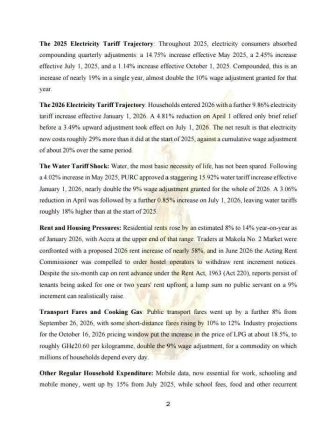
Comparing wages to the rising cost of living, the Caucus noted that electricity now costs roughly 29 per cent more than it did at the start of 2025, water tariffs are roughly 18 per cent higher, and transport fares and cooking gas have also seen significant increases.
It noted that residential rents rose by an estimated eight to 14 per cent year-on-year, with Accra at the upper end of that range.
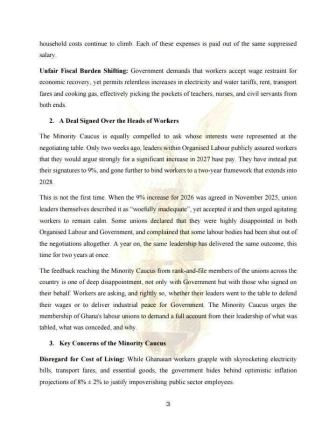
The Caucus also accused the government of unfair fiscal burden shifting, stating that it demands workers accept wage restraint for economic recovery while permitting relentless increases in utility tariffs, rent, transport fares, and cooking gas, effectively picking the pockets of teachers, nurses, and civil servants from both ends.
It further alleged bad faith in negotiations, describing the move to force a restrictive two-year framework as a tactic to tie the hands of workers. The Caucus called on the leadership of organised labour to publish the proposals tabled and explain to its members the basis on which it accepted the deal.
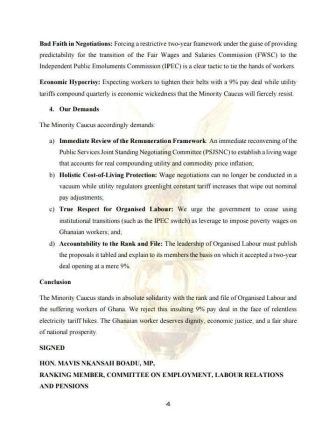
The Minority Caucus demanded an immediate review of the remuneration framework through the reconvening of the Public Services Joint Standing Negotiating Committee, holistic cost-of-living protection, true respect for Organised Labour, and accountability to the rank and file.
"The Ghanaian worker deserves dignity, economic justice, and a fair share of national prosperity," the statement added.