
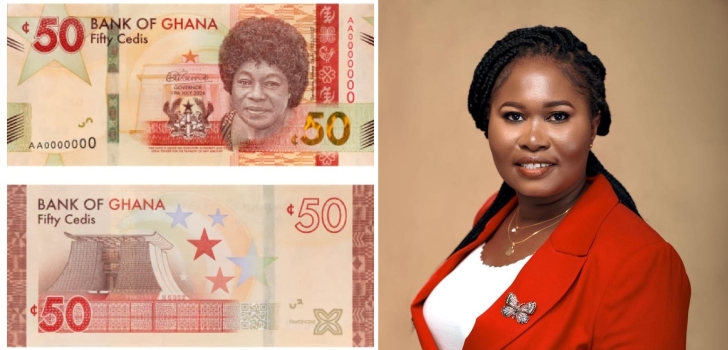
Following public discussion on the portrait on the newly introduced GH¢50 note by the Bank of Ghana on whether or not it was a portrait of Theodosia Salome Okoh who designed the Ghana flag or her younger sister, Dr Leticia Obeng, who was a scientist and famous for being Ghana's first lady PhD, a member of the BoG Board, Beatrice Feehi Annangfio has provided some clarification.
- Read also:
- Portrait of Theodosia Okoh on GH¢50 was developed from different photos and not her sister Dr Leticia Obeng - BoG's full explanation
- Hairstyle swap and security features: BoG's full explanation for Theodosia Okoh GH¢50 portrait controversy
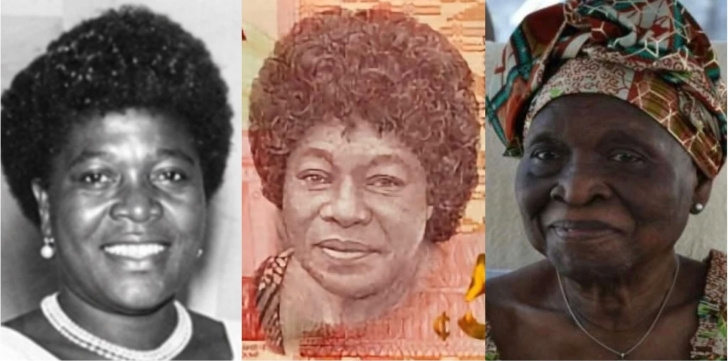
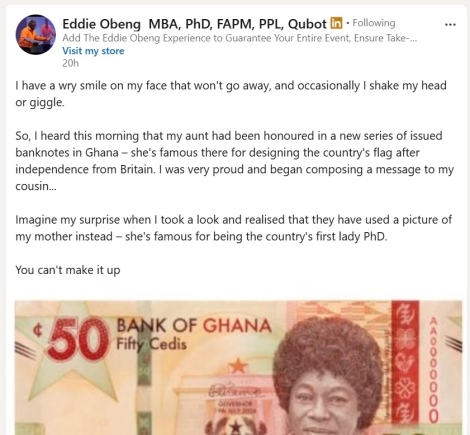
The public discussion was ignited by a post on LinkedIn by Dr Eddie Obeng, a nephew of Theodosia Okoh, who has said the portrait on the GH¢50 is that of his mother, Dr Leticia Obeng who is famous for being Ghana's first lady PhD.
I have a wry smile on my face that won't go away, and occasionally I shake my head or giggle.
"So, I heard this morning that my aunt [Theodosia Okoh] had been honoured in a new series of issued banknotes in Ghana – she's famous there for designing the country's flag after independence from Britain. I was very proud and began composing a message to my cousin...
"Imagine my surprise when I took a look and realised that they have used a picture of my mother [Dr Leticia Obeng] instead – she's famous for being the country's first lady PhD.
"You can't make it up
Dr Obeng added:
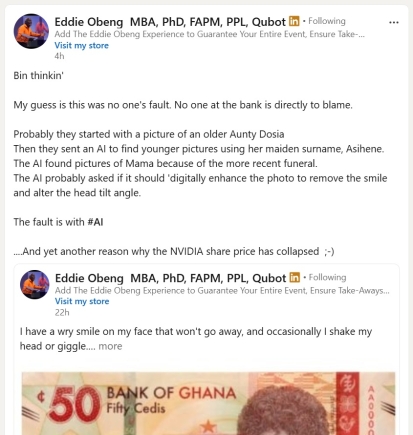
Bin [ I have been] thinkin'
My guess is this was no one's fault. No one at the bank is directly to blame.
Probably they started with a picture of an older Aunty Dosia [Theodosia]
Then they sent an AI to find younger pictures using her maiden surname, Asihene.
The AI found pictures of Mama [Dr Leticia Obeng] because of the more recent funeral.
The AI probably asked if it should 'digitally enhance the photo to remove the smile and alter the head tilt angle.The fault is with #AI
Read also: Here are the names of the faces on the newly introduced Ghana cedi notes and the security features

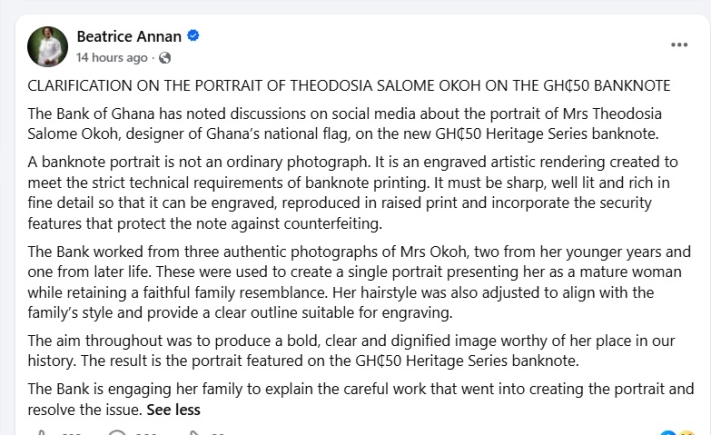
But Beatrice Annan, who is a Board Member of the BoG and a presidential staffer reacted on Facebook following the public discussion ignited by Dr Eddie Obeng's post on LinkedIn.
Beatrice Annan wrote:
"The Bank of Ghana has noted discussions on social media about the portrait of Mrs Theodosia Salome Okoh, designer of Ghana’s national flag, on the new GH¢50 Heritage Series banknote.
"A banknote portrait is not an ordinary photograph. It is an engraved artistic rendering created to meet the strict technical requirements of banknote printing. It must be sharp, well lit and rich in fine detail so that it can be engraved, reproduced in raised print and incorporate the security features that protect the note against counterfeiting.
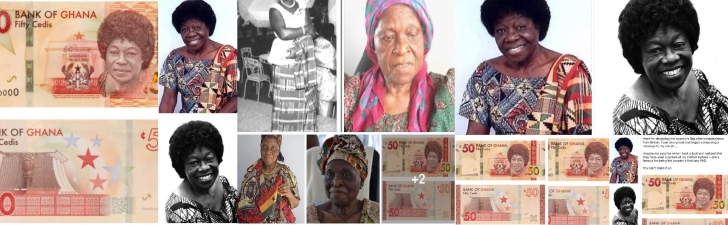
"The Bank worked from three authentic photographs of Mrs Okoh, two from her younger years and one from later life. These were used to create a single portrait presenting her as a mature woman while retaining a faithful family resemblance. Her hairstyle was also adjusted to align with the family’s style and provide a clear outline suitable for engraving.
"The aim throughout was to produce a bold, clear and dignified image worthy of her place in our history. The result is the portrait featured on the GH₵50 Heritage Series banknote.
"The Bank is engaging her family to explain the careful work that went into creating the portrait and resolve the issue."
Who is Theodosia Salome Okoh the woman who designed Ghana's national flag
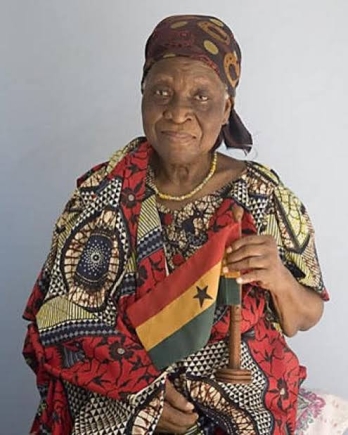
Theodosia Salome Okoh (1922–2015) was a Ghanaian artist, teacher, and sports administrator. She is best known for designing Ghana's national flag.
Her design was officially adopted for Ghana's independence on March 6, 1957.
Ahead of Ghana's independence from British colonial rule, the government invited designs for a new national flag and Theodosia Okoh's design was selected.
She chose red to represent the blood of those who fought for independence, gold for Ghana's mineral wealth, and green for the rich forests and agriculture. She placed a five-pointed black star at the centre as a symbol of African emancipation and unity.
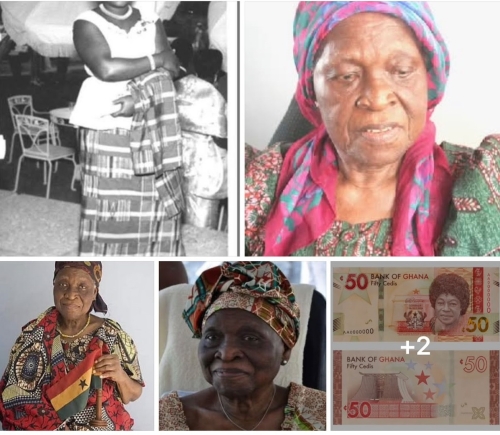
Born Theodosia Salome Abena Kumea Asihene on June 13, 1922, she studied fine arts at Achimota School before working as a schoolteacher.
Beyond the Ghana flag, she was an accomplished painter and collage artist whose works addressed Ghanaian life, architecture, and postcolonial themes.
Known affectionately as the "Joan of Arc of Ghana Hockey," Theodosia Okoh was a pioneer in developing field hockey in Ghana and became the first female chairman of the Ghana Hockey Association and later served as president of the Ghana Hockey Federation for more than 20 years.
Theodosia Okoh died on April 19, 2015, at the age of 92.
Her legacy remains central to Ghanaian national identity, and it is based on this that the Bank of Ghana selected her portrait to be honoured on the front of the Heritage Series GH¢50 banknote unveiled on November 12, 2026.
Her younger sister is Dr Leticia Obeng.

Who is Dr Leticia Obeng?
Dr Letitia Eva Takyibea Obeng (1925–2023) was a pioneering Ghanaian zoologist and environmental scientist, widely regarded as the "grandmother of female scientists in Ghana".
She made history as the first Ghanaian woman to earn a degree in zoology and the first to be awarded a doctorate in science.
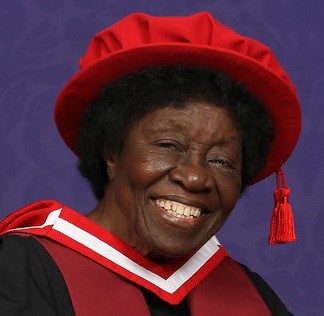
She was born on January 10, 1925 at Anum in the Eastern Region of Ghana. Her interest in science began on her father's farm where she studied local plants and insects.
After attending Achimota School, she travelled to the United Kingdom on a government scholarship and earned a BSc in Zoology and Botany in 1952) and an MSc in Parasitology in 1962) from the University of Birmingham.
In 1964, she earned her PhD from the Liverpool School of Tropical Medicine. Her doctoral work focused on the freshwater biology of the blackfly (Simuliidae), the insect vector responsible for spreading river blindness across West Africa.
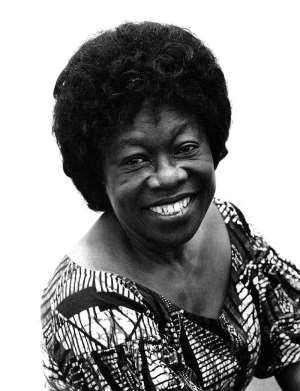
She returned to Ghana in 1952, and became the first female scientist and lecturer at the Kwame Nkrumah University of Science and Technology (KNUST) in Kumasi.
She became the first scientist employed by Ghana's National Research Council, now the Council for Scientific and Industrial Research (CSIR). In 1964, she founded and directed the Institute of Aquatic Biology to study the ecological impacts of the newly created Lake Volta.
After participating in the 1972 UN Human Environment Conference in Stockholm, she joined the United Nations Environment Programme (UNEP) in 1974. She later served as the Director of UNEP's Regional Office for Africa, shaping water and environmental policy across the continent.
In 1965, she became a fellow of the Ghana Academy of Arts and Sciences. Decades later, she broke another barrier by becoming the academy's first female president.
In 2006, she received Ghana's highest civilian honour, the Order of the Star of Ghana, for her lifetime contributions to science and environmental management.
Both the CSIR laboratory in Ghana and a meeting room at the Liverpool School of Tropical Medicine have spaces named in her honour.
Dr Leticia Obeng passed away on March 23, 2023 at the age of 98, leaving behind a lasting legacy for African women in STEM.
For feedback:
