

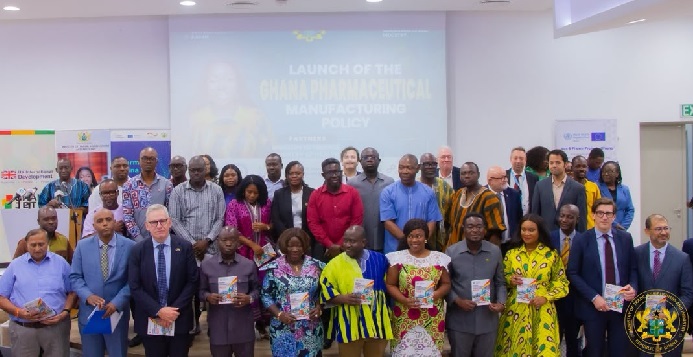
A policy to help boost local medicine production, reduce dependence on imports and position Ghana as a pharmaceutical manufacturing hub for West Africa has been launched.
The Minister of Trade, Agribusiness and Industry, Elizabeth Ofosu-Adjare, at the launch of the policy in Accra on Wednesday, October 28, 2026, said the initiative would help provide a coordinated framework to attract investment, strengthen local manufacturing and improve the competitiveness of the pharmaceutical industry.
She said the policy sought to increase the share of locally manufactured medicines in the domestic market from about 30 per cent to 60 per cent and double the value of pharmaceutical exports to ECOWAS markets, as part of efforts to achieve at least 70 per cent pharmaceutical self-sufficiency within five years.na was also entirely dependent on imported vaccines.
She noted that pharmaceutical imports across Africa cost more than US$14 billion annually, resulting in significant foreign exchange outflows and the loss of employment and industrial opportunities that could otherwise be created locally.
“Medicines are not ordinary goods. A country that cannot produce its own essential medicines leaves its health, economy and sovereignty vulnerable to decisions made elsewhere,” she said.
She identified four major constraints facing local pharmaceutical manufacturers: the high cost of imported raw materials, expensive financing, limited product diversification, and gaps in technology and specialised skills.
Key pillars
The policy, she said, would address these challenges through six key pillars covering quality assurance and international standards, market access through public procurement, investment and financing, expansion into pharmaceutical inputs and other products, skills development and research, and access to regional markets.
Mrs Ofosu-Adjare said the government would also collaborate with the Development Bank Ghana, Ghana EXIM Bank and the Ghana Investment Promotion Centre to provide affordable, long-term financing, support factory upgrades and attract strategic investors and joint ventures.
The Minister called on pharmaceutical manufacturers to invest in their facilities, upgrade production systems and pursue the highest quality standards. She also urged investors to support the development of pharmaceutical plants, ingredient production and vaccine manufacturing.
She called on regulators and procurement agencies to maintain strict quality standards while ensuring efficient and predictable processes to facilitate access to safe and effective medicines.
Appreciation
Mrs Ofosu-Adjare expressed appreciation to the European Union, the German Government, GIZ and the WHO for their support, as well as the Pharmaceutical Manufacturers Association of Ghana and the Small-Scale Pharmaceutical Manufacturers Association of Ghana for their advocacy and partnership.
The Pharmaceutical Manufacturers Association of Ghana (PMAG) on its part expressed appreciation stakeholders for their collaboration in advancing Ghana’s pharmaceutical manufacturing industry.
The association said the successful implementation of the Ghana Pharmaceutical Manufacturing Policy would require coordinated investment, regulatory support, technology transfer and improved market access to transform Ghana from a major consumer of imported medicines into a competitive producer and exporter.
In a speech read on his behalf at the launch of the policy, President of the PMAG, Samuel Amo Tobbin, said Ghana’s pharmaceutical sector was the second-largest in West Africa after Nigeria. The policy indicated that the sector had 40 registered manufacturing companies in 2020, directly employing more than 10,000 people and indirectly supporting approximately 100,000 livelihoods.
The European Union (EU) Ambassador to Ghana, Rune Skinnebach on his part urged the government to prioritise trade facilitation and evidence-based market positioning in implementing the Ghana Pharmaceutical Manufacturing Policy to strengthen the sector’s competitiveness and expand its export potential.
He said these measures should form the foundation of the policy’s implementation as Ghana seeks to transition from serving mainly its domestic market to becoming a major pharmaceutical producer and exporter.
Ambassador Skinnebach reaffirmed Team Europe’s commitment to supporting Ghana’s pharmaceutical manufacturing ambitions, noting that EU and German cooperation through the PharmaVax Ghana Programme had provided technical assistance to the Ministry of Trade, Agribusiness and Industry during the policy development process.
He said Team Europe had committed up to €40 million to initiatives supporting the strengthening of local pharmaceutical manufacturing capacities across Africa.
