
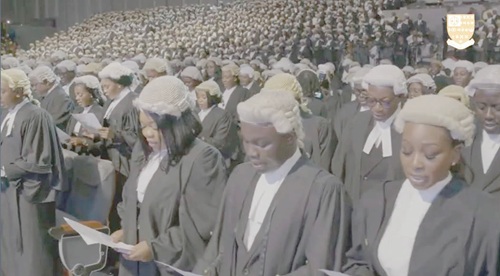
A total of 1,568 newly qualified lawyers have been called to the Ghana Bar.
The ceremony, held Friday, had four Members of Parliament (MPs), two of whom are ministers of state and some prominent media practitioners among the new lawyers.
The MPs are Samuel Nartey George (MP for Ningo-Prampram and Minister of Communication, Digital Technology and Innovations); Emmanuel Armah-Kofi Buah (MP for Ellembelle and Minister of Lands and Natural Resources); Davis Ansah Opoku (MP for Mpraeso); and Phyllis Naa Koryoo Okunor (MP for Awutu Senya East, Kasoa).
The media practitioners are Umaru Sanda Amadu, a broadcast journalist with Channel One TV and Citi FM; Naa Ashorkor Mensah-Doku, a broadcast journalist with TV3, Media General; and Ayisha Ibrahim, a broadcast journalist, among others.
They joined the other inductees after satisfying the requirements for entry into the legal profession.
The newly qualified lawyers were sworn in by the Chief Justice, Justice Paul Baffoe-Bonnie, who chairs the General Legal Council (GLC), while qualifying certificates were presented by justices and other dignitaries.
Best student
An alumna of the Kwame Nkrumah University of Science and Technology (KNUST) Faculty of Law, Akosua Achiaa Sarpong, was adjudged the overall best student in the Professional Law Examinations.
She received the John Mensah Sarbah Award for the best all-round performance and was also awarded Best Student in Civil Procedure.
Her achievement marked the 11th time a KNUST graduate had won the overall best student award since 2011 and the fourth consecutive year the university had claimed the distinction award.
Awards
KNUST graduates won four of the 11 awards presented at the ceremony, with Eunice Agyei receiving the award for Best Student in Advocacy and Legal Ethics, while Anita Enyonam Dei was awarded Best Student in Conveyancing and Drafting.
Other award recipients included Clement Kolamong Kantam, who was adjudged Best Student in Law of Evidence; Awuradwoa Asantewaa Nkrumah, Best Student in Law Practice Management and Legal Accountancy; Richlyn Naaatswe Adjetey, Best Student in Alternative Dispute Resolution; Keren Naa Amoatsoo Sackey, Best Student in Company and Commercial Law Practice; Sylvester Leslie Ankomah Oware, Best Student in Interpretation of Deeds and Statutes; and Veronica Aba Gwira, Best Student in Family Law and Practice.
Promote justice, protect people
Addressing the new lawyers, Justice Baffoe-Bonnie said the success of legal education should not be measured simply by the number of lawyers produced but by the quality of professionals entering the legal system.
He said the 1,568 lawyers admitted represented the largest number to be called to the Bar at a single ceremony.
He urged them not to become merely part of the growing number of lawyers but to use their knowledge and professional acumen to promote justice and protect people from the abuse of power.
The Chief Justice said the legal profession conferred considerable power on its practitioners, whose work could affect people's liberty and property, shape commercial transactions, influence public policy and challenge the exercise of state power.
He said such influence came with a responsibility to serve the public rather than a privilege to be used for personal importance.
“The law does not give you influence so that you may become important. It gives you influence so that you may become useful,” he said.
Justice Baffoe-Bonnie urged the lawyers to verify information before speaking, particularly in an era when messages, videos and claims circulated rapidly on social media.
He said they must not allow the speed at which information travelled to determine the speed of their judgements, adding that integrity was central to the practice of law.
The Chief Justice also urged them to make legal services accessible to people who could not afford expensive representation.
Transition
Welcoming the newly qualified lawyers and other dignitaries to the ceremony, the Judicial Secretary, Musah Ahmed, said the call to the Bar marked the transition from legal education to professional practice.
He said the GLC was mandated under Section 7 of the Legal Profession Act, 1960 (Act 32), to convene formal meetings for the enrolment and call to the Bar of qualified applicants.
Mr Ahmed said the ceremony was not merely the culmination of an academic journey but also the beginning of a vocation that demanded diligence, sacrifice and the support of families.
He reminded the new lawyers that their admission to the profession came with the responsibility of upholding the rule of law.
“As you prepare to receive your certificates, you do not only do so as an individual who has met an exacting standard, but also as officers of the court,” he said.
