
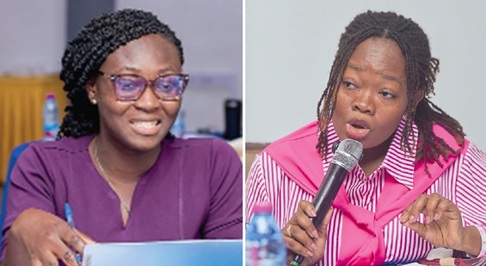
Two journalists from the Graphic Communications Group Ltd. (GCGL) have been selected for the Ghana cohort of the 2026 Media Excellence in Emerging Technologies (MEET) Fellowship.
The two, Evelyn Obeng Akese, a Staff Writer with The Mirror, and Juliet Akyaa Safo, a reporter with the Daily Graphic, were selected following a rigorous process involving more than 500 applicants, from which 30 journalists were chosen for the fellowship.
The programme has brought together journalists and content creators to interface with researchers to examine emerging technologies, interrogate evidence and develop stories that connect scientific research with everyday life.
The focus areas for the fellowship include artificial intelligence (AI), climate resilience, biomedical innovation, public health and electronic waste (e-waste).
The 2026 fellowship is being delivered in partnership with Imperial College London through Imperial Global Ghana, the British High Commission in Accra and Nigeria, with support from the United Kingdom’s Foreign, Commonwealth and Development Office (FCDO).
Collaboration
Speaking at the opening ceremony in Accra last Monday, the Associate Director of Imperial Global Ghana, Amma Boakye-Danquah, said Imperial Global Ghana was working with Ghanaian universities and researchers to address challenges affecting communities, including flooding and extreme heat.
She said journalists had an important role to play in shaping public understanding of emerging technologies, including AI, and ensuring that African perspectives were adequately represented in discussions about their development and use.
She challenged journalists and researchers to strengthen their collaboration and improve the translation of scientific findings into accessible information for the public.
However, Mrs Boakye-Danquah also acknowledged the challenges facing journalists, including being underpaid, undervalued and overextended, but urged them to continue pursuing evidence-based reporting.
Fellowship
A representative from the British High Commission in Ghana, Ryan Davis, said the 2026 programme marked the fourth year of the UK Media Excellence in Emerging Technologies Fellowship.
He said about 70 journalists had completed the programme over the previous three years, with some producing science, technology, health and climate stories and others establishing lasting relationships with researchers and fellow journalists.
He said the growing network of alumni across Ghana and West Africa was important because the challenges confronting journalism were too complex for individual reporters, newsrooms or institutions to address alone.
He said the fellowship was intended to strengthen journalists’ ability to ask critical questions, challenge assumptions, scrutinise evidence and explain complex issues in ways that audiences could understand and use.
Domestic investment
The acting Administrator of the Ghana National Research Fund, Professor Abigail Opoku-Mensah, called for increased domestic investment in research and innovation to reduce the country’s dependence on foreign grants.
She said Ghanaian universities and public research institutions had contributed significantly to research, innovation and human capital development, but the country’s research ecosystem had faced funding constraints and relied substantially on development partners.
She said dependence on external grants created vulnerabilities, particularly when changes in donors’ priorities or foreign policies affected funding availability.
Prof. Opoku-Mensah said that African Union member states had committed to investing at least one per cent of their gross domestic product (GDP) in research and development, but Ghana and several other African countries remained below that target.
She said the Ghana National Research Fund Act, 2020 (Act 1056), provided the legal basis for the fund, but the passage of legislation alone was insufficient without the resources and systems needed to make it operational.
Prof. Opoku-Mensah urged journalists to communicate science, technology and innovation in simple, accessible language and to work closely with Ghana’s research community to ensure that scientific knowledge and technological advances benefitted the public.
