
One year after the launch of the 24-Hour Economy (24H+) programme in July last year, the Secretariat says it has moved from diagnosing what holds Ghanaian businesses back to building the tools to remove those barriers.
It includes a statutory Authority, a no-collateral credit guarantee in the works, and a growing pipeline of joint development agreements.
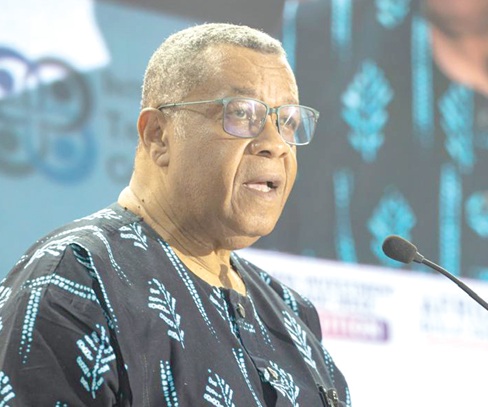
The Chief Programme Officer of the 24H+ Secretariat, Abdul-Nasser Alidu, told the Daily Graphic that the programme was aimed at an “integrated and sustainable transformation” of the economy, and that the first year laid the foundations for that.
What has been achieved?
The first year went into pinning down what blocks business growth. That work produced a book on the constraints, with land, infrastructure and access to finance emerging as the main obstacles,” he said.
On land, Mr Alidu said the Secretariat had finalised a land access policy and mobilised about 600 hectares for priority investments.
“A participatory land access model now makes traditional authorities and land-owning communities minority equity holders in projects developed on their land,” he explained.
Aside from that, Mr Alidu said about eight million hectares of arable land had been identified along the Volta Economic Corridor for large-scale agricultural investment.
Also, in partnership with the National Petroleum Authority (NPA) and the downstream petroleum sector, 12 oil marketing companies and their 268 filling stations had started operating 24 hours, adding that 33 manufacturing companies and about 11 state agencies had also begun multi-shift operations that provide 24-hour services.
“We are working with Ghana Statistical Services to undertake research in the area of job creation, for independent data on that. The results will be there for all to see,” he stated.
Mr Alidu said the Secretariat had also deployed the Enterprise Support Programme under which it had assigned businesses to enterprises to prepare them to be investment-ready before they approach banks.
“More than 10,000 businesses have registered for support, according to information from the Ministry of Labour, Jobs and Employment.
About financing, the Arab Bank for Economic Development in Africa (BADEA) has approved $290 million to support small and medium enterprises, Mr Alidu said, explaining that the funds did not go to the Secretariat but to participating banks, with a large share channelled through the Development Bank Ghana, which on-lent through commercial banks on their own assessments.
Collateral remains a stubborn barrier, he said, and cited an entrepreneur who built a soybean crushing facility in the north but was refused working capital because banks wanted property in Accra rather than the Tamale facility.
For such cases, the Secretariat’s answer is a no-collateral credit guarantee scheme, a joint development agreement signed with the firm to set it up, and the Secretariat is seeking authorisation from the Bank of Ghana and the National Insurance Commission to set up the fund and raise capital.
Touching on infrastructure, Mr Alidu said that Ghanaian firms most often provided roads, transformers, security and effluent treatment themselves, raising costs, particularly outside Accra.
The secretariat said it was working to make shared infrastructure available.
Operational footprint
According to the 24H+ Secretariat, as of May this year, the secretariat reported $5.5 billion in joint development agreements within a $11.5 billion pipeline.
The pipeline includes the $1.45 billion Buipe solar and battery project, expected to cut industrial electricity costs from about 23 cents to nine cents per kilowatt-hour when its first phase comes on stream in 2027.
On pharmaceuticals, Mr Alidu stated that the Food and Drugs Authority had attained WHO Maturity Level 3, allowing certified medicines to compete for international tenders.
He said the Legon Pharmaceutical Innovation Park at Asutsuare, being developed with the Ghana Infrastructure and Investment Fund, was expected to create about 30,000 jobs, with expressions of interest due by October 31, 2026.
The 24-Hour Economy Authority Act, 2026, signed in February, gives the programme statutory backing, while the 2026 Budget allocated GH¢110 million to it.
What was promised?
The achievements are measured against the promises made at the launch.
The programme rests on three goals: self-sufficiency, competitiveness and jobs.
Mr Alidu pointed to COVID-19, when many Ghanaians realised that a country that did not produce what it ate could quickly be in trouble.
For jobs, he said: “We have opportunities, but the opportunities are translated into jobs for other people, not necessarily for people within the economy.”
The headline target is to cut unemployment to below five per cent by 2035 — a steep task, given official figures showing unemployment averaging 12.8 per cent in the first three quarters of 2025, with youth unemployment at 21.9 per cent.
The method matters as much as the goals. Unlike past efforts that placed the burden on the government, 24H+ is designed so that the government acts as an enabler while the private sector tackles the constraints that affect it.
“The private sector must take the lead and assume the credit risk,” Mr Alidu said, adding that “ it is the only way this country can develop.”
