
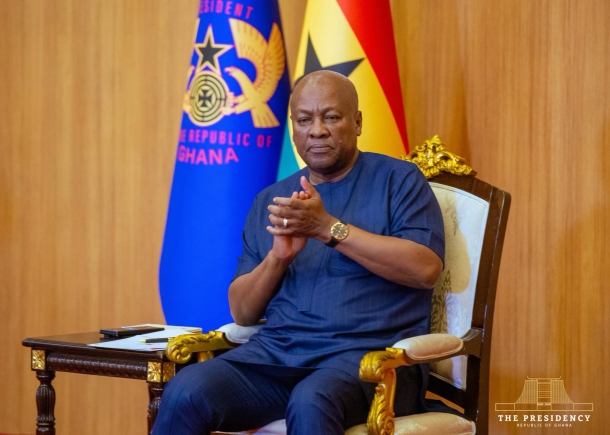
President John Dramani Mahama has stated that “the time has come for Africa to chart a different course” towards its economic transformation by moving away from being exporters of raw materials and consumers of finished products.
“We must bring part of that processing and value addition into Africa to create jobs for our young people,” he said.
Speaking in London yesterday at the Financial Times Africa Summit, he said Ghana had targeted to stop raw ore exports by 2030.
“Seventy per cent of gold is now refined locally, and government is expanding the downstream jewellery industry,” he told the summit.
He said a policy requiring at least 50 per cent of cocoa beans to be processed locally had also been introduced, and that in the bauxite-aluminium chain, he had identified an alumina refinery as the missing link, and invited investors.
“You cannot have prosperity in the midst of poverty.
That itself is a danger to investments,” the President stated.
Accra Reset
Speaking on the “Accra Reset”, President Mahama said it had become the framework for the Global South to reduce dependency on foreign aid and promote value addition.
The initiative, which began as a health-focused response to dwindling Official Development Assistance (ODA), had expanded into a broader agenda for economic self-reliance.
Key targets include halting raw mineral exports by 2030, processing at least 50 per cent of cocoa locally, and mobilising $20 billion in self-financed development programmes over nine years.
Aid response
President Mahama said the Accra Reset was born out of necessity after Ghana lost $154 million per annum following the withdrawal of the United States Agency for International Development (USAID) funding, with $74 million of that going into healthcare.
“The response to dwindling aid is not to learn how to improve your begging skills,” he said. “You need to respond in a different way,” the President told the summit.
The initiative has established a governing council with support from Germany, the United Kingdom (UK), the global vaccine alliance - Gavi, the Global Fund and the World Health Organisation.
“You cannot own the outcome when you are not part of the decision-making. We must have some control,” he said.
Investor Call
President Mahama urged Western investors to move beyond scepticism about Africa.
“It is to their own disadvantage if investors are still skittish about Africa.
The returns are good, and everybody is coming.
The Indians are there, the Chinese are there,” he said.
The President criticised the cautious approach of some, stressing: “The typical Western investor comes with a notebook and asks, ‘Do they have an independent judiciary? Is the media free?’
By the time you get to the fifth point, the Chinese have invested and the Indians have invested.”
Reaffirming non-alignment, he said: “We are friends to all and enemies to none.”
The President announced that Ghana had completed its International Monetary Fund (IMF) programme successfully and transitioned to a Policy Coordination Instrument (PCI).
“It is not a bailout.
It does not come with any financing, and so a lot of that financing is being provided by ourselves,” he explained.
The Reset Agenda included amendments to the Public Financial Management Act and Procurement Act, and establishment of a Fiscal Responsibility Council, freeing resources for investment.
Government is implementing a $10-billion Big Push infrastructure programme over five years, while the Finance Minister will launch a $10-billion new economy plan over four years, targeting nine job-rich areas, including tourism, energy, agriculture, agro-processing, pharmaceuticals and textiles.
Despite global disruptions, inflation stands at about five per cent, with a stable currency and falling interest rates.
“The economy is holding steady,” he said.
Financial system
President Mahama declared that “the global order was rigged against Africa.
“We borrow at eight times the interest rates at which Western nations borrow.
Sometimes, we borrow to ameliorate the effects of climate change, which we did not create,” he said.
President Mahama stated that Africa contributed four per cent of greenhouse gas emissions, yet borrowed at eight times the cost to deal with climate effects.
“About $80 billion goes out annually in interest and debt repayments, another $90 billion through illicit financial flows, while ODA fell 23.5 per cent in 2025,”
“Africa is a very resilient continent... I wonder how Europe would have survived under those conditions, yet Africa is still on the map,” the President said.
On reparations for slavery, President Mahama said a simple financial settlement would be inadequate for “centuries of brutality, forced labour and other abuses.”
“It is uncharitable to think that a simple payoff is the response,” he said, noting the UN General Assembly voted 123 in favour of recognising slavery as the gravest crime against humanity.
Germany, France and others have opened dialogue.
“We call it repair. It begins with acceptance,” he said, citing the return of artefacts.
“Those who do not learn from the mistakes of history are bound to repeat them,” he warned, adding: “A strong Global South is not a threat to the West.
A strong Global South is an advantage.”
Background
The Financial Times Africa Summit is one of the world’s key platforms for discussing Africa’s business, economic and geopolitical future.
Organised annually by the Financial Times of London, it brings together African Heads of State, policymakers, investors, business leaders and entrepreneurs, and is widely seen as a bridge between African leadership and international capital.
The summit has run for more than a decade, and is usually a two-day event held in London, a global financial hub that attracts investors and institutions such as the World Bank and the IMF.
Its aim is to identify opportunities for sustainable and inclusive growth in Africa and help leaders navigate global volatility and the climate crisis.
It also connects Africa with international investors and development institutions, helping to shape the global narrative on Africa.
The 2026 edition, the 13th, themed “Mobilising Growth in a New Global Order”, explored shifting trade patterns, domestic capital and stronger regional markets—issues central to Africa’s response to a fast-changing global economy.
This makes the 2026 summit particularly relevant to ongoing debates on trade, investment and economic transformation across the continent.
The summit attracted high-profile figures, including President John Dramani Mahama, as well as business leaders including Aliko Dangote and Mo Ibrahim.
