
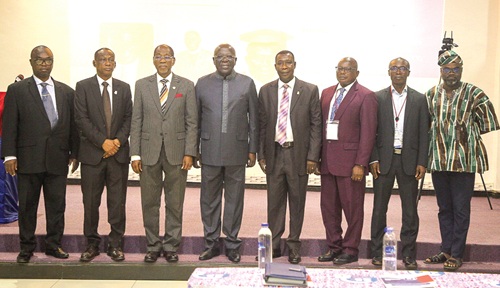
A Renowned Ghanaian businessman and Chancellor of the University of Cape Coast, Sir Sam Jonah, has warned that Africa risks repeating the mistakes it made in gold production in the area of data if it becomes only a consumer of artificial intelligence (AI) and new technologies.
“Africa must build, not just buy,” Dr Jonah said as he delivered the keynote address at the Methodist University Ghana (MUG) International Conference 2026, in Accra last Thursday.
He said Africa had already proven its capacity to innovate, citing mobile money which did not come from Silicon Valley but grew in Africa because millions had phones but no bank accounts.
Ghana, he said, was among the first in the world to achieve mobile money interoperability.
“That is African innovation: practical, problem-solving and built for ordinary people.
“There is a real danger that Africa becomes only a consumer of these technologies, never a creator.
That we import the tools, export our data, and pay rent on both.
We did that with gold for a century. We shipped the raw ore and bought back the finished goods.
We must not do it again with data,” he warned.
Dr Jonah outlined three imperatives to gain the advantage in the digital age, namely building local technical capacity to write code, and not just using apps; solving African problems first in farming, health, logistics, energy and finance; and making enterprise respectable.
“Too many of our brightest young people still see business as something you do only if you could not get a government job. A nation of job-seekers will always be poor. We need a nation of job-creators,” he said.
The two-day conference was on the theme: “Excellence, Morality and Service at 25: Advancing Digital Innovation, Equity and Sustainability in a Transforming World”.
Dr Jonah, speaking on the topic: “Gain, Save, Give: Enterprise with a Conscience for Africa's Next Twenty-Five Years”, anchored his lecture on John Wesley’s three rules: Gain all you can, Save all you can, Give all you can.
John and his brother, Charles, founded the Methodist Church in the 18th Century.
Stewardship
Sir Sam said Wesley’s second rule, “Save all you can”, was a call to waste nothing.
Drawing from his experience in the mining business, he said every miner must answer what was left behind; that is whether a hole and poisoned river or schools, skills and businesses.
“We cannot talk about sustainability in Ghana this morning and avoid the obvious.
Illegal mining, galamsey, is destroying our rivers, our forests and our farmland.
Rivers that fed our grandparents now run the colour of chocolate milk.
“This is not only an environmental problem.
It is an economic problem, a health problem and, in the end, a moral problem.
It is what happens when people gain all they can and forget Wesley's condition about not hurting,” he said.
Dr Jonah decried waste in public spending through abandoned projects, borrowing for consumption, and the export of talent.
“We educate brilliant young people at great cost, and then offer them nothing to do.
Some sit at home. Some leave.
Our best export is too often our best people,” he said.
He said digital tools such as satellite tracking for galamsey, digital land registries and digital procurement existed, but require political will to use them even when transparency was uncomfortable for the powerful.
Access
Dr Jonah said Wesley’s call to “giving”, in the modern economy, was not only charity but opportunity and access to education, finance, markets and decision rooms.
He warned that the digital divide could widen inequality if a child in Dansoman with a laptop and internet lived in a different century from a child in a village with no electricity.
He called for the deliberate inclusion of women, insisting that an economy that underused half of its talent would be running on one leg.
“The countries that industrialised did so on the backs of technicians, artisans and engineers,” he said, adding that mentorship was the greatest gift.
Ethical leadership
Dr Jonah said without integrity, gaining would become greed, saving would become hoarding, and giving would become patronage.
“Excellence without morality produces clever thieves.
Morality without excellence produces good people who change nothing.
And neither means much without service,” he said.
He maintained that trust was the most valuable asset, and that it took decades to build but an afternoon to destroy; ethics was tested in small moments like unaudited contracts and promotions; while leaders must own problems rather than blame others.
“Africa does not need more leaders who are brilliant at serving themselves. It needs leaders whose brilliance is put to work for others,” he said.
