
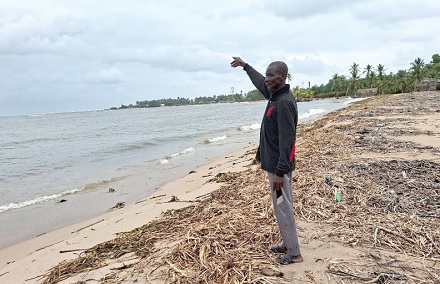
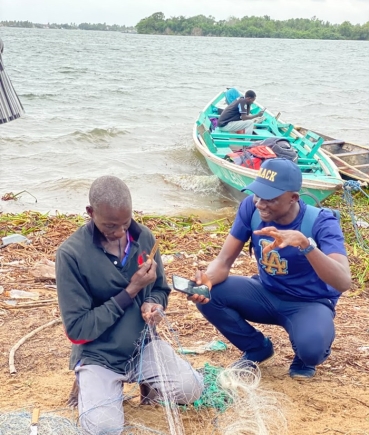
When a motor boat, which had journeyed from Ada Foah in the Ada East District in the Greater Accra Region, pulled up at the shores of the island community of Azizape at 2:45 p.m., after 29 minutes across the Volta River and the Atlantic, 61-year-old Noah Aggrey was spotted busily cleaning up his net.
The salt-crusted hands of the lifelong fisherman moved rhythmically as he mended a couple of tears in his nylon fishing net.
He was not just repairing a tool; he was patching together the fragments of a disappearing livelihood.
Around him, the island of Azizape, a rich enclave for a thriving natural ecosystem, is gradually being dismantled by the rising, restless waves of the Atlantic Ocean.
“The sea used to be our provider, but now it has become a depriver,” Mr Aggrey said, gesturing towards a few metres away where waves now lick the foundations of the homes that stood a hundred metres inland only a decade ago.
Now it is their landlord, and it is evicting them.
Indelible scars
In the northern part of the island, 71-year-old Abena Gbafa was counting her losses after the ravaging tides swept through the house in which her umbilical cord was cut.
“I was sleeping in the night one day when the seawater entered my room; it nearly swept me away,” she said, her voice carrying the heavy toll of life defined by loss.
I met her sitting on a jagged stump of concrete that once served as her porch. The septuagenarian’s eyes were clouded not just by age, but by a profound, weary dejection.
She pointed to what looked like relics of human settlement about 400 metres in the sea, saying, “That used to be the boundary of this island; my house used to be in the middle, but now it has been swallowed up.”
Just like Mr Aggrey and Mrs Gbafa, many of the islanders speak of their losses ranging from the abandonment of ancestral plots to the slow erosion of their community’s dignity.
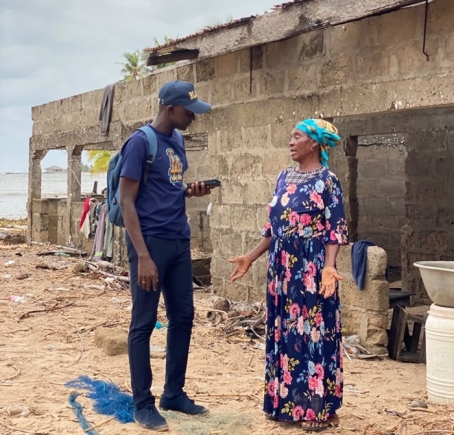
The impact of this environmental decay is not distributed equally. Women in Azizape are the primary processors and sellers of fish.
With catch yields plummeting due to ocean warming and habitat destruction, their economic autonomy has crumbled.
Kudjo Ama, a local fishmonger, and other women now wait hours for canoes that return nearly empty.
Their coconut oil production business is also taking a nosedive.
“The sea was farther away from us, and this used to be a much bigger island; but the sea keeps eating away the land, and we are losing our coconut trees,” she said.
Amid the dwindling fortunes, many of the youth who dropped out of school to engage in fishing are now at their wit’s end, while others have started deserting the island in search of greener pastures elsewhere.
For instance, 17-year-old Caleb Sarpong took to full-time fishing after completing Azizape Basic School because he had no means of continuing junior high school in another town.
However, his hope of fending for himself has been dashed by the declining catch.
Wider picture
The fate of the Azizape islanders tells a bigger story about the devastation climate change is causing in communities that straddle the country’s 550-kilometre coastline stretching from Aflao in the Volta Region to Half Assini in the Western Region.
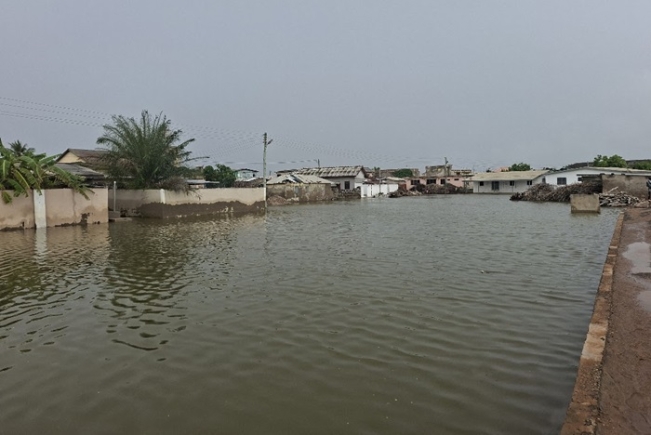
During the one-week visit to other coastal communities and those close to the coast, such as Fuveme, Anyako, and Keta in the Volta Region, it was observed that some settlements now sit deep in the belly of the sea while the people face a series of displacements by the ravaging sea waves.
Those along the Keta Lagoon, for instance, are also suffering the ravaging effects because the lagoons now retain more water than necessary since the coasts are now closer to them than previously.
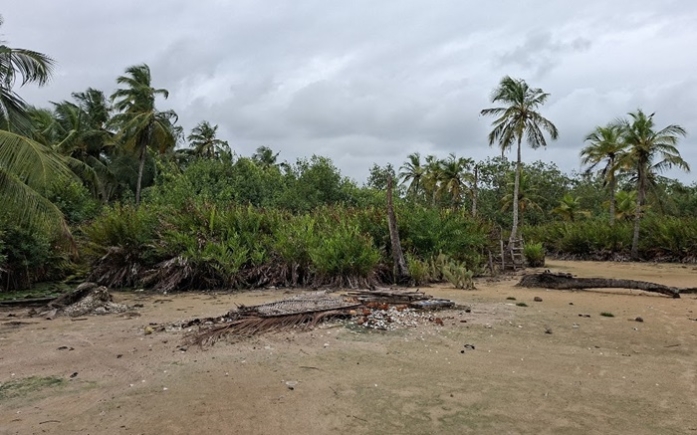
In Keta, swathes of land have been swallowed by the Gulf of Guinea while erosion continues to cut families from their ancestral homes.
The displacements are pronounced at Fuveme, where houses built by generations of families are now relics lying deep in the belly of the sea.
Many school buildings along the Keta-Anloga belt have also been washed away by the rising tides, forcing some of the pupils to attend school in makeshift structures or travel long distances to learn.
Forty-year-old Thywill, an opinion leader at Anyako-Lashibi, a fishing community with a population of about 9,000 people, said human activities had contributed to worsening the impact of climate change in the area.
Ecosystem destruction
Beyond the disappearing settlements and livelihoods, a different kind of tragedy unfolds in all the coastal communities.
Mangroves, the natural armour of coastal communities, are disappearing.
The struggle for survival has forced residents of the island into a desperate paradox. As the sea encroaches, the natural buffers that once protected the coastline — the mangrove forests are being felled.
Driven by the need for quick income or fuel for fish smoking, residents have cleared large swathes of these essential ecosystems.
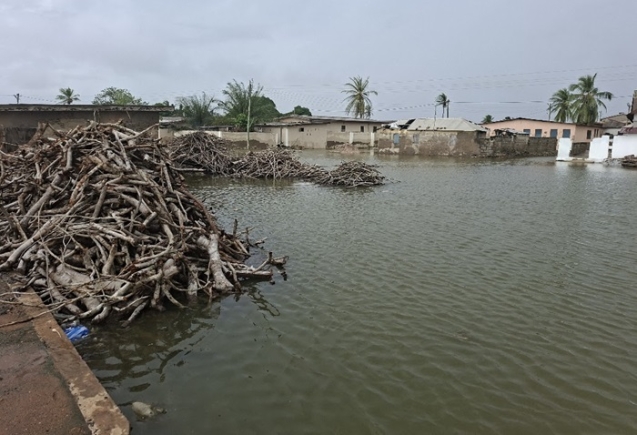
While the mangroves act as natural carbon sinks and nurseries for fish, their removal has left the coastline vulnerable to storm surges and erosion.
It is a short-term survival tactic that is accelerating the long-term erasure of the coastal communities.
From interactions with the dwellers in coastal communities, it was clear that they know the ecological significance of mangroves. However, they prefer to sacrifice them for a livelihood.
"We know they protect us, but when the fishing dies, what are we to do? We sell the mangroves to buy the grain we can no longer grow," 28-year-old Barnabas Sorgbordzor said.
However, by cutting the mangroves to survive the present, the residents are signing the death warrant for their future.
This is because the roots that once filtered nutrients and provided nurseries for fish are being sold for cash, leaving the soft silt exposed to the relentless waves.
A Climate Adaptation and Sustainable Development Governance specialist, Professor Bob Offei Manteaw, said that although climate change was a contributor, the worsening situation in coastal communities had been aggravated by human activities such as sand winning, the destruction of mangroves, and encroachment on wetlands.
“We need sand and mangroves as a buffer to reduce the impact of sea-level rise, but people are also looking at it from the economic livelihood viewpoint.”
“In areas like Keta, sand winning is a thriving industry. Coconut trees were common along the beaches; mangroves, which were supposed to be a buffer and a place nature has created to soak in excess water, are being cut for firewood,” Prof. Manteaw said.
Adaptation measures
Despite the threat posed by the ravaging sea waves, the residents of coastal communities say relocating them is not an option because that is where they have lived and known as their home for decades.
“I was born here; I have lived all my life here; I fish to survive, so if you take me to another place, it will be difficult for me to survive there,” 51-year-old Noah Otoo, a resident of Azizape, stressed.
It was observed that the coastal dwellers have taken to traditional sea defence systems by constructing makeshift barricades using sandbags, coconut husks and timber poles to break wave currents.
In extreme cases, some of them have adopted the-managed-retreat approach by moving further inland to rebuild their structures.
At Anyako-Lashibi, it was discovered that the residents established a community-led monitoring system with informal networks that share early warning information during high tides to evacuate vulnerable households.
Despite these local efforts, the residents of the coastal communities have called on the government to construct sea defence walls to protect them from extinction.
However, an associate professor at the University of Ghana, Prof. Yaw Agyemang Boafo, said sea defence alone was not the magic wand to curb climate change impacts on coastal communities.
“Evidence across the world shows that having a sea defence which is made up of concrete does not solve the problem; it can help to minimise the impact in some cases. But eventually, it is important to look at how we can bring about restoration of loss ecosystem, wetlands and mangrove vegetation, which are more important natural buffers that can deal with issues of sea-level rise and erosion,” he said.
The climate change expert said the ideal approach was to adopt the hybrid system by integrating sea defence with nature-based solutions.
He also stressed the need for diversification of livelihoods in coastal communities to ensure that “people have something to do all-year-round so that their dependence on nature will be minimised.”
Again, he underscored the need for intensified climate education and awareness creation in coastal communities to make people know the magnitude of the problem and take proactive action.
