
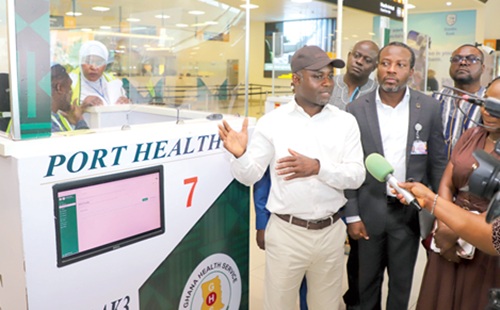
Ghana is fully prepared to detect, contain and manage any Ebola case, although the country has not recorded a case of the disease, the Ministry of Health has reassured.
Presently, surveillance and response measures have been strengthened at the country’s entry points, while testing, contact tracing, isolation and treatment capacity have also been enhanced to ensure a swift response should a case be detected.
The Minister of Health, Kwabena Mintah Akandoh, gave the assurance yesterday when he visited the Accra International Airport (AIA) to assess Ebola preparedness at the country’s primary entry point following reported cases of the disease in other African countries.
“We are ready. We are praying we don’t record any case, but if we do, we are ready to do the needful.
So, we should not be afraid,” Mr Akandoh stated.
Accompanied by health officials, the Health Minister held a closed-door meeting with airport executives, technical officers and Port Health personnel before touring the airport to inspect measures instituted to screen travellers and identify suspected cases.
Measures implemented
Mr Akandoh explained that the latest assessment followed an earlier visit in May, during which he directed the installation of thermal scanners and the introduction of electronic health declaration forms to strengthen surveillance.
He said the thermal scanners had since been installed, while work on the electronic declaration system was nearing completion.
The minister also stated that the declaration form had been amended following a demonstration of the system and indicated that he would soon issue a directive requiring airports to ensure that passengers entering Ghana completed the forms.
The information collected, he explained, would enable health authorities to assess arriving passengers and facilitate contact tracing should a case be detected.
Testing capacity
Mr Akandoh said the country’s laboratory testing capacity was also being expanded, with the number of laboratories capable of supporting the response increasing from three to five.
He added that the reference laboratory was ready for testing, while the infectious disease centre had the capacity to provide isolation and treatment services.
The Health Minister further said the absence of a specific treatment for the Bundibugyo strain of Ebola made prevention, early detection and rapid contact tracing critical to the country’s defence.
He said developments elsewhere on the continent, particularly a recently reported case in Nigeria and the volume of travel between Ghana and affected countries, made continuous monitoring of the country’s gateways necessary.
Funding
On funding, the minister said the government had not placed a fixed ceiling on expenditure for Ebola preparedness and would provide resources as and when they were required.
He cited the procurement of personal protective equipment, thermal scanners and logistics for the electronic declaration system as interventions already financed by the government.
“When they need what, we should be able to provide it,” he added.
No exceptions
Mr Akandoh also directed Port Health officials to strictly enforce health protocols for all arriving passengers without exception.
He said officials should politely but firmly ensure that travellers complied with hand sanitisation and other screening requirements, stressing that status should not determine who underwent the processes.
“Diseases are no respecter of anybody.
So, both at the VIP level and everywhere, anybody who arrives must go through their processes,” he said.
The minister further said the country continued to coordinate its preparedness efforts with other countries and continental health institutions, including the Africa Centres for Disease Control and Prevention, at different technical and ministerial levels.
