
The government is deploying more buses into the contraflow traffic management of the Bus Rapid Transport (BRT) Aayalolo buses within the Greater Accra Metropolitan Area (GAMA).
This follows the successful implementation of the initiative on three dedicated road corridors over the past two months.
Towards the expansion, the government is retooling the Motor Traffic and Transport Department (MTTD) of the Ghana Police Service to support the contraflow traffic management initiative to benefit more passengers ahead of the Christmas season.
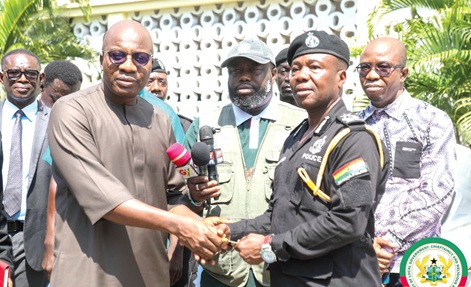
The Minister of Local Government, Chieftaincy and Religious Affairs, Mahama Ayariga, last Thursday evening presented four Honda dispatch motorbikes to the MTTD to support the free movement of the Aayalolo buses.
The Commanding Officer of the Police MTTD, Deputy Commissioner of Police (DCOP) Prince Jude Cobbinah, received the motorbikes on behalf of the Inspector-General of Police (IGP) last Thursday evening.
Context
The government introduced dedicated contraflow lanes for Aayalolo Bus Rapid Transit (BRT) services on three major routes into Accra’s Central Business District (CBD).
The contra flow runs during peak hours, 6 a.m. to 9 a.m. and 4 p.m. to 8 p.m., covering the Amasaman–Accra, Adentan–Accra and Kasoa–Accra corridors.
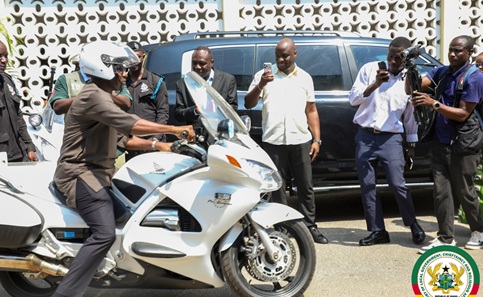
Mahama Ayariga, Minister of Local Government, Chieftaincy and Religious Affairs, riding one of the motorbikes
The initiative was rolled out with the aim of improving the flow of traffic and reducing the economic cost of gridlock in the city.
Expansion
While describing the contraflow initiative as “very successful so far”, the minister said there were some logistical challenges that needed to be addressed for the buses to achieve optimum benefit.
"The number of dispatch riders to lead the buses is not enough because the buses are increasing and the number of trips per bus will increase as we approach Christmas; and that is why we need more dispatch riders," he said.
Mr Ayariga explained that in the coming days, more buses would be deployed to help contain the expected human traffic associated with the season.
The Bawku Central Member of Parliament (MP) said he had directed the Managing Director of the Greater Accra Passenger Transport Executive (GAPTE) to increase the number of trips to accommodate the increasing number of passengers on the street around this time.
He added that the President, John Mahama, had directed that more pick-up vehicles be procured to support the expansion exercise.
The minister dispelled rumours that an Aayalolo bus got involved in an accident on the Amasaman route.
MMDAs directive
Mr Ayariga said he had asked all Metropolitan, Municipal and District Assemblies (MMDAs) to clear the roads of trading and encroachment on road infrastructure across the country.
"People cannot continue to trade on pedestrian walkways and clog the cities.
The police would go ahead and enforce the law. We will permanently keep the bus stops and walkways clean all the time so that people cannot come back,” he stressed.
The Local Government Minister added that key stakeholders, including the ministries of Local Government, Transport, and the Interior, and the MMDAs, were working together on a strategy to decongest the cities of Accra, Kumasi, Tamale, Sekondi, and other places by blocking vehicles from accessing some parts of the cities during some periods of the day.
For his part, DCOP Cobbinah said the Police MTTD was committed to enforcing the road traffic regulations to guarantee the safety of road users.
He said the motorbikes that had been presented to support dispatch riders would be useful in ensuring that there was law and order in the operation of the BRT buses.
Passenger experience
Some members of the public, who have used the Aayalolo buses on the contraflow, have shared profound experiences that point to the common view that the initiative has improved their travel time and reduced their stress levels.
A commuter who works with a media house in Accra, Michael Osei Bonsu, told the Daily Graphic that he has used the Accra-Kasoa corridor and has lasting memories.
"When the car moves from the Aayalolo terminal at Kinbu, it goes straight to Kasoa, without stopping.
The interesting thing is that people who live at Weija prefer to take the Aayalolo bus and go to Kasoa before picking another commercial bus back to Weija,” he said.
He said instead of spending close to three hours in traffic, many people preferred to go to Kasoa in just 50 minutes and return to Weija within a cumulative time of less than one hour 30 minutes.
Another passenger of the Accra-Kasoa corridor, Amos Azindow, said that since the contraflow was implemented, he now heaved a sigh of relief.
"Now, I get home very early to help my children do their homework," he said.
For Xorlase Twum, who also travels on the Aayalolo bus every day on the Accra-Amasaman corridor, her travel time in traffic using commercial vehicles has reduced from two hours to a maximum of 30 minutes.
"Before the contraflow was implemented, coming to work was so stressful because no matter how early you woke up, you would be late. It affected my productivity.
But now, I can comfortably leave at 5 p.m. and be sure to get home in just 30 minutes," she said.
Samirah Adine, who stays at Broadcasting but works at the Makola Shopping Mall, told the Daily Graphic that she preferred coming to the Kasoa Ayalolo bus terminal to pick the bus because it was affordable and did not get delayed on the road due to the police escort.
"I pick the bus to work, and when I close, I join it back to Kasoa because it is faster.
When I get to Kasoa, then I pick a bus at GH¢3 back to Broadcasting.
So I come to Kasoa every morning to join as well," she said.
Kwesi Dwumina, a senior citizen, told the Daily Graphic he preferred using Ayalolo because it gave preference to the aged and the physically challenged when it came to the seating plan.
"I prefer Ayalolo whenever I'm going to town because the conductors make sure the elderly and disabled have seats.
We are a priority," he stated.
