
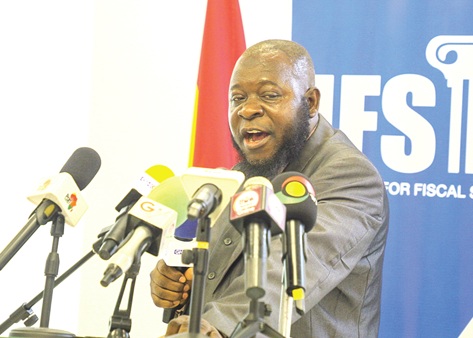
The country loses an estimated $6.56 billion in potential revenue from the mining sector every year due to the government’s limited participation in mineral extraction, the Institute for Fiscal Studies (IFS) has revealed.
The institute explained that the country could have generated that additional money from mining in 2025 if its revenue generation from the sector had matched Botswana’s performance due to its active involvement in the sector.
The Executive Director of the IFS, Dr Said Boakye, who made this known at a policy briefing on low government revenue mobilisation in Accra yesterday, said the situation reflected the country’s inability to maximise returns from its considerable mineral resources, and, therefore, asked the authorities to use the upcoming 2027 Budget to correct the leakage.
Dr Boakye further identified revenue leakages, including tax evasion, underreporting, tax avoidance and collusion involving revenue administrators, as major factors undermining domestic revenue mobilisation.
He cited revelations by the Commissioner-General of the Ghana Revenue Authority, Anthony Sarpong, in April 2026 that the country had lost more than GH¢11 billion in revenue at its ports through incorrect declarations involving the country of origin, classification and valuation of imported goods.
He said the low government revenue mobilisation had constrained the country’s ability to finance development.
Dr Boakye added that the country’s total revenue and grants-to-GDP ratio stood at 15.7 per cent in 2022, against the average of 20.1 per cent for 25 sub-Saharan African countries examined in the IFS report.
The institute estimated that Ghana would have collected GH¢288.26 billion in total revenue and grants in 2025 if its revenue-to-GDP ratio had matched the sub-Saharan African average, compared with the actual collection of GH¢224.88 billion.
Poor performance
The figure, he said, placed Ghana 18th among the 25 countries, highlighting the country’s relatively poor performance compared with its regional peers.
Comparing the systems in Ghana to Botswana’s, for instance, he said the southern African country generated $13.4 billion in value added from mining in 2025, while Ghana’s revenue from the sector amounted to only $1.6 billion, representing 11.9 per cent of the sector’s value.
He said if it had generated mining revenue at Botswana’s average rate of 60.9 per cent, the government would have earned $8.16 billion instead of the $1.6 billion collected.
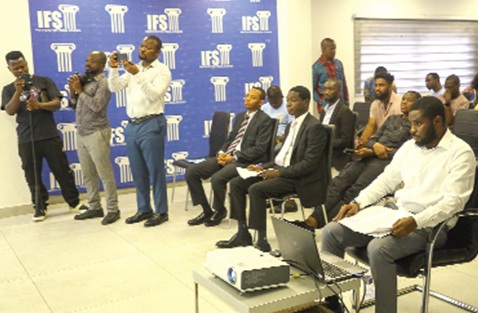
Participants during the event Picture: CALEB VANDERPUYE
Dr Boakye attributed Botswana’s stronger performance to the government’s active involvement in the mining sector through partnerships with private companies.
He explained that such arrangements enabled Botswana to benefit from corporate income taxes, dividends and royalties, while gaining better insight into the operations and profitability of mining companies.
“The government of Botswana does not only earn large corporate income tax revenue from mining because it has an insider knowledge of mining operations and profitability, it earns even larger revenue from dividend payments and royalties,” he said.
He contrasted the arrangement with Ghana’s concession-based system, under which private companies largely undertake mineral extraction, leaving the government with limited access to information about their operations and profitability.
Dr Boakye said the revenue shortfall had serious implications for public investment and the country’s debt situation.
“The low government revenue mobilisation usually leads to shortage of money to fund the government’s developmental projects, making it resort to borrowing. This has led to frequent large debt build-ups, high debt service costs, and fiscal or debt crisis,” he stated.
Tax exemptions
Dr Boakye further identified excessive tax exemptions granted to businesses as another factor contributing to the country’s weak revenue performance.
The report cited incentives under the Free Zones regime and the automotive industry development policy, which offered businesses tax holidays, import duty exemptions and other fiscal concessions.
Dr Boakye said the Ghana Investment Promotion Centre’s incentives inventory lists 31 income tax, customs and financial incentive packages available to businesses across various sectors.
Recommendation
To address the challenges, Dr Boakye recommended greater government participation in the extractive sector through direct investment and partnerships with private companies.
He also proposed production-sharing agreements as an alternative to the existing concession arrangements, saying such agreements would provide the government with better returns from the exploitation of the country’s natural resources.
He further called for an intensified fight against corruption within tax and non-tax revenue collection agencies, alongside a review of existing tax incentive packages.
Dr Boakye urged the government to discontinue exemptions which did not make economic sense in relation to the revenue being forfeited, and to rely more on improvements in the macroeconomic and political environment to attract investment.
