
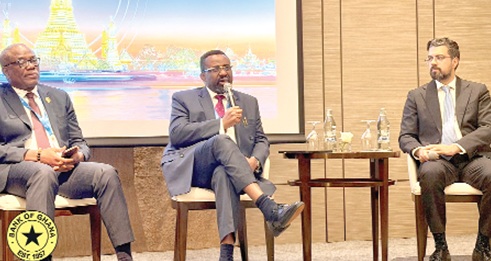
The Governor of the Bank of Ghana, Dr Johnson Pandit Asiama, has assured international investors that Ghana’s economic recovery is gaining momentum, supported by declining inflation, lower interest rates, stronger private-sector credit growth and sustained improvements in macroeconomic stability.
Speaking at the Barclays Investor Roundtable last Wednesday as a side event of the IMF–World Bank Annual Meetings in Bangkok, Thailand, the Governor said Ghana had made substantial progress in restoring economic stability, following a period of significant macroeconomic challenges.
Dr Asiama emphasised that the bank’s priority was now to consolidate the gains through disciplined monetary policy, stronger institutions and the creation of conditions for sustainable, private-sector-led growth.
“Ghana has made substantial progress in restoring macroeconomic stability. Our responsibility now is to make that progress durable by maintaining policy discipline, rebuilding buffers and creating the conditions for sustainable, private-sector-led growth,” he stated.
Inflation falls, improved borrowing conditions
Dr Asiama highlighted the significant decline in inflation from 23.8 per cent at the end of 2024 to 5.2 per cent in September 2026, stating that inflation had remained below the lower bound of the bank’s eight-to-six per cent band since December 2025.
The Governor said the improvement in price stability had enabled the Monetary Policy Committee of the central bank to reduce the policy rate by a cumulative 1,400 basis points, from 28 per cent to 14 per cent, where it had remained since March 2026.
He explained that the benefits of monetary easing were increasingly being transmitted to the real economy, with the interbank rate declining from 23.1 per cent to 10.2 per cent, while the average lending rate fell from 24.2 per cent to 15.9 per cent.
Private-sector credit growth also accelerated significantly, reaching 36.4 per cent at end-August 2026, compared with 13.3 per cent a year earlier.
Outstanding private-sector credit stood at GH¢124.2 billion.
“Our priority is to ensure that this recovery in credit supports productive investment, business expansion and employment,” Dr Asiama emphasised.
Stronger fiscal, external fundamentals
Beyond monetary policy, the Governor pointed to improvements in Ghana’s fiscal performance, with the country recording a primary surplus of 1.4 per cent of Gross Domestic Product (GDP) between January and July this year, compared with a target of 0.2 per cent.
The overall fiscal deficit was contained at 0.2 per cent of GDP, against a target of 1.9 per cent, while public debt declined to 45.9 per cent of GDP from 73.1 per cent before the Domestic Debt Exchange Programme.
Ghana’s external sector has also strengthened, with the current account moving from a deficit of 2.8 per cent of GDP in 2021 to a surplus of 8.2 per cent in 2025.
A further surplus of 3.8 per cent of GDP was recorded in the first half of 2026.
Dr Asiama added that the BoG remained committed to rebuilding international reserves, targeting 15 months of import cover by the end of 2028 under the Ghana Accelerated National Reserve Accumulation Programme (GANRAP).
Banking sector strengthens confidence
The Governor also highlighted improving banking-sector conditions, with the Capital Adequacy Ratio standing at 19.1 per cent, comfortably above the regulatory minimum of 13 per cent.
He told the investors that the non-performing loans (NPLs) ratio has declined from 20.8 per cent to 15.7 per cent, while the central bank had directed regulated financial institutions to reduce their NPL ratios below 10 per cent by the end of December 2026.
Dr Asiama stressed that strengthening credit assessment, loan recovery and the resolution of impaired assets would remain essential to sustaining the recovery in lending.
The Governor assured investors that Ghana’s focus was shifting beyond short-term stabilisation towards stronger institutions, sustained policy credibility and long-term economic resilience.
Dr Asiama cited continued engagement with the IMF, improvements in sovereign credit ratings, plans to establish a Fiscal Council and a legislated path towards recapitalising the BoG by 2032 as important measures to safeguard the country’s economic progress.
The Governor acknowledged that external uncertainties remained but reaffirmed the bank’s commitment to maintaining price stability, strengthening foreign-exchange market arrangements and rebuilding external buffers.
“Ghana’s recovery gives us a stronger foundation from which to pursue these priorities.
We intend to use this period to strengthen our institutions, sustain policy credibility and support productive investment. That is how we will turn stabilisation into lasting economic opportunity,” he concluded.
