
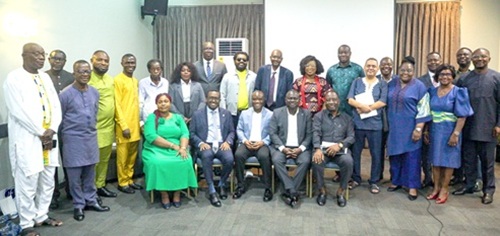
The Minister of State for Government Communications, Felix Kwakye Ofosu, has announced that the government has initiated plans to retool and modernise state-owned media houses as part of measures to strengthen their operations and enable them to compete in the country’s changing media environment.
As part of the move, he said the government had developed a turnaround plan for the state media following a review of the challenges facing the sector, with the aim of improving their operations within 24 months.
At the opening of a two-day meeting of the Federation of African Journalists (FAJ) Steering Committee in Accra yesterday, Mr Ofosu said the government was working to provide the Ghana Broadcasting Corporation (GBC) with modern offices, equipment and investment in human capital.
“We’re also taking steps to recapitalise and restructure the Graphic Communications Group Ltd. We expect to achieve this by the end of this year,” the minister said.
The meeting, hosted by the Ghana Journalists Association (GJA), is to provide a platform for members of the FAJ Steering Committee to deliberate on issues affecting journalism on the continent, including press freedom, journalists’ safety and welfare, and professional development.
Mr Ofosu said the government recognised the financial difficulties confronting media organisations, particularly as traditional media faced growing competition from digital platforms and changing audience preferences.
He said state-owned media organisations faced additional challenges because of their public service obligations, which often limited their ability to commercialise their operations.
“Through that, we have come up with a turnaround which we are currently implementing. It is our hope that in 24 months from now we will see a clear change,” he said.
GBC’s transformation
The minister said the government was particularly focused on transforming GBC into a modern public broadcaster capable of producing quality content and competing effectively in the changing media environment.
He commended GBC for what he described as the quality and professionalism of some of its current programmes, saying the organisation had the potential to regain a strong position in the media industry.
He said the government’s plans for the state media were not intended to terminate their operations, but to strengthen them and make them fit for purpose.
“Our concern at the moment is to bring them back on their feet, modernise them, make them fit for purpose, so that they can hold their own against any new technology that emerges,” he explained.
Mr Ofosu also disclosed that the government was considering measures to support private media houses, particularly in training and human resource development.
Press freedom
On press freedom, Mr Ofosu reaffirmed the government’s commitment to creating a safe environment for journalists to work, adding that the government did not have a policy of tolerating the harassment or intimidation of journalists.
He said journalists and media practitioners were partners in national development and had played a significant role in Ghana’s democratic development.
Mr Ofosu also distinguished between freedom of expression and conduct which violated the law, saying the government had a duty to enforce laws designed to protect society.
He said the growth of digital media had made it easier for individuals to publish content without the traditional editorial structures and accountability mechanisms associated with established media organisations.
This development, he said, had created new challenges for professional journalism, including breaches of ethical standards and instances where individuals faced legal consequences for the content they published.
He said law enforcement agencies also had a responsibility to exercise restraint and distinguish between legitimate criticism and conduct which violated the law.
“People are free to express themselves as much as they can, and we welcome that sort of freedom,” he said.
NMC reform
Mr Ofosu further called for reforms to the National Media Commission (NMC) to make the institution more responsive to the current media environment.
He said the media landscape had changed significantly since the NMC was established under the 1992 Constitution, with the country moving from a media environment dominated by state-owned outlets to one with hundreds of private media organisations.
He argued that the commission’s role needed to evolve to reflect the changes in media ownership, technology and professional practice.
He proposed a review of the NMC’s involvement in the day-to-day management of state-owned media, suggesting that its focus should instead be centred around media content, professional standards and ethical conduct.
Mr Ofosu said the commission should continue to ensure fair and equal coverage in state-owned media, while mechanisms should be developed for the effective day-to-day management of those organisations.
GJA’s position
The President of the Ghana Journalists Association, Albert Kwabena Dwumfour, said the country’s democratic development had benefited significantly from the work of journalists and media organisations.
He said press freedom was a fundamental pillar of a democratic society and therefore urged stakeholders to protect journalists’ ability to gather, process and disseminate information in the public interest.
“For the GJA, press freedom is not merely a professional interest. It is a fundamental pillar of democratic society,” Mr Dwumfour said.
He expressed worry that journalists across Africa continued to face physical attacks, threats, harassment, arbitrary arrest and legal pressures, while economic difficulties were affecting the ability of media organisations to sustain quality journalism.
Mr Dwumfour said the GJA had intensified its advocacy for the safety of journalists and was working with state institutions, media organisations, civil society and international partners on prevention, rapid response, accountability and support for journalists facing threats or attacks.
He also called for attention to the economic and professional welfare of journalists, including decent working conditions, social protection, professional development and continuous training.
FAJ support
The President of the FAJ, Omar Faruk Osman, said Ghana remained an important destination for journalists across the continent because of the working environment for journalists.
He said the situation facing journalists in several African countries included violations of fundamental rights, escalating pressure, restrictions and impunity.
“Ghana remains a beacon of hope for many of us to stand up and present and organise journalists across this continent,” Mr Osman said.
He thanked the government and people of Ghana for hosting the meeting and commended the GJA for its work in defending journalists and promoting professional standards.
