
The country has discovered a substantial new gas and condensate offshore, a major boost for the nation’s upstream petroleum sector.
The find was made at the Nya Gyidie-1X exploration well in the Deepwater Cape Three Points (DWCTP) block, located in the prolific Tano Basin.
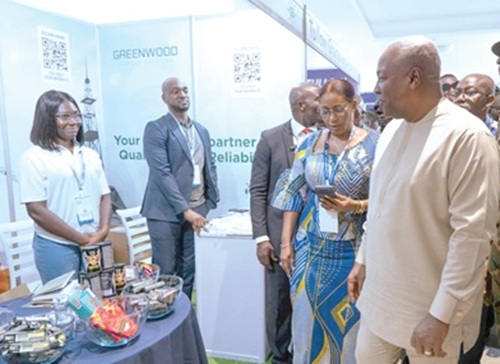
President John Dramani Mahama announced this in Takoradi yesterday when he opened the 2026 Petroleum Commission’s Local Content Conference and Exhibition.
The discovery marks a major turnaround for the DWCTP block, which was previously operated by US major ExxonMobil before the company relinquished its interest in 2021.
The block is now operated by Planet One Oil & Gas, which holds a 75 per cent participating interest, in partnership with the Ghana National Petroleum Corporation (GNPC) with 15 per cent, and GOIL Upstream with 10 per cent.
Present at the event were the Minister of Energy and Green Transition, Dr John Abdulai Jinapor; the Minister of Lands and Natural Resources, Emmanuel Armah-Kofi Buah; the Chief Executive Officer of the Petroleum Commission, Emeafa Hardcastle, and leaders in the oil and gas industry.
Shareholding structure
The President said the new shareholding structure highlighted the growing capacity of indigenous companies to lead high-stakes exploration in the country’s oil and gas industry.
President Mahama described the discovery as a testament to the resilience and potential of Ghanaian-owned enterprises in the energy sector.
“The hydrocarbon discovery at the ‘Nya Gyidie’ marks an important milestone for Ghana.
It is the country's first successful test of a Cenomanian-Turonian Carbonate-Clay as a primary exploration target,” he said to a packed auditorium.
He added: "The well also targeted the Albian as a secondary objective.
The experts understand what it means."
The President explained the significance of the well's name.
“By drilling this well, Planet One and its partners fulfilled an exploration commitment and demonstrated confidence in Ghana and in the direction of our reset agenda. And that is why it is called ‘Nya Gyidie’, which means have faith.”
The discovery follows an intensive exploration campaign by Planet One, using the Noble Venturer rig.
Decline to resurgence
President Mahama used the platform to draw attention to the recovery of the entire sector, which he said had suffered from “poor governance and lack of regulatory consistency”, leading to a steep decline in production.
He stated that output had fallen from approximately 195,000 barrels per day (bpd) in 2019 to about 88,000 bpd.
However, the President said his administration’s efforts to resolve outstanding upstream disputes and restore investor confidence were yielding results.
“We are beginning to see the results. Crude oil production has risen to more than 120,000 barrels per day, and existing operators are committing capital to new projects,” he stated.
Major wins
The President also spoke about significant renegotiations that would result in major savings for the country.
“At Jubilee, the investment is expected to sustain oil output and also increase gas production. The Jubilee gas price is also expected to decline by about 18 per cent, with estimated savings of about $300 million for Ghana,” he said.
He added that under a renegotiated gas sales agreement with ENI, the average gas price was expected to fall by 23 per cent, with projected savings of about $3.5 billion over the remaining life of the field.
These savings, President Mahama explained, came as the country’s gas production is set to increase.
“We are currently producing approximately 400 million standard cubic feet (mmscf) of natural gas per day.
That figure is expected to approach 500 million mmscf when the upgrade to the Offshore Cape Three Points non-associated gas facilities is completed,” he said.
Future beyond upstream
The President linked these upstream developments to a broader industrial vision, including the $28 billion agreement to develop the second phase of the Petroleum Hub project and the recommissioning of the Tema Oil Refinery (TOR), which recently processed 950,000 barrels of Sankofa crude.
He tasked the Petroleum Commission to ensure that operators engaged communities early and to create opportunities for Ghanaians.
“We must judge this industry's progress by what Ghanaian workers and businesses can achieve as a result of the investments that we attract,” President Mahama stressed.
Minister on sector gains
In his address, Dr Jinapor commended the Petroleum Commission's cost audit, which identified about $229 million in infractions, and announced that the value of services provided by indigenous Ghanaian companies rose from $227.5 million in 2024 to $451.8 million in 2025, nearly 99 per cent growth.
He disclosed that crude oil production had risen from about 102,000bpd in 2025 to approximately 122,700 bpd, a 22 per cent increase, with the government prioritising the Eban-Akoma and Pecan fields and GNPC's Hummingbird concept for marginal discoveries.
On gas, Dr Jinapor said production was expected to rise from about 270 million mmscf to 350 million mmscf by 2028, supported by improved pricing arrangements.
For her part, Ms Hardcastle expressed gratitude to the President and the Energy Minister for the launch of the Local Content Fund, describing it as the financial springboard for indigenous Ghanaian small and medium enterprises in the sector.
