
The country's population reached 33.7 million in 2025, up from 18.9 million in 2000, with about 12 million people — approximately one in three Ghanaians — aged between 15 and 35, the largest youth population in the country's history.
In a new flagship publication dubbed “Ghana in Numbers 2025”, the Ghana Statistical Service (GSS) reported that, during the first three quarters of last year, unemployment averaged 32.4 per cent among people aged 15 to 24 and 21.9 per cent among those aged 15 to 35. The national average was 12.8 per cent.
“This means that young jobseekers were more likely than the wider labour force to be unable to find work,” the 178-page document launched in Accra last Thursday, pointed out.
The document said more than seven in 10 jobs remain informal, only 7.7 per cent of the country's 2,644,363 businesses are formal, close to two million young people are neither working nor in education or training; while about 13 million people faced food insecurity in 2025.
The average rate of young people aged 15 to 35 who were neither employed nor enrolled in education or training (known as the NEET rate) was 17.9 per cent during the first three quarters of 2025. In the third quarter alone, close to two million people aged 15 to 35 were in this group.
Women made up more than 60 per cent, with 20.6 per cent in urban areas, 18.0 per cent in rural areas and 25.3 per cent in the Central Region.
Ghana in Numbers brings the country's essential official statistics — on population, social development, the economy, governance, the environment and the Sustainable
Development Goals (SDGs) — into one plain-language volume for the first time, and concludes that while progress is real, it is not shared evenly.
The launch of the publication was attended by government officials, policymakers, public institutions, academia, development partners, businesses, civil society, young people and the media.
Job quality, skills
The report pointed out that about 65 per cent of employed youth said their skills fitted their jobs, but only 58 per cent said their level of education matched what the job required.
“More than 70 per cent of all jobs were informal.
This means that the youth employment question is not only whether a person works, but also whether the work uses the person’s training and provides stable, protected employment,” the report revealed.
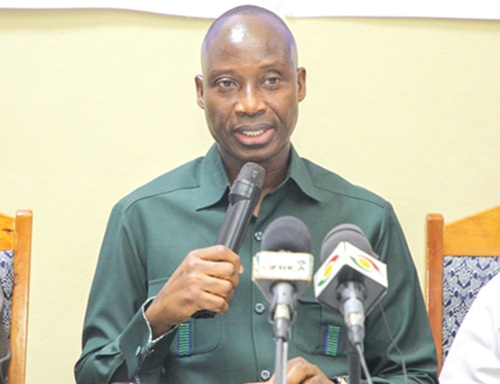
Speaking at the launch, the Government Statistician, Dr Alhassan Iddrisu, said the labour figures should be read together: “Close to two million young people are neither working nor in education or training, what we refer to as the NEET group, and more than six in 10 of them are young women.”
Demographic opportunity time-bound
The Government Statistician said the report showed the share of children aged zero to 14 fell from 41.8 per cent of the population in 2000 to 35.0 per cent in 2025, while the youth share remained at about 35 per cent.
The GSS said Ghana’s age structure having many people aged 15 to 35 with children aged zero to 14 falling can support faster development when a larger working-age population has the health, skills and jobs to be productive.
The report pointed out that the country’s demographic window opened in the early 2000s and has been narrowing since 2019.
“Ghana’s youth window is open, but it is closing,” Dr Iddrisu said, stressing that “Our choices on schooling, skills and jobs in the next 10 years will decide whether it becomes a dividend or a burden.”
Per capita income
The document also reveals that nominal gross domestic product (GDP), which represents the total market value of final goods and services produced within the economy, stands at GH¢1.43 trillion, or GH¢42,502 per person, compared with GH¢4,710 per person in 2013.
While inflation fell from 54.1 per cent in December 2022 to 5.4 per cent in December 2025 — now 5.2 per cent — multidimensional poverty fell from 31.2 per cent in 2022 to 23.0 per cent across the first three quarters of 2025.
Life expectancy rose from 40.3 years in 1960 to 65.1 years in 2021.
Further details
It details that Ghana recorded a goods surplus of GH¢148.3 billion in 2025, with exports of GH¢401.5 billion against imports of GH¢253.2 billion.
Gold bullion alone accounted for 62.9 per cent of exports, followed by raw cocoa beans (8.6 per cent) and crude petroleum (8.3 per cent), while gas oil (11.2 per cent) and motor spirit (9.2 per cent) topped imports.
Asia took 50.1 per cent of exports, with the UAE alone buying GH¢104.0 billion.
Yet the country's first survey of informal cross-border trade found GH¢38.4 billion of goods crossing land borders with Togo, Burkina Faso and Côte d'Ivoire in the year to September 2025 — 1.4 times the formal flow with those neighbours, and about six in 10 cedis traded with them.
The first Integrated Business Establishment Survey counted 2,644,363 businesses in 2024 — including, for the first time, businesses without buildings.
Establishments rose from 638,235 in 2014 to 1.87 million in 2024, nearly tripling, while the people working in them only doubled from 3.38 million to 6.90 million.
Nine in 10 establishments are micro businesses with one to five people; 84.0 per cent of open-space businesses are run by women; and 2,087 children aged 10 to 14 work as mobile traders.
Formal businesses are most common in Greater Accra (12.8 per cent) and rarest in North East (1.8 per cent).
The document states that young people are leaving farming: Ghanaians aged 15–24 in agriculture fell from 866,000 in 2010 to 381,000 in 2021, and those aged 15–35 from 2.026 million to 1.223 million.
"Ghana's youth window is open, but it is closing. Our choices on schooling, skills and jobs in the next 10 years will decide whether it becomes a dividend or a burden," Dr Iddrisu said at the launch.
Population, society
The document said the country added between 0.5 and 0.7 million people every year — the equivalent of a new city annually — although growth continued to slow: from 2.7 per cent a year between 1984 and 2000, to 2.5 per cent between 2000 and 2010, and 2.1 per cent between 2010 and 2021, stretching the doubling time from 25.9 years to 33.3 years.
The country became more urban than rural in 2010. By 2025, 58.7 per cent of Ghanaians lived in towns and cities, with Greater Accra (6.1 million, 18.2 per cent) and Ashanti (5.8 million, 17.0 per cent) together holding more than a third of the population.
Greater Accra's density rose from 1,236 to 1,681 people per square kilometre between 2010 and 2021.
Families are becoming smaller and living longer.
A woman had about 6.4 children in 1988 and 3.9 in 2022; households averaged 3.6 people in 2021, the smallest on record.
Environment
The environment is under strain. Forest reserve cover has shifted north, with Western North's share of land under forest falling from 19.6 per cent in 1990 to 6.5 per cent in 2021 and Western from 17.0 to 8.4 per cent, while Savannah rose from 6.5 to 14.9 per cent and Northern from 1.1 to 6.9 per cent.
Coastal plastic debris rose more than fivefold between 2016 and 2019 and, although it eased in 2020, it remained more than four times the 2016 level. Some 30.8 per cent of urban residents live in slums.
Appreciation and requests
Dr Iddrisu thanked the Minister of Finance, Dr Cassiel Ato Baah Forson, for providing for the annual production of the publication in the 2026 Budget, "turning a single publication into a national institution," and for the GH¢207 million allocation for the rebasing of GDP and the Consumer Price Index.
He made two requests: sustained domestic financing for statistical work beyond 2026 so that "the numbers a nation budgets with should not rise and fall with external funding cycles"; and support for the passage of the Statistics Bill through Cabinet and Parliament.
In the foreword, Dr Forson said: "Good policy is not built on opinion or guesswork. It is built on evidence".
