
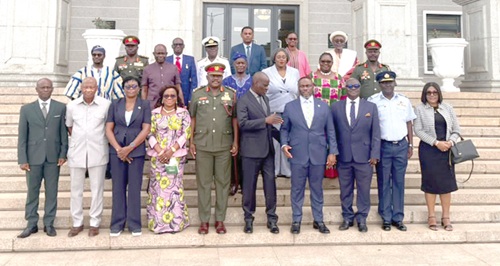
The 19-member Governing Council of the National Defence University (NDU) was inaugurated in Accra yesterday to oversee the establishment and development of the institution as an independent centre for defence and security education.
The council is chaired by a Ghanaian Professor of Epidemiology and former Vice-Chancellor of the University of Health and Allied Sciences (UHAS), Prof. John Owusu Gyapong.
The inauguration follows the passage of the National Defence University Bill, 2026, by Parliament, paving the way for the establishment of a specialised university to unify and coordinate tertiary-level education programmes within the Ghana Armed Forces (GAF).
The university is expected to offer diploma, undergraduate, postgraduate and doctoral programmes to military personnel, security professionals and civilians working in defence-related fields in the country and across Africa.
Already, the government has made available GH¢25 million in seed funding to support the university's take-off.
Responding to emerging threats
Speaking at the ceremony, the Minister of Defence, Kenneth Gilbert Adjei, said the institution would play a key role in preparing military and security personnel to respond to emerging threats through education, research and leadership development.
He said the changing nature of security threats, including the growing influence of technology and cyber threats, required a more comprehensive approach to training military and security personnel.
“We cannot afford to prepare our people for yesterday's challenges and expect them to overcome tomorrow's,” he said.
Mr Adjei said the university's mandate should go beyond awarding certificates and degrees to producing leaders capable of making sound decisions under pressure and exercising their responsibilities with integrity.
He urged members of the council to protect academic standards, promote meaningful research and provide strategic direction to ensure the institution fulfilled its mandate.
Institutional integration
The Minister of Education, Haruna Iddrisu, said the establishment of the university was informed by the need to consolidate and standardise tertiary-level defence and security education in the country.
He said the institution would bring existing military and security training institutions under a common academic framework, allowing for greater coordination of programmes and the development of specialised skills.
Mr Iddrisu said the university would also help address emerging security, cyber and geopolitical challenges across West Africa and the wider African continent.
“Its programmes will extend beyond military officers to personnel from other security agencies, including the Police and Prisons services, as well as civilians working in national security institutions and government agencies.
This university is expected to focus on strategic studies, peace, security, defence, leadership and international politics, while undertaking research to support national and international security policy,” he said.
Independent degree-awarding status
In his acceptance remarks, Prof. Gyapong said the council would prioritise the establishment of a sound governance framework, the integration of constituent institutions, the maintenance of academic standards and the development of a strategic plan.
He said the integration process would require consultation with the leadership and staff of existing institutions, while ensuring continuity in teaching, training and student support.
Prof. Gyapong said the council would also work to strengthen research and policy engagement, with particular attention to security and defence priorities in Ghana and across Africa.
The NDU
For more than two decades, institutions such as the Ghana Armed Forces Command and Staff College, the Kofi Annan International Peacekeeping Training Centre, the National College of Defence Studies and military health institutions have offered postgraduate programmes accredited by the Ghana Tertiary Education Commission (GTEC).
Those institutions have operated under mentorship arrangements with existing universities in the country.
The passage of the National Defence University Bill provides the legal framework for the new institution to award its own certificates, diplomas and degrees for programmes accredited by GTEC.
