
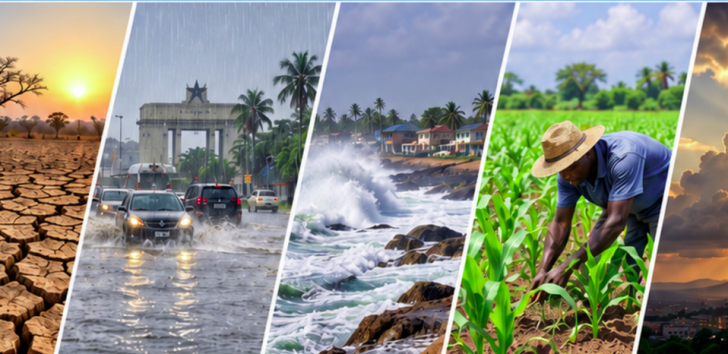
Ghana is bracing for significant climate impacts as the Ghana Meteorological Agency (GMet) has confirmed the development of a very strong El Niño event, warning of a hotter and drier dry season, heightened heat stress and potential risks to agriculture, water resources and hydropower generation through 2027.
According to a technical brief released by GMet and revised following a scientific review on October 27, 2026, the tropical Pacific Ocean is experiencing a strong and still intensifying El Niño event.
The agency noted that the event is very likely to reach very strong intensity, with an approximate 96 per cent chance that the November 2026 to January 2027 index reaches or exceeds the threshold. The event is expected to persist into early 2027, peaking between October 2026 and January 2027.
Drawing on historical data, GMet highlighted that Ghana's experience of past El Niño episodes, particularly the very strong events of 1982/83, 1997/98 and 2015/16 and the moderate 2023/24 event, shows the country's vulnerability to rainfall variability and associated impacts on agriculture, water resources, hydroelectric power generation and public health. However, the agency stressed that El Niño increases the likelihood of certain climate anomalies but does not produce uniform conditions across Ghana, and its influence depends strongly on the state of the tropical Atlantic Ocean.
Current outlook and divergent weather patterns
GMet's observations and seasonal forecasts for 2026 have already highlighted these differences. Exceptionally heavy rainfall caused widespread flooding in parts of southern Ghana in June, while prolonged dry spells subsequently affected farming activities in parts of northern Ghana.
The updated seasonal outlooks indicate predominantly normal-to-below-normal rainfall across much of the country for the remainder of 2026, with above-normal rainfall expected in some areas, alongside warmer-than-average temperatures.
Looking ahead, the agency warned that from November 2026 to April 2027, the principal risks are a hotter and drier dry season in many areas, bushfires, water stress and dust, with heat stress likely to peak between February and April 2027, especially in the north. The 2027 rainy seasons remain uncertain in both directions: late and weak rains are possible if El Niño decays slowly, while above-normal northern rainfall, flooding and Volta spillage become more likely if La Niña develops by mid-2027.
Hydropower and water security
Regarding energy, GMet noted that hydropower generation through the 2026/27 dry season depends mainly on water already stored in Lake Volta. The El Niño-sensitive period is the 2027 inflow season, which will determine generation in 2028. The agency emphasised the need for continuous climate monitoring, regular forecast updates, strengthened impact-based early warning and coordinated sectoral preparedness.
The technical brief identifies rain-fed agriculture, cocoa, dry-season public health, Volta basin water management and hydropower as the sectors most exposed.
To mitigate the risks, GMet has recommended the activation of a National El Niño Preparedness Task Force, the strengthening of real-time monitoring of Volta Lake levels, pre-positioning of drought-tolerant seeds, heat-health action plans, and a coordinated national public-awareness campaign to manage public expectations and direct citizens to authoritative sources of information.
What is El Niño
El Niño is a naturally occurring climate pattern characterised by unusually warm ocean surface temperatures in the central and eastern equatorial Pacific Ocean, which can significantly alter weather patterns around the world, including in Ghana.
What causes it?
Under normal conditions, trade winds blow from east to west across the Pacific, pushing warm water towards Asia. During an El Niño, these winds weaken or even reverse. This allows the warm water to spread eastward toward the coast of South America, while reducing the upwelling of cold, nutrient-rich water that normally supports marine life. The phenomenon was named "El Niño" (Spanish for "the Christ Child") by Peruvian fishermen who noticed the warm waters appearing around Christmas time.
How does it affect the weather?
El Niño is a major driver of global weather variability. It typically has a warming effect on the global climate and shifts rainfall patterns. While its most direct impacts are felt around the Pacific (causing flooding in South America and drought in Indonesia/Australia), its influence reaches far beyond, affecting rainfall and temperatures in Africa, Asia, and the Americas.
What does it mean for Ghana?
For Ghana, El Niño is not a direct forecast of disaster, but rather a shift in the probability of certain weather outcomes. Its impact is complex and depends on how it interacts with other systems like the West African Monsoon and Atlantic Ocean temperatures. Historically, it has been associated with:
Rainfall Variability: A higher likelihood of below-normal rainfall, delayed onset of rains, or longer dry spells. However, this is not guaranteed, and some El Niño years have seen normal or even above-normal rainfall.
Higher Temperatures: An increased chance of warmer-than-average conditions, which can lead to heat stress.
Sectoral Risks: These changes can affect rain-fed agriculture (crops like maize and cocoa), water resources (Lake Volta inflows), hydropower generation, and public health (e.g., heat-related illness or meningitis risk in the north).
In short, El Niño is a distant ocean phenomenon that tilts the odds toward hotter and potentially drier conditions for Ghana, making preparedness—rather than alarm—the most appropriate response.
