
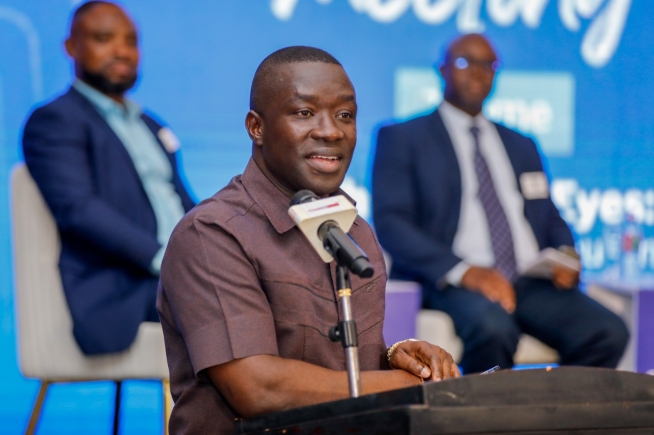
The Narcotics Control Commission (NACOC) has requested the management of various universities to consider including mandatory drug tests as part of the medical requirement for admissions as part of the fight against drug abuse by students.
Speaking in a radio interview on Thursday, a Deputy Director-General in charge of Enforcement, Control and Elimination at NACOC, Alexander Twum-Barimah said NACOC will be seeking legal backing to make drug testing a compulsory requirement for admission into universities.
This, he said will form part of efforts to expand mandatory screening beyond the current practice for recruitment into the security services.
The Commission said the proposal was intended to detect drug use early among young people, reduce substance abuse on university campuses and limit the number of drug users entering the workforce.
The Deputy Director-General in charge of Enforcement, Control and Elimination at NACOC, Mr Alexander Twum-Barimah, disclosed this in a radio interview on Joy FM's Super Morning Show on Thursday, July 30, 2026.
He said the Commission wanted both public and private universities to include drug screening as part of the medical examinations prospective students undergo before admission.
"We are pushing, and I know government is pushing that there should even be legal backing for us to be testing almost everybody on every other thing," Mr Twum-Barimah said.
Explaining the proposal, Mr Twum-Barimah said universities already required newly admitted students to undergo medical examinations, making drug screening a practical addition.
"When we are admitted, we do the medical. Part of that medical background should be your drug test. So now we can know those who are coming in on a high level of drugs or those who are not coming in on drugs," he said.
He added that NACOC was also proposing compulsory drug testing before graduates undertook their National Service to discourage drug use before they entered the labour market.
"If I know that today I am in Level 100, by the time I finish Level 400 and go to do my National Service, I am going to do a drug test. If I don't do the drug test, I cannot do my National Service. Will I still be on drugs? The answer is no," he said.
Mr Twum-Barimah explained that the proposal would build on the compulsory drug screening introduced this year for applicants seeking recruitment into the Ghana Police Service, the Ghana Prisons Service and the Ghana National Fire Service.
According to him, more than 100,000 applicants were screened during the recruitment exercise, with about 6,000 testing positive for one or more prohibited substances, including cocaine, heroin, cannabis, methamphetamine and opioids.
He said the outcome showed the need to intervene earlier by identifying drug use before students entered tertiary institutions or graduated into the job market.
Mr Twum-Barimah also linked the proposal to what he described as the growing incidence of drug abuse in educational institutions, where some students were selling cannabis-infused food, drinks and confectionery to their colleagues.
He said peer influence remained the biggest driver of drug abuse among young people, with senior students often introducing younger colleagues to narcotic substances.
Mr Twum-Barimah said legislation and compulsory testing alone would not solve Ghana's drug abuse problem.
He said parents, schools, religious organisations and communities all had roles to play in preventing young people from abusing drugs.
"This fight cannot just be left to the Commission alone. We are just a handful compared to the population of the country," he said.
Mr Twum-Barimah said NACOC intended to work more closely with educational institutions and engage the Christian Council to include drug awareness in youth activities organised by churches.
He said the Commission had already begun working with the Ministry of Education and guidance and counselling coordinators in second-cycle schools to strengthen drug prevention education.
Mr Twum-Barimah also appealed to the public to volunteer information on drug trafficking and drug abuse, assuring them that the identities of informants would remain protected.
"I can assure them that anybody who makes a report to us, your identity will forever be concealed and we will never expose you to any person," he said.
He urged Ghanaians to treat the fight against narcotic drugs as a shared national responsibility, warning that drug abuse affected not only users but also families, communities and public safety.
