
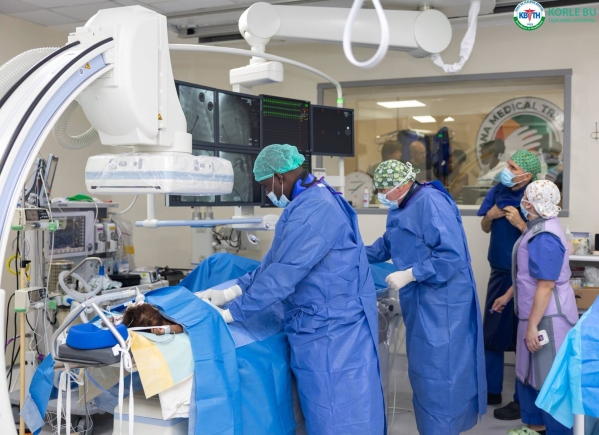
The National Cardiothoracic Centre (NCTC) at the Korle Bu Teaching Hospital (KBTH) has successfully performed Ghana’s first minimally invasive pulmonary valve replacement, marking a significant breakthrough in local cardiac care.
The one-hour procedure announced in a Facebook post by the KBTH was performed on a 14-year-old girl with severe pulmonary valve regurgitation.
The medical team implanted the Harmony Valve, an innovative device designed for patients with enlarged pulmonary arteries. Instead of opening the chest, surgeons inserted the valve through a blood vessel in the patient’s thigh and guided it to the heart to restore normal function.
The operation was carried out in collaboration with Kinderherzen International and the Gerald Asamoah Foundation, both based in Germany. The intervention formed part of an annual partnership engagement involving about 30 medical professionals who performed complex open-heart surgeries and cardiac catheterisation on children with congenital heart diseases.
Medical assessments after the procedure confirmed that the patient was recovering well and the implanted valve was functioning excellently. She was advised to rest for a week and avoid lifting heavy objects to allow the incision in her leg to heal.
Dr Katja Pauli, team lead for the German partners, stressed the importance of early diagnosis and timely treatment. She noted that isolated pulmonary valve insufficiency can occur without other heart diseases, making regular medical assessment essential, and added that some heart conditions can be detected during pregnancy.
Dr Kow Entsua-Mensah, Director of the NCTC, described the achievement as a major milestone in the Centre’s efforts to bring cutting-edge cardiac care closer to Ghanaians. He said the Harmony Valve represents an advancement in transcatheter technology gaining global acceptance, and expressed pride that Ghana had joined the countries performing the procedure.
He added that the partnership had also enabled several babies and children to benefit from critical interventions using the Centre’s newly installed Catheterisation Laboratory. Future procedures planned include Patent Ductus Arteriosus (PDA) closure and Atrial Septal Defect (ASD) closure.
Parents of the beneficiaries expressed gratitude to the medical teams, describing the interventions as a source of hope and relief, particularly for providing access to specialised, life-saving treatment at no cost through the Centre, its partners and the Ghana Medical Trust Fund.
The breakthrough demonstrates the NCTC’s growing capacity to undertake complex cardiac procedures locally and reduce the need for patients to travel abroad for specialised treatment.
