
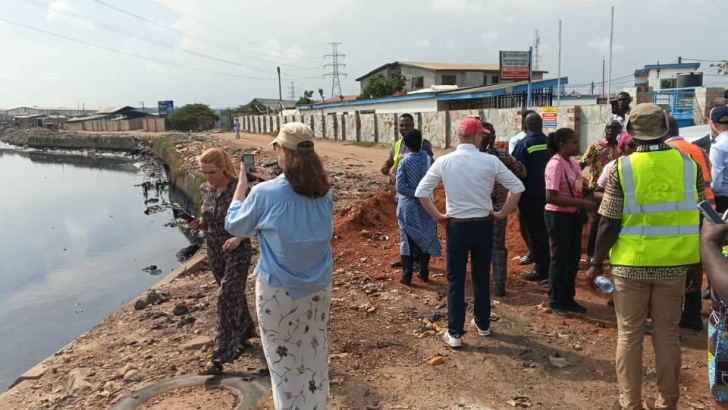
A delegation from the Foreign Policy Committee of the Danish Parliament has paid a familiarisation visit to Tema to assess progress in a bilateral cooperation in water management and climate adaptation as part of ongoing discussions to strengthen the partnership.
The collaboration is expected to support efforts to improve water efficiency, promote nature-based solutions and address environmental challenges, including industrial pollution and flooding in Tema.
The Sector Councilor for Cities, Water and Climate at the Embassy of Denmark, Mathias Thuborg Madsen, in an interview said the partnership, which began in 2019, would continue until 2030, with increased emphasis on affordable infrastructure and sustainable wastewater management.
He was speaking to Graphic Online during the visit by an eight-member Danish parliamentary delegation, led by Karsten Hønge, to the Chemu Lagoon on Friday, [October 30, 2026], to assess the environmental and infrastructure challenges confronting the metropolis.
Mr Madsen said the visit formed part of efforts by the parliamentarians to understand Ghana's development priorities, security challenges and bilateral relations.
He said the engagement was being undertaken through the Strategic Sector Cooperation (SSC), involving the City of Aarhus and its water utility, in partnership with the Ghana Water Limited and the Tema Municipal Assembly (TMA).
He said industrial wastewater management was a major concern, stressing that industries were responsible for treating their effluent at source before discharging it into the environment, while the Assembly handled domestic wastewater.
Mr Madsen said the cooperation was entering its third phase, which would focus increasingly on low-cost infrastructure, nature-based solutions for domestic wastewater treatment and climate adaptation measures to mitigate flooding.
Industrial waste
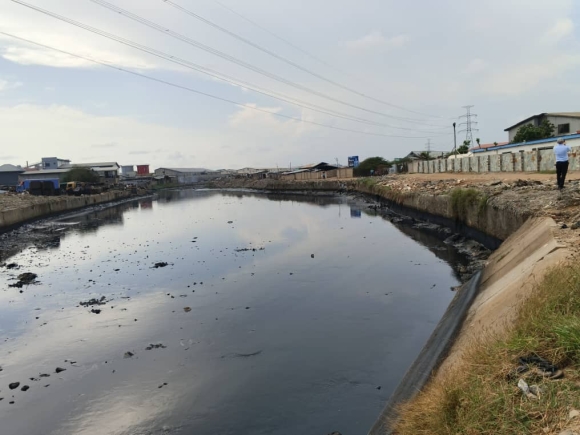
On his part, the Urban Roads Engineer for TMA, Benjamin Bampoh, said the Chemu Lagoon received wastewater from four water bodies flowing through Tema's industrial areas.
He said the tributaries collected effluent from aluminium, cement, chemical, petroleum and metallurgical companies before converging near the lagoon.
Mr Bampoh said inadequate management of industrial waste at source had contributed significantly to the pollution, leaving the water bodies unable to support meaningful aquatic life.
He said the Assembly, in collaboration with the Environmental Protection Authority (EPA), was engaging the industries concerned to address the problem, although sustained investment and commitment would be required.
He also identified industrial air pollution as another environmental challenge confronting the metropolis.
On climate adaptation, Mr Bampoh said the Assembly was exploring nature-based solutions but faced implementation challenges because of limited space and the city's heavily built-up nature.
He recalled that flooding along the watercourse on June 29, 2026, claimed five lives.
He attributed the recurring flooding partly to siltation of the drainage channel over the past 10 to 15 years, resulting in part from sediment washed down from neighbouring communities with largely unpaved roads.
Experience
He said the Assembly was keen to learn from Denmark's experience in addressing similar environmental and infrastructure challenges.
The leader of the Danish parliamentary delegation, Mr Karsten Hønge, reaffirmed the commitment of both countries to sustaining their partnership, describing access to clean water as a fundamental human right.
He assured that Denmark would continue to work with Ghana, particularly in the areas of water management and environmental sustainability.
Writer's email
