
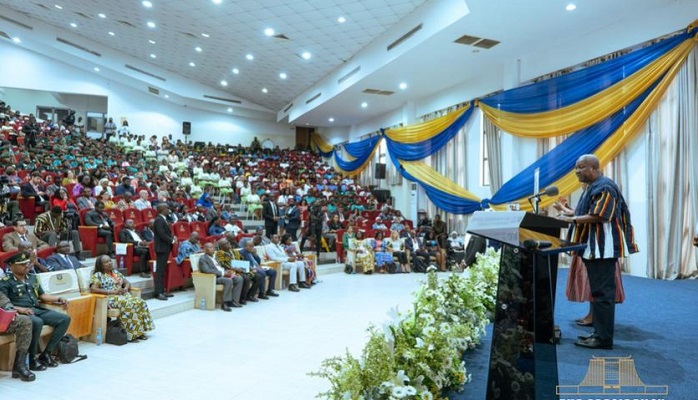
President John Dramani Mahama has condemned the brutalisation of suspected illegal immigrants by vigilante groups, insisting that migration challenges must be addressed through lawful and humane means rather than mob justice.
The President made the remarks in his keynote address at the opening of the Metropolis International Migration Conference at the University of Ghana, Legon, in Accra.
The 2026 Metropolis International Migration Network Conference is being held under the theme: “Rethinking African Mobility: Past Lessons, Present Realities, Future Possibilities.”
The conference is hosted by the Centre for Migration Studies (CMS) at the University of Ghana in partnership with the Metropolis International Migration Network and the African Union Commission.
Being organised in Africa for the first time, the conference seeks to examine the evolving dynamics of mobility across the continent, draw lessons from contemporary developments and explore future scenarios towards a much-needed paradigm shift in migration discourse.
President Mahama, commenting on recent attacks on foreigners in South Africa, acknowledged the country's legitimate right to address its migration challenges but warned that “the challenges of migration will not be solved by vigilantism.”
“They will not be resolved by marauding crowds, searching for and brutalising people believed to be illegal immigrants,” he stated.
Turning to Ghana's own migration realities, the President noted that violent extremism in the Sahel had triggered an influx of refugees into the country, many of whom lacked skills and resorted to begging along roadsides, while their children remained out of school.
He, however, stressed that migration, when properly governed, could offer immense opportunities.
“Well-governed migration can bring enormous benefits. Our task, therefore, must be to govern mobility in ways that allow people to move and realise those benefits,” he said.
The President highlighted positive developments in labour mobility, citing recent labour exchange agreements Ghana had signed with several Caribbean countries, which had facilitated the dignified migration of Ghanaian health professionals to live and work abroad on fixed-term contracts.
Similar agreements with countries in the Middle East, he added, had enabled the recruitment of drivers, security personnel and construction workers on contractual terms.
President Mahama noted that for three decades, the Metropolis International Migration Conference had brought together policymakers, scholars and practitioners to examine issues of migration, integration and belonging.
“Today, for the first time, this global conversation is taking place on African soil. That matters because it affirms a principle that should increasingly guide how the world engages with our continents,” he said.
He stressed that Africa must have a voice in shaping global conversations about the continent, noting that while the world often looked to Africa for migration data, case studies and examples of policy challenges, African countries also produced knowledge and shaped policy.
He called for greater African ownership of migration discourse, insisting that the continent must develop and define its own mobility agenda.
The President commended the Metropolis International Migration Network, the African Union Commission and the University of Ghana's Centre for Migration Studies for hosting the conference in Ghana.
He recalled that knowledge and commerce had long flowed through African cities such as Kumasi, Kano, Timbuktu, Salaga and Djenné, emphasising that African societies had been interconnected long before migration became a subject of international policy debate.
“Mobility did not arrive in Africa as a crisis. It has always been part of Africa's story. Africans will continue to move as they have done for generations,” he said.
President Mahama said the critical question was whether institutions, laws and partnerships could enable Africans to move safely, legally and with dignity while maximising the opportunities available at their destinations.
He observed that global narratives about African migration often began in the Mediterranean, focusing on boats, borders, detention centres and tragedies.
“Every life lost along a migration route is one too many,” he said.
“We must confront irregular migration, trafficking and exploitation, as well as the desperation that drives people to undertake such dangerous journeys.”
The President noted that across Africa, young people, workers, entrepreneurs, students, traders, professionals and families continued to move within and across national borders and regions in search of opportunities, adding that the conference was therefore timely.
Meanwhile, the Vice-Chancellor of the University of Ghana, Professor Nana Aba Appiah Amfo, in a speech read on her behalf, announced that the university had allocated land for the construction of a new complex for the Centre for Migration Studies.
She said a sod-cutting ceremony would be held soon to pave the way for work to begin.
