
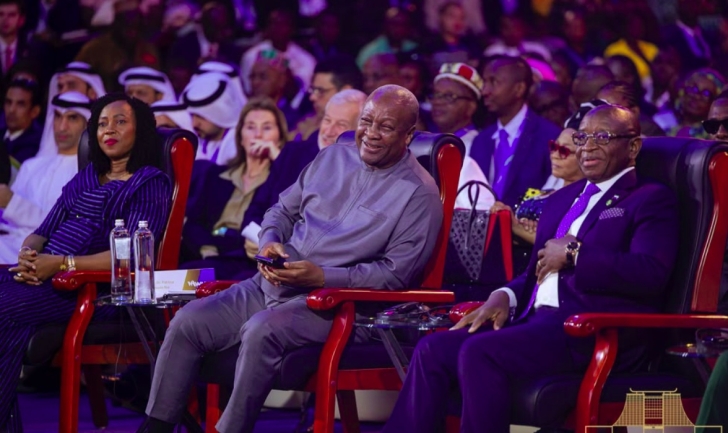
President John Dramani Mahama has proposed a phased introduction of the ECO, the planned common West African currency, allowing countries that meet the convergence criteria to adopt it.
He said countries ready to adopt the currency should be allowed to proceed, with others joining when they achieve the required economic benchmarks.
Speaking at the West African Integration and Investment Summit (WAIIS) in the Sierra Leonean capital of Freetown, President Mahama said the decades-long quest for monetary integration had been hampered by repeated changes in the number of countries meeting the convergence criteria.
He observed that the number of qualifying countries had fluctuated over the years, making it difficult for the 15-member Economic Community of West African States (ECOWAS) to achieve the collective threshold required to launch the currency.
“I am sure some of you were not born when we started talking about the ECO, a common West African currency,” he said.
He recalled that the criteria had, at different times, been met by two, five, three and seven countries, only for the numbers to change again.
A new proposal
President Mahama disclosed that he and Sierra Leonean President Julius Maada Bio had presented a proposal at the last ECOWAS summit to break the impasse.
The proposal, he said, was to allow countries ready for monetary integration to begin using the ECO alongside their national currencies, while others joined progressively. Under the arrangement, national currencies would remain in circulation, while the ECO would facilitate trade settlements among participating countries without routing transactions through the United States dollar.
President Mahama said the initiative by President Bio to convene WAIIS offered an opportunity to bring together ECOWAS leaders, the Commission, the private sector and financial institutions to advance regional integration.
Infrastructure deficit
On infrastructure, he identified inadequate logistics and transport connectivity as major constraints to intra-African trade, despite progress made since the signing of the African Continental Free Trade Area (AfCFTA) agreement.
He said intra-African trade, which stood at about 11 per cent when the agreement was signed, had reportedly increased to about 15 per cent, compared with about 50 per cent to 60 per cent within the European Union.
“But the constraint mainly is in the logistics. Do we have the ports? Do we have the railways? Do we have the roads?” he asked.
President Mahama recalled that the Lagos-Abidjan corridor was first mooted when he was a young minister in the late 1990s, with plans subsequently extending to the Abidjan-Dakar Highway. Decades later, he noted, the proposed corridor remained largely on the drawing board, despite his progression from minister to Vice President and subsequently President.
“Today, I am pushing 70, and the Abidjan-Lagos corridor is still on the drawing board,” he said, describing the slow pace of implementation as evidence that regional integration remained largely aspirational.
He said West African leaders needed to move beyond declarations and accelerate the implementation of practical infrastructure projects to facilitate the movement of people and goods across the sub-region. Completing the Abidjan-Lagos corridor, he said, would provide the foundation for advancing the Abidjan-Dakar Highway and other regional transport networks.
He advocated an integrated road network supported by common border posts and the removal of unnecessary police and security barriers to facilitate cross-border trade, noting that such practical interventions required the commitment of political leaders.
WAIIS, convened under the leadership of President Julius Maada Bio, seeks to advance regional economic integration through commitments and projects to be tracked by its Secretariat. The summit brings together Heads of State, ministers, investors, development finance institutions, business leaders and project owners to align regional priorities with investment opportunities.
West Africa has a market of more than 450 million people, regional economic growth of 4.7 per cent and an investment pipeline exceeding US$180 billion across four strategic pillars.
