
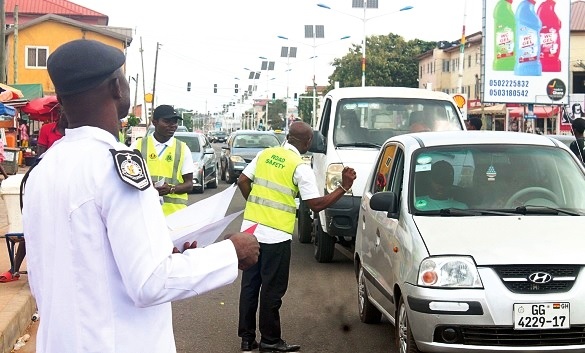
The Director of the Legal and Prosecution Unit at the Criminal Investigations Department (CID) Headquarters, ACP Alexander Odonkor, has urged police officers to stop hiding behind containers to intercept motorbike riders during roadside enforcement operations.
He said the practice was not an appropriate way to enforce traffic laws and urged officers to adopt more civil approaches when dealing with motorists.
“If we are doing that, then we need to stop. I mean, that is not the best way to enforce the law,” he said during a Ghana Police Television programme on Wednesday, November 18, 2026.
His comments followed concerns raised by viewers about the conduct of some police officers during roadside checks.
Some viewers alleged that officers hid behind containers near traffic lights before stopping motorbike riders.
Another viewer complained that police officers often switched off his motorbike, removed the ignition key and instructed him to push the bike to the roadside without explaining why he had been stopped.
Responding to the concerns, ACP Odonkor said police officers had the authority to request documents such as riders’ licences, insurance certificates and roadworthiness certificates for inspection.
He explained that officers sometimes switched off motorbike engines and removed ignition keys to prevent riders from escaping before the checks were completed.
He said officers should, nonetheless, explain their actions to riders and direct them to move to a safer part of the road for the checks.
“Let the person know what you are doing and let them park,” he said.
Dr Odonkor added that officers should explain their concerns when they suspected that a motorbike or a rider’s backpack might be carrying arms or ammunition.
He said roadside checks should be conducted in a civil manner, warning that practices perceived as harassment could discourage motorists from cooperating with the police.
He also urged police officers to adopt more appropriate ways of engaging road users and encouraged motorists to comply with traffic regulations and lawful police instructions.
The discussion formed part of a public education programme on arrest warrants and the legal procedures governing police operations.
