
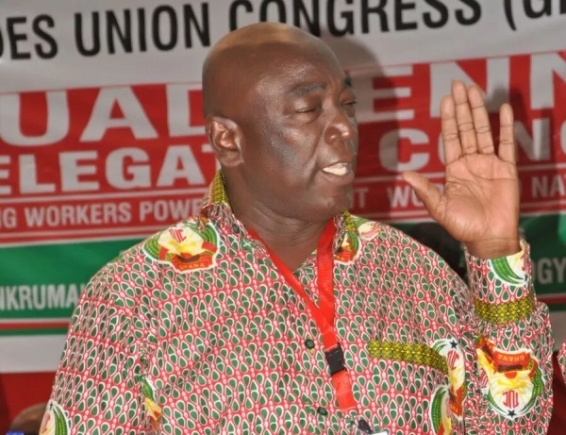
The Trades Union Congress (TUC) has said a five year presidential tenure must be backed by stronger governance and reforms.
It however, cautioned that in the event of mis-governance,, the citizenry would have to endure the consequences for a longer period than the current situation.
“The TUC draws attention to the fact that in the event of misgovernance, a five-year tenure also means citizens will have to endure the consequences for a longer period than under the current dispensation. The acceptance of this recommendation, therefore, imposes an obligation to improve governance and bolster confidence in democratic governance.
Recommendation
“In other words, this recommendation is tied to other recommendations that are intended to strengthen and improve governance. One cannot, therefore, merely agree to tenure extension and leave everything else the same,” the Secretary General of the union, Joshua Ansah, said at a press conference in Accra on Wednesday (September 9, 2026).
The press conference was to state the TUC’s position on the Review of the 1992 Constitution: The Process, CRC Recommendations and Government Position.
Mr Ansah said the union had noted the recommendation by the CRC for the amendment of Article 66(1) to extend the presidential term from four to five years and the Government’s acceptance of that recommendation.
Mr Ansah said “We further take note of the Government’s position that “A longer term provides a more realistic timeframe for the formulation, implementation, and assessment of government policy”.
Appointments
On presidential appointments, Mr Ansah said the TUC agreed with the recommendation to amend Article 70 to limit the appointment powers of the President.
But, the TUC Secretary General said “we, like the government, also find the four classifications of public service appointments proposed by the CRC to be vague.
“The TUC will work with the Constitution Review Implementation Committee (CRIC) as it develops a more appropriate and practical classification system for limiting the appointment powers of the President.
“However, in the opinion of the TUC, amending this Article alone will not limit the President’s appointment powers. In fact, Article 70 refers to a limited set of Public Institutions commonly described as Independent Constitutional Bodies,” he said.
Mr Ansah, among other things, said insulating their appointment from the partisan instincts of a president would strengthen their independence and public confidence in their work.
“We have also taken not of Government proposal to delete the words “except that the majority of Ministers of State shall be appointed from among members of Parliament” from Article 78(1). This deletion will allow a President to nominate any number of ministers from among members of parliament.
Backs
“The TUC backs this recommendation by the CRC. We do not expect Ministers of State to act simultaneously as Members of Parliament,” he said.
Again, Mr Ansah said the TUC does not support the CRC recommendation that an MP who resigned from Parliament must be barred from appointment as a Minister during the term of the Parliament to which the member was elected.
“We have no problem if Members of Parliament resign and take up ministerial appointments. Our problem is with Ministers of State doubling as Members of Parliament. The uniquely Ghanaian hybrid system has weakened parliamentary oversight and occasioned Executive dominance of the legislation. It has also weakened accountability,” he said.
Dual Citizenship
The TUC General Secretary said the TUC had also taken note of the recommendation to amend Article 94(2)(a) to allow dual citizens to contest parliamentary elections and become 8 members of parliament while remaining a citizen of another country.
Again, he said the union had equally taken note of the government’s acceptance of that recommendation, including the current efforts in parliament to allow dual citizens to hold any public position except president and vice president.
“The TUC disagrees totally with the recommendation by the CRC, and the government’s acceptance of it as well as the current legislative processes on the matter of dual citizenship. In fact, we characterise the recommendation as self-serving and a direct assault on the genuine citizenship. It is contradictory and serves no useful purpose for the country,” he said and that “It is strange for the CRC to recommend that a teacher in the Ghana Education Service (GES) who is serving mother Ghana in a deprived community must resign a full year before he or she can contest parliament elections, but a dual citizen does not have to resign their other citizenship. This is the contradiction and the unfairness. We must not constitutionalise this unfairness. The current arrangement must remain”.
Amendment
Mr Ansah said the TUC accepted the recommendation and amendment of Article 89(2) to create a 33-member Council of State and also to change composition of the council.
In the view of the TUC, he said the Council of State remained a useful organ of state that must be reformed to be effective at meeting the expectations of citizens.
However, he said the overwhelming dominance of presidential appointees on the council was unhelpful and that the processes for electing regional representatives had become infested with partisan politics.
On the election of district chief executive, Mr Ansah said the union agreed with the government’s position on the CRC recommendation.
“However, the TUC totally disagrees with the proposal by the Government that, for the election of DCEs, an incumbent Government will select or 10 nominate five candidates, out of which of three will be shortlisted as candidates for election of a DCE.
“The TUC rejects this proposal. It is paternalistic, and it retains the central government’s dominance of the district administration. Most likely, an NDC government will select five NDC members or sympathisers. An NPP government will do same. And Ghanaians will ask: did we go or did we come?,” he asked.
Lands
On lands and natural resources, it said the TUC found it strange that, given all the historical and contemporary concerns over the country’s lands and natural resources, government found no value in all the recommendations by the CRC.
“The TUC agrees with the broad recommendations by the CRC that seek to reform the legal framework for managing our lands and natural resources,” he said.
Mr Ansah said a simple arithmetic of the total number of recommendations proposed by the CRC versus the recommendations accepted or rejected by government showed that government has rejected an overwhelming 54% of the recommendations.
He said the proposed referendum would, therefore, be based on issues exclusively selected by Government to the exclusion of issues favoured by other groups.
