
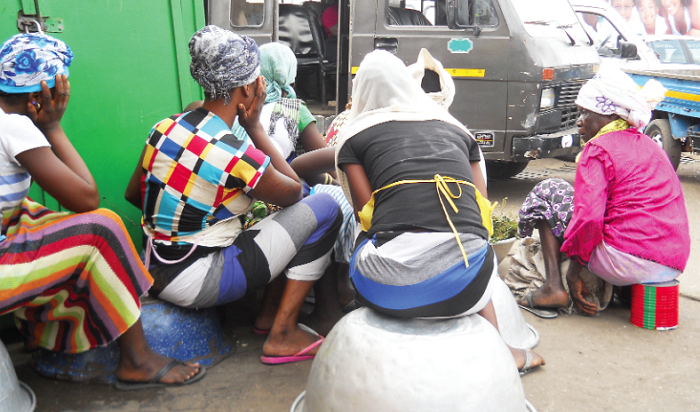
The United Nations Population Fund (UNFPA) and the Ministry of Gender, Children and Social Protection are developing a framework to address the underlying causes of vulnerability among head porters, popularly known as Kayayei.
The proposed Kayayei Management and Vulnerability Framework is expected to provide a coordinated approach to addressing the economic and social challenges facing the women and girls, particularly those exposed to exploitation and limited livelihood opportunities.
The framework is also expected to incorporate the lived experiences of Kayayei into policy development to ensure that interventions address the circumstances that expose them to vulnerability.
Abena Afari of UNFPA Ghana’s Gender and Human Rights Unit announced this at a media forum in Accra on Wednesday, November 4, 2026.
She said a technical working committee was being established to develop the framework, which would subsequently be handed over to the government.
“We are currently developing what we call the Kayayei management and vulnerability framework,” she said.
Ms Afari explained that the initiative was intended to address the root causes of Kayayei vulnerability rather than concentrate on its visible effects.
“We are trying to see how we can have a framework which looks at the root causes. What is causing this to happen? How do we centre the Kayayei? How does the lived experiences of the Kayayei influence the framework we have?” she asked.
She expressed concern that policies were sometimes developed without adequate input from the people they were intended to benefit.
“Sometimes we develop frameworks without the lived experience of the survivors or without the input of the survivors,” she said.
Ms Afari said economic vulnerability also contributed to gender inequality, explaining that limited access to sustainable livelihoods could undermine women’s independence and their ability to make decisions about their lives.
She cited UNFPA’s Kayayei Assistance Programme, implemented with private-sector partners, as one of the interventions aimed at improving the economic circumstances of vulnerable women through skills training and livelihood support.
She said some beneficiaries had received training and established their own businesses, enabling them to move away from head portering.
Ms Afari said the Gender and Human Rights Unit was also working with traditional authorities, queen mothers, religious leaders, civil society organisations and government institutions to address harmful social norms and strengthen protection systems.
She said UNFPA was supporting one-stop centres within the Ghana Police Service’s Domestic Violence and Victim Support Unit (DOVVSU) to provide survivors with medical, police, legal and psychosocial assistance.
The organisation was also working with the Ghana Statistical Service to develop a Gender-Based Violence Information Management System to bring together information currently scattered across different platforms.
The proposed system is expected to improve access to information on gender-based violence and provide evidence to guide policy decisions.
On reproductive health, Vitus Atanga, Programme Officer-in-Charge of Reproductive Health at UNFPA Ghana, said limited access to contraceptives and reproductive health services could expose vulnerable women and adolescent girls to unintended pregnancies, with possible consequences for their education and economic opportunities.
He said UNFPA currently procured between 40 and 45 per cent of Ghana’s family planning commodities, including implants, injectables and intrauterine devices.
Mr Atanga said the withdrawal of the United States Agency for International Development (USAID) from contraceptive procurement had left an estimated 45 per cent funding gap.
He said government representatives had informed UNFPA at a meeting two days before the forum that the government’s contribution to contraceptive procurement was approximately 10 per cent.
“If you were to put a pie chart for today in terms of the procurement of commodities, government is currently contributing about 10 per cent to this pie, and we are still around 40 to 45 per cent. USAID is no longer there, so there is a gap of 45 per cent that nobody is really filling the space yet,” he said.
Mr Atanga urged journalists to hold the government accountable for increasing domestic financing to prevent disruptions in access to family planning services.
He also spoke about UNFPA’s TIMER initiative, which is being piloted in selected communities to address transport and financial barriers facing pregnant women who require emergency medical attention.
The initiative explores community-based funding arrangements, including crowdsourcing, as well as partnerships with transport operators to facilitate emergency transportation to health facilities.
Mr Atanga said some pregnant women, particularly those in underserved communities, struggled to find transport when complications arose.
“When labour comes at night, 2am, 3am, the woman is complaining of the stomach. I am feeling some pain around my abdomen. That is when you need to rush her to any facility. There is no transport. How do you get here? Ambulance is not available,” he said.
Adjoa Yenyi, Programme Specialist for Adolescent and Youth Development at UNFPA Ghana, said economic empowerment, reproductive health education and leadership development were necessary to help young women and girls make informed decisions about their futures.
She said UNFPA and the United Nations Children’s Fund (UNICEF), with support from Global Affairs Canada, were implementing a programme targeting 400,000 adolescent girls by 2030 through reproductive health interventions.
Ms Yenyi also spoke about UNFPA’s YoLe Plus initiative, which provides leadership development opportunities for young people.
She said the eighth cohort of the fellowship comprised 30 young people undertaking a one-year programme.
She added that UNFPA was working with the National Youth Authority to develop a leadership module that had already been tested with more than 200 young people.
The organisation was also working with the National Service Authority on a work-readiness and leadership programme to equip national service personnel with workplace skills and address safeguarding concerns, including sexual abuse.
Ms Yenyi said young people should be recognised as active contributors to national development rather than being treated merely as beneficiaries of interventions.
“Young people are not merely leaders of tomorrow; they are partners building Ghana today,” she said.
She also said UNFPA was working with the Ministry of Education and other partners on a proposed menstrual hygiene task force to identify gaps in the implementation of the government’s free sanitary pad initiative.
The task force is expected to examine access to sanitary pads, disposal arrangements and measures to reduce school absenteeism among girls.
For her part, Emmily Naphambo, Deputy Representative of UNFPA Ghana, said the organisation’s eighth country programme, which began in 2023 and ends in 2027, was designed to reduce preventable maternal deaths and unmet needs for family planning.
She said the programme was estimated to cost US$37 million, comprising US$12.8 million from UNFPA and approximately US$24 million in co-financing.
Ms Naphambo said inadequate access to contraception among adolescents and young women remained a concern, disclosing that more than half of those who wanted to avoid pregnancy did not have access to contraceptives.
She also said one in every four maternal deaths in Ghana occurred among adolescents, while adolescent girls in rural communities were twice as likely to begin childbearing as their urban counterparts.
She explained that the programme had three main areas of intervention: improving the quality of reproductive health services, addressing harmful gender and social norms, and strengthening adolescent and youth development.
Ms Naphambo urged journalists to assess whether development interventions were reaching their intended beneficiaries and producing measurable results.
“What has moved since 2023, and what has not, and why?” she challenged the media to ask.
She said the ultimate objective was to ensure that adolescent girls survived, remained in school and had the opportunity to determine their own futures.
The Country Representative of UNFPA Ghana, Dr Wilfred Ochan, also called on journalists to strengthen accountability in reporting development interventions and look beyond official announcements and programme launches.
He said the media had an important responsibility to examine whether partnerships between the government and development organisations were producing tangible improvements in people’s lives.
“We do not expect you to become the publishing arm of UNFPA network. This is not your responsibility,” he said.
Dr Ochan urged journalists to question whether interventions were reaching vulnerable populations, whether communities were involved in shaping solutions and whether institutions were fulfilling their responsibilities.
He also called for accurate and responsible reporting that protected the privacy and dignity of survivors of violence.
The media forum brought together journalists, government representatives and development stakeholders to discuss population and development issues affecting women, girls and young people.
The discussions centred on reproductive health, economic vulnerability, harmful social norms and accountability in the implementation of development programmes.
