
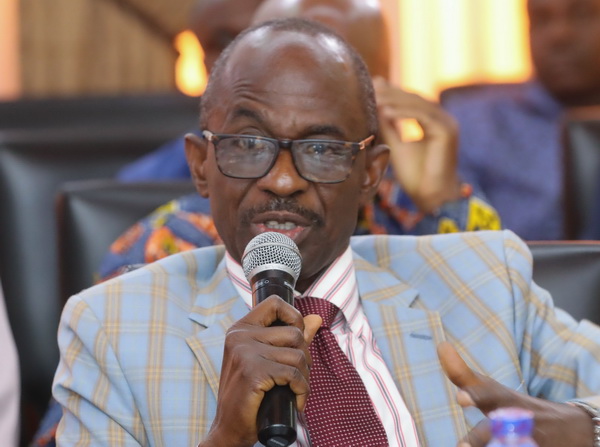
Abolishing the delegate system in selecting parliamentary and presidential candidates for political parties would increase the cost of organising internal elections, the National Chairman of the National Democratic Congress (NDC), Johnson Asiedu Nketiah, has said.
Nonetheless, he says the NDC, for instance, was ready to comply within the one-year deadline set by the Supreme Court in its recent interpretation of the law.
Speaking in an interview with JoyNews' on the programme PM Express on Wednesday [August 5 2026], Mr Asiedu Nketiah said the most important requirement for the new voting system was a credible membership register.
He said the NDC for instance would require between one million and two million ballot papers to conduct its presidential and parliamentary primaries under the proposed one-member-one-vote system.
"The most important thing in such elections is the register. If you get a correct register, then you are good to go," he said.
He added: "One year is enough. We can do it."
On July, 29, 2026, the Supreme Court, in a 5-2 majority decision, declared the delegate-based electoral college system used by political parties unconstitutional. The court directed all registered political parties to allow every card-bearing member in good standing to vote directly in presidential and parliamentary primaries instead of relying on delegates.
The seven-member panel, chaired by Chief Justice Paul Baffoe-Bonnie, gave political parties one year to comply with the ruling. It also held that decisions and appointments made under the delegate system before the judgment remain valid.
The case was brought by Professor Kwabena Frimpong-Boateng, Dr Nyaho Nyaho-Tamakloe and Dr Christine Amoako-Nuamah, with the Attorney-General's Department supporting the action.
Mr Asiedu Nketiah said the NDC's branch election register, compiled during the party's recently concluded branch elections, could serve as the foundation for the expanded voting system.
He said the party had not yet decided whether to reopen registration to admit new members and those who had recently become eligible before the primaries.
According to him, the party must decide whether to use the existing register for both the internal elections and the primaries or open a fresh registration period for the presidential and parliamentary contests.
Mr Asiedu Nketiah said since the Supreme Court's decision applies only to presidential and parliamentary primaries and does not affect the NDC's ongoing internal leadership elections, which cover branch, constituency, regional and national executive positions the elections will go ahead.
He said those elections were expected to end with the election of national executives later this year.
Mr Asiedu Nketiah recalled that the NDC adopted the universal membership suffrage for its presidential primary in 2014 but said the arrangement was discontinued after the party's defeat in the 2016 general election, when some members attributed the loss to the method used to elect the presidential candidate.
"We did it successfully, but there were challenges. I thought that the challenges were things that were not insurmountable," he said.
Mr Asiedu Nketiah also renewed his call for the state to fund presidential and parliamentary primaries conducted by the Electoral Commission for certified political parties.
He argued that candidates who emerge from those primaries contest for public office and that the cost of the exercise should not be borne by political parties alone.
To prevent the abuse of public funding, he proposed the establishment of a regulatory body to certify political parties that satisfy constitutional requirements before they qualify for state support.
He said the proposal formed part of the government's position paper on the recommendations of the Constitution Review Committee.
