
The Minority in Parliament has criticised the 2027 Budget, saying its revenue measures and expenditure allocations would increase the financial burden on households.
The caucus said the budget further reduced funding for social protection programmes by about 35 per cent.
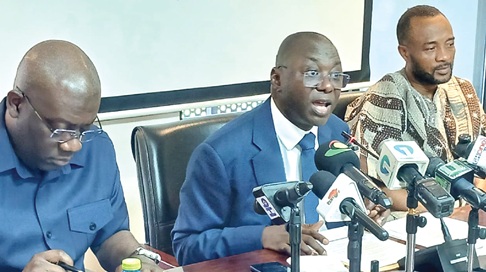
Addressing a press conference in Accra Friday [Nov 13], the Ranking Member of the Finance Committee of Parliament and former Minister of Finance, Dr Mohammed Amin Adam, said although the government had highlighted improvements in key economic indicators, including inflation, interest rates and the primary balance, the budget did not adequately address the economic difficulties facing households, businesses and the unemployed.
The Member of Parliament (MP) for Karaga said the budget presented a picture of economic recovery, which did not reflect the financial circumstances of ordinary Ghanaians.
“The Finance Minister celebrates the paper economy – inflation at 5.5 per cent, a primary surplus, lower Treasury bill rates and better credit ratings. We acknowledge those gains.
But the budget’s own tables show the pocket economy being asked to pay more in 2027, while support for the poorest is cut,” Dr Amin said.
Dr Amin Adam said allocations for social intervention programmes, including the Livelihood Empowerment Against Poverty (LEAP), the School Feeding Programme and the Capitation Grant, had been reduced from GH¢3.46 billion in 2026 to GH¢2.26 billion in 2027, representing a reduction of about 35 per cent.
He further said although the government had announced an increase in the LEAP grant, the reduction in the overall allocation would limit the programme’s ability to support vulnerable households and those newly affected by rising living costs.
He also raised concerns about the projected increase in fees and charges, which he said would rise from GH¢1.3 billion in 2026 to GH¢6.1 billion in 2027, representing an increase of 354 per cent.
Dr Amin Adam said the proposed increases, alongside higher projected collections from taxes on domestic goods and services, would place additional pressure on households and businesses.
He said taxes on domestic goods and services were projected to increase by 22.8 per cent in 2027, while Pay-As-You-Earn (PAYE) collections were expected to rise by 15.6 per cent, compared with a 13.8 per cent increase in the government’s wage bill.
He also questioned the government’s assertion that the budget would not introduce new taxes, arguing that increases in fees, charges and existing tax collections would still result in higher payments by Ghanaians.
On employment, the former Finance Minister said the budget had failed to provide immediate solutions to the country’s unemployment challenges, particularly among young people.
He argued that the government’s proposed New Economy programme was largely a rebranding of the 24-Hour Economy initiative, with several projects and policy interventions carried over from the earlier programme, which he said had failed.
According to him, six of the eight pillars of the New Economy corresponded with existing programmes under the 24-Hour Economy, while several flagship projects had been given new names and implementation timelines extending into 2028 and beyond.
He said the government had yet to provide an account of the jobs created under the 24-Hour Economy, which had earlier been projected to create 1.7 million jobs.
“The Budget, therefore, does not address the immediate demand for jobs.
If the government were serious about jobs, these projects would have started in 2025, so that the jobs arrived in 2026 and 2027,” he said.
He also questioned the financing arrangements for the New Economy, particularly the projected GH¢85 billion in domestic borrowing and the reduction in the primary surplus target from 1.5 per cent to 0.5 per cent of Gross Domestic Product (GDP).
He said the allocation for the programme in 2028 had been reduced from GH¢53.4 billion in the government’s May 2026 Fiscal Strategy to GH¢30.9 billion in the 2027 Budget.
Debt, sector allocations
He further expressed concern about the government’s debt-servicing obligations, which it said stood at approximately GH¢61 billion.
He said the amount exceeded the combined allocations to agriculture, energy, the Big Push infrastructure programme, youth development, industry and tourism, which totalled GH¢37.874 billion.
He also noted that interest payments exceeded the allocations to education and health, which stood at GH¢48 billion and GH¢40.3 billion, respectively.
Dr Amin Adam said the expenditure pattern raised questions about the resources available to drive economic growth, create jobs and improve productivity.
He further pointed out that public debt had increased from 44.7 per cent of GDP at the end of 2025 to 47.5 per cent by October 2026, despite the painful debt restructuring exercise.
The Ranking Member on the Finance Committee also questioned the decline in import cover from 5.7 months at the end of 2025 to 4.5 months at the end of September 2026, despite the country’s reported trade and current account surpluses.
