
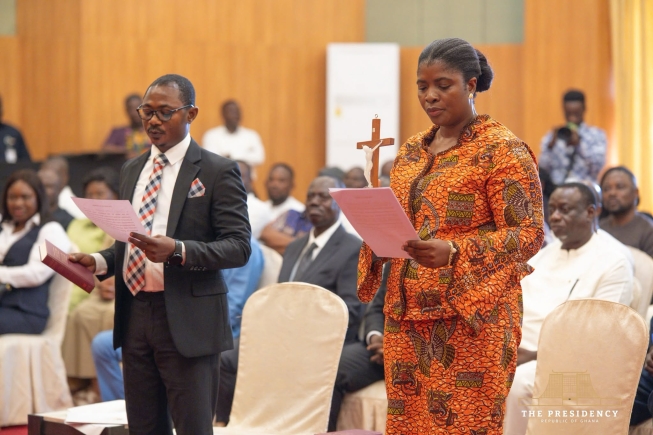
The Director of Governance, Justice and Peace of the Ghana Catholic Bishops’ Conference (GCBC), Rev. Fr. Michael Quaicoe, has urged the two newly appointed deputy chairpersons of the Electoral Commission (EC) to demonstrate impartiality in both decision-making and conduct as they discharge their duties.
“Their ultimate obligation is to the Constitution and the Ghanaian people, not to the political interests of any government or party,” he said.
Speaking in an interview on the brouhaha that has been generated since President John Dramani Mahama swore in the two, Emelia Affi Agbenyo and Dr Joseph Kwaku Asamoah, into office last Monday, Rev. Fr Quaicoe said the country’s democratic stability and peaceful transfers of political power were among Ghana’s most important national achievements.
“Yet, in a politically polarised society, these gains depend significantly on public confidence in the EC,” he said.
The President, acting in accordance with Article 70(2) of the 1992 Constitution and on the advice of the Council of State, appointed Dr Joseph Kwaku Asamoah, a former Director of Finance and Head of Training at the EC and Emelia Affi Agbenyo, a Deputy Director-General of the Ghana TVET Service and a Commissioner at the National Development Planning Commission.
However, there have been some groups, especially the New Patriotic Party (NPP), calling for the withdrawal of Ms Agbenyo for being a known activist of the ruling National Democratic Congress (NDC).
The NPP has also criticised Dr Asamoah for his alleged partisan comments after he had been sworn into office.
EC’s independence
Rev. Fr Quaicoe said although the 1992 Constitution granted the President the powers to appoint the EC’s chairperson, deputy chairpersons and other members, that constitutional mandate must be matched by an unwavering commitment to Article 46, which guarantees the commission’s independence from the direction or control of any person or authority, subject to the Constitution and applicable law.
He explained that those provisions demanded not merely lawful appointments, but principled and independent service.
He said in accordance with the commission’s functions under Article 45, voter registration, electoral boundary demarcation, elections and referenda must be managed competently, transparently and consistently.
“Decisions must be evidence-based, communicated clearly and open to lawful scrutiny. Errors should be corrected promptly, with institutional responsibility replacing defensiveness.
“The commission should improve electoral logistics, results transmission, cybersecurity, independent technical audits and accessible dispute-resolution mechanisms. Technology must reinforce, rather than substitute for, verifiable procedures and public accountability,” he stated.
Rev. Fr Quaicoe said sustained stakeholder engagement was indispensable to the success of the EC.
“Constructive dialogue with political parties, civil society, traditional authorities, the media, religious bodies and security agencies can reduce mistrust, counter misinformation and prevent electoral tensions from escalating into violence. Inclusive voter education must also reach young people, persons who are challenged and marginalised communities,” he stressed.
Rev. Fr Quaicoe, therefore, urged the two deputy chairpersons to champion ethical leadership, professional competence and institutional transparency.
“Their success must be measured not by partisan approval, but by demonstrable fairness and public confidence,” adding that “electoral integrity is a constitutional obligation and a national trust.”
He said the new deputy chairpersons could help ensure that every vote was protected, that every outcome was credible and that Ghana’s democracy remained a source of national unity and peace.
