
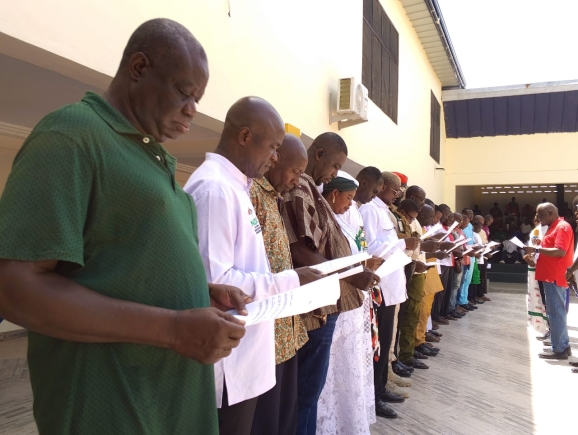
The governing National Democratic Congress (NDC) has completed the first and perhaps most decisive layer of its re-election architecture for 2028.
In elections held across 276 constituencies last weekend, the party renewed its constituency executive base — the street-level machinery upon which every presidential ambition ultimately rests.
On the surface, it was a low-voltage affair.
No national figures were on the ballot.
No fiery presidential primaries.
Yet for the student of party organisation and electoral sociology, the exercise was profoundly revealing.
What unfolded was less a contest than a consolidation; less an election than a ritual of cohesion.
The exercise confirms a maturing trend in the country’s internal party democracy.
The era of ballot-box snatching and machete-wielding at constituency polls appears to be receding.
Reports from many centres describe largely peaceful polls, managed by the Electoral Commission (EC) and observed by party faithful.
That in itself is a democratic dividend worth noting, particularly for a party that has historically been accused of chaotic internal elections.
More interesting, however, is the sociology of the contest.
With no national names directly involved, the campaigns became proxies.
Delegates and observers alike read into every chairmanship race the invisible hand of national aspirants — ministers, Members of Parliament (MPs), and would-be flag-bearer loyalists seeking to plant their flags ahead of the succession battles that will inevitably define the NDC after President Mahama.
It is the classic paradox of incumbent parties: while publicly projecting unity, they privately begin the careful calibration of future power centres.
The constituency executive member, who controls the polling station register and mobilises the base, becomes the first currency in that long transaction.
Anomaly of consensus
Perhaps the most striking statistic from the weekend is this: in 24 constituencies, all executive positions went unopposed.
No voting took place at all.
For a party of the NDC's size and competitive culture, that is unprecedented.
It signals one of two things: either a remarkable level of internal consensus and elite bargaining that pre-empted contestation, or a worrying closure of space where local oligarchies have become so entrenched that challenging them is deemed futile.
Political scientists would be right to interrogate whether this unanimity reflects unity or apathy, cohesion or coercion. It deserves deeper study.
Three constituencies illuminate the divergent local logics at play.
In Odododiodoo, a constituency that has become a bellwether for Ga-Dangme urban politics, incumbent chairman, Paul Oblie Laryea, was re-elected.
His post-victory rhetoric was instructive — not about internal party ideology, but about electoral arithmetic.
"We were able to increase the voter margin to a certain level, from 5,000 to 14,000.
So that is what we did, and we are going to do the same come 2028," he said.
It is a telling shift. Constituency chairmen now speak the language of psephologists.
Their legitimacy is no longer derived solely from loyalty to the party, but from their ability to deliver vote margins.
This is the professionalisation of the grassroots.
In Ketu South, the NDC's electoral World Bank, voting took place on Friday, and the contest was fiercely competitive, reflecting the high stakes of controlling the most reliable vote bank.
Ahorlu Ferguson Kwabla emerged victorious with 946 votes in a four-way race against Dzila Bright (525), Kelie Elolo White (497) and Amedorme Sylvanus Yao (433).
Abelia Seth Kwasi clinched the vice-chairmanship with 1,075 votes, while Zigah Reginald Edem Kodzo won the secretary position with a commanding 1,524 votes.
Significantly, Ketu South voted a day early, on October 23, after the national leadership rescheduled the polls to avoid clashing with the final funeral rites of Torgbui Addo, Paramount Chief of Klikor.
That small administrative deference — culture over party calendar — speaks to a party in power learning to navigate the delicate balance between state and chieftaincy, a balance many previous incumbents have mishandled.
In Tamale North, in the party's northern heartland, Nayi Alhassan, popularly known as Ngbagu, retained his chairmanship with 518 votes, defeating Salifu Mohammed (352) and Abdul Halim Wayo Issahaku (147).
Retention in the north, where personal networks often outweigh party structures, suggests the incumbents still enjoy deep community embeddedness.
It was not without friction. In Atwima Kwanwoma in the Ashanti Region, a party stronghold for the opposition, aggrieved delegates alleged their names had been expunged from the register and reportedly invoked curses on the executive — a reminder that in Ghanaian political culture, the spiritual and the electoral are never fully separate.
The register, as always, remains the most potent tool of exclusion.
Anticipating such disputes, the NDC’s Deputy Director of Elections, Rashid Tanko-Computer, was careful to emphasise institutional channels.
"We always have a team at the national headquarters that deals with matters of this nature.
We have an election committee.
If you have any issue, you appeal to the election task force," he said.
Mr Tanko-Computer’s assertion that no issue had yet been escalated to the national level suggests either efficient local resolution or, more likely, a strategic containment of disputes before they acquire national visibility.
Building pyramid from base
What the NDC has done is classic party institutionalism.
While the public and media focus obsessively on who will succeed President Mahama, the party is building the pyramid from the base.
The constituency party official is the polling station register, the branch mobiliser, the funeral attendee, the arbiter of local grievances.
Two hundred and seventy-six such officials control the party.
Looking ahead
If the 2024 victory was about capturing disaffection with the previous regime, 2028 will be about proving that the NDC can institutionalise power without atrophying into complacency.
Last weekend's largely peaceful, largely bureaucratic exercise was the first test of that.
For scholars of comparative party politics, the NDC's internal process offers a case study in how dominant parties in Africa attempt to manage succession anxieties and grassroots expectations simultaneously — not through grand ideological congresses, but through the quiet, unglamorous renewal of the constituency executive.
