
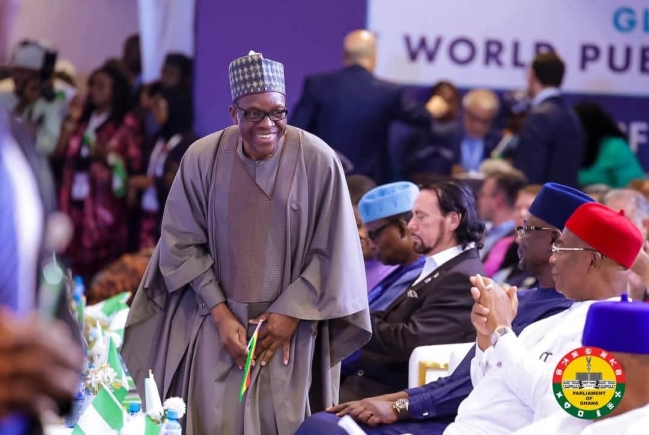
The Speaker of Parliament, Alban Sumana Kingsford Bagbin, has urged African parliaments to move beyond merely communicating decisions to citizens and create platforms for them to influence governance and policy.
He said democratic institutions could only earn public trust when they communicated openly, made their work accessible and allowed citizens to participate meaningfully in decisions affecting their lives.
“Our democratic institutions must not only speak to the people; they must also listen to the people,” he said.
Inform citizens
Speaking at the 2026 World Public Relations Forum in Abuja, Nigeria, on Thursday (Nov 19, 2026), Mr Bagbin, who is a special guest, said democracy was weakened when citizens were misinformed, public institutions became inaccessible and political discourse was reduced to hostility.
“For democracy to flourish, citizens must be informed. For institutions to command public confidence, they must communicate openly and responsibly.
“And for governance to deliver meaningful results, there must be an enduring relationship of trust between those who govern and those who are governed,” he said.
The five-day forum - November 16 to 20, 2016 - has communication professionals, government officials, legislators, policymakers, diplomats, academics and business leaders from more than 130 countries attending.
The theme for event is “Responsible Communication: The Voice of the World.”
Promote understanding
Speaker Bagbin said communication was not simply about transmitting information but about building trust, promoting understanding and enabling citizens to participate in decisions that affected their lives.
He explained that parliamentary communication must go beyond reporting proceedings and announcing decisions to explaining issues, policy choices and the implications of legislation to ordinary citizens.
“Parliamentary communication must, therefore, go beyond reporting proceedings or announcing legislative decisions. It must explain the issues, illuminate the choices before the House and make the work of Parliament accessible to ordinary citizens,” he said.
Citing Ghana's Parliament as an example, he said the Parliament had established the Broadcasting Department, Citizens Bureau, Department of Public Engagements and Media Relations Department to broaden public access and facilitate information-sharing.
He said the First Open Parliament Action Plan paved the way for Parliament TV, which broadcasts sittings and committee proceedings live and streams them online, including using sign language to reach deaf citizens.
Other initiatives, including the Editors’ Forum, Time with Senior Editors, Parliament Connect, Citizens in Focus and Parliament Aayalolo, he said, had strengthened public engagement and created opportunities for citizens and groups to contribute to national policy discussions.

Accurate information
Mr Bagbin said the initiatives had contributed to Ghana's Parliament being adjudged the most open unicameral parliament in Africa in the 2024 Open Parliament Index.
He said the recognition was significant because it reflected Parliament's capacity to explain legislative processes, communicate committee work and provide opportunities for citizens, civil society organisations and professional groups to contribute to policy discussions.
He, therefore, called for transparency and accountability to be institutionalised in public communication, insisting that access to timely and accurate information was a responsibility of democratic governance, not a public relations exercise.
“Transparency should not be treated as a public relations exercise but as an essential responsibility of democratic governance,” he said.
Mr Bagbin also cited the Right to Information Act, 2019 (Act 989), as a milestone in strengthening citizens' access to information held by public institutions.
Uphold truth, accuracy
He also urged communication professionals to uphold truth, accuracy, fairness and accountability, while calling for stronger media literacy to help citizens, particularly young people, identify misinformation and assess information sources.
Mr Bagbin further cautioned against communication that promoted hatred or tribal, religious and political divisions, and urged African countries to take greater ownership of their narratives.
“Africa's story must be communicated by Africans, informed by evidence, lived experiences and the continent's development priorities,” he said.
He said responsible communication should ultimately be measured by the trust institutions built, the integrity they demonstrated and the difference they made in people's lives.
Other speakers
Other speakers, high-profile personalities at the event included the President of Nigeria, Bola Ahmed Tinubu; the President of Zambia, Hakainde Hichilema; and the Speaker of the Nigerian House of Representatives, Abbas Tajudeen.
The rest were the President and Chief Executive Officer of the Dangote Group, Alhaji Aliko Dangote, and the President of the International Public Relations Association (IPRA), Esther Cobbah.
