
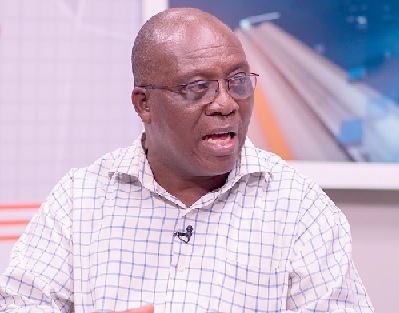
Veteran football administrator Kudjoe Fianoo has demanded the immediate resignation of Ghana Football Association (GFA) President Kurt Simeon-Okraku and his entire Executive Council, calling for a revolution to rescue Ghana football from what he describes as years of failed leadership, declining standards and institutional decay.
In a blistering attack on the GFA leadership, the former Ghana League Clubs Association (GHALCA) Chairman declared that Ghana football had deteriorated so badly that sweeping changes were now unavoidable, insisting that even the threat of FIFA sanctions should not stand in the way of reforms to save the country's sinking football fortunes.
In a hard-hitting interview with Graphic Sports, Mr Fianoo argued that the Black Stars' humiliating 4-2 defeat to The Gambia in Accra in the 2027 Africa Cup of Nations qualifiers was further evidence of an administration that had failed to reverse the country's footballing decline.
For him, the problems run far deeper than the senior national team's results. He pointed to deteriorating infrastructure, disappointing performances across several national teams, inadequate youth development and an administrative culture he believes has increasingly prioritised personal interests over the national game.
Leadership clear-out
Mr Fianoo, a former CEO of AshantiGold FC, challenged the FA boss, who assumed office in October 2019, to accept responsibility for the persistent setbacks and relinquish his position rather than continue presiding over what he considers a failing system.
"You can give him an excuse in your first four years, or even in your first two years. But if it is not progressing, it is rather regressing."
His demand, however, extends beyond the GFA President. Mr Fianoo wants the entire Executive Council to take collective responsibility for the state of Ghana football and make way for a new leadership.
"He headed a body that failed to perform. So they should all leave," he insisted.
FIFA sanctions no excuse
In perhaps his most provocative intervention, the veteran administrator challenged the longstanding fear of FIFA sanctions whenever government intervention in football administration is proposed.
He argued that Ghana could not continue watching its football deteriorate simply because of concerns about possible sanctions from the world governing body.
"If it is because of FIFA, our football is collapsing, and because we fear FIFA, we cannot rescue our sinking ship, then we should stop this conversation," he declared.
Mr Fianoo maintained that Ghana, as a sovereign state, had every reason to demand accountability, particularly when taxpayers' money finances national-team activities and the development of football infrastructure.
His argument raises a fundamental question about the relationship between the GFA's institutional autonomy and the government's financial obligations to the sport.
While FIFA's regulations prohibit undue third-party interference in the affairs of member associations, Mr Fianoo believes those restrictions should not become a shield against scrutiny or accountability.
He consequently proposed a radical restructuring of football financing, challenging the GFA to operate as a genuinely independent, commercially sustainable institution if its leadership wishes to remain insulated from government involvement.
"Then we have to appeal to the government not to use our taxpayers' money in football," he said. "Let's make the GFA a completely private, self-sustaining association."
He also suggested that football supporters and other concerned stakeholders could express their frustration through peaceful demonstrations and sustained public pressure for reforms.
Years of mixed fortunes
Mr Fianoo's intervention comes amid growing scrutiny of Mr Simeon-Okraku's stewardship, with the record of Ghana's national teams presenting a troubling picture despite some notable successes in women's football.
Since Okraku took office in October 2019, the Black Stars have suffered successive group-stage eliminations at the 2021 and 2023 AFCON tournaments, failed to progress beyond the group stage at the 2022 FIFA World Cup and missed qualification for the 2025 AFCON.
Their latest qualifying campaign has offered little encouragement. Defeats to Côte d'Ivoire and The Gambia have left Ghana without a point after two matches in the race for the 2027 continental showpiece.
The struggles have not been restricted to the senior side.
The Black Starlets exited the 2026 Under-17 AFCON at the group stage, missing out on one of Africa's 10 qualification places for the FIFA Under-17 World Cup.
The Black Satellites also endured a disappointing WAFU B Under-20 campaign, finishing third in their group with just two points from three matches.
At the 2026 FIFA Under-20 Women's World Cup, the Black Princesses finished bottom of their group and failed to reach the knockout stage.
Their 3-1 victory over South Korea was sandwiched between defeats to Ecuador and France.
Nonetheless, the picture has not been entirely bleak. The senior national women’s team, Black Queens, have registered some encouraging results, winning the Pink Ladies Cup and bronze at the 2025 Women's Africa Cup of Nations before reaching the quarter-finals of the 2026 tournament.
They subsequently defeated Côte d'Ivoire to secure a place in the inter-confederation play-offs for the 2027 FIFA Women's World Cup.
The Black Maidens have also provided grounds for optimism, qualifying for the 2026 FIFA Under-17 Women's World Cup in Morocco and recording several convincing victories in the WAFU B Girls' Cup.
