
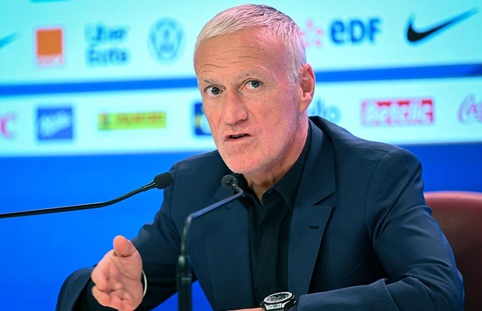
By the time Didier Deschamps walks away from the France national team after Saturday's third-place playoff, the pain of missing out on one final World Cup triumph will still be fresh.
It was never supposed to end this way.
After 14 years at the helm of Les Bleus, Deschamps had envisioned the perfect farewell—lifting the FIFA World Cup for a second time as coach and cementing his place among the greatest managers the game has ever known.
Instead, France's hopes were shattered by a 2-0 semi-final defeat to Spain, denying the 57-year-old the storybook ending he had dreamed of.
Football, however, has never been obliged to deliver fairytale endings.
Deschamps leaves behind far more than one painful defeat. He departs as one of the most successful figures in football history, having won the World Cup both as captain in 1998 and as manager in 2018.
Only Brazil's Mario Zagallo and Germany's Franz Beckenbauer have achieved the same remarkable feat.
His France journey has been defined by consistency, resilience and sustained excellence.
Since replacing Laurent Blanc in 2012, Deschamps has transformed France into a perennial contender on the biggest stage.
Under his leadership, Les Bleus reached three major finals, winning the 2018 FIFA World Cup before finishing runners-up at Euro 2016 and the 2022 World Cup. Even in tournaments where France fell short, they remained among the favourites, a testament to the stability and winning culture he instilled.
Yet football is often judged by the final result.
Against Spain, France looked a shadow of the team many had tipped to win the tournament.
Their attacking stars struggled to impose themselves, their pressing lacked intensity, and their technical quality deserted them when it mattered most.
Deschamps did not hide his frustration after the match.
"I don't want to come across as a whiner because we lost, but did tonight's referee have the level to officiate a World Cup semi-final?" he asked during his post-match press conference.
His comments generated debate, but they did little to divert attention from France's underwhelming performance.
Mbappe’s criticism
Captain Kylian Mbappé was equally candid.
"When you don't do what you have to do in a World Cup semi-final, you don't win," he admitted.
"They like to control the ball and the tempo.
Our plan was to press them high so they couldn't establish their rhythm.
We didn't manage to do it.
We were too sloppy technically.
"Even when we recovered the ball, our first touches were not good enough.
That gives you defeat. It is a huge disappointment."
The criticism did not stop there.
Former France captain Patrick Vieira questioned the commitment and performance of the team's biggest stars.
"They haven't shown up," Vieira said.
"I was expecting more. There were big expectations for France to win the World Cup. All our top players went missing.
Collectively, we were really bad."
For Olivier Giroud, the disappointment was deeper because the players had one final opportunity to repay the man who had led France through one of the country's greatest footballing eras.
"There was extra motivation for all the players at this World Cup to give Didier the ending he wanted and deserved," Giroud said.
"He deserved to leave through the front door. He didn't quite manage that, but he remains a great because of everything he has achieved over the last 14 years.
His record speaks for itself."
Not everyone believes Deschamps should be judged by one defeat.
Clichy praises
Former France defender Gaël Clichy insists history will remember the coach for restoring France to football's elite after inheriting a team that had lost its identity.
"His legacy is that he took a team that was below par and brought it back to the top," Clichy said.
"What he has done for French football as both a player and coach is phenomenal."
Indeed, Deschamps' greatest achievement may not simply be the trophies he won, but the culture he built.
He oversaw the emergence of one of the most talented generations in French football history, blending experienced leaders with exciting young stars to create a squad capable of challenging every major tournament.
His France sides were admired for their discipline, resilience and ability to deliver under pressure, even if they were not always celebrated for expansive football.
Like every great coach, however, Deschamps' tenure was not without criticism.
His pragmatic approach divided opinion, with some believing France's extraordinary attacking talent deserved a more adventurous style of play. Others argued that results ultimately justified his methods.
That debate is likely to continue long after his departure.
What cannot be disputed is his place in French football history.
Only a handful of managers have remained at the summit of international football for more than a decade while consistently competing for the biggest honours.
Deschamps did exactly that, overseeing one of the most successful periods Les Bleus have ever enjoyed.
Now, attention inevitably turns to the future.
Former France great Zinedine Zidane is widely expected to succeed Deschamps, inheriting a squad blessed with world-class talent but also burdened by enormous expectations.
