
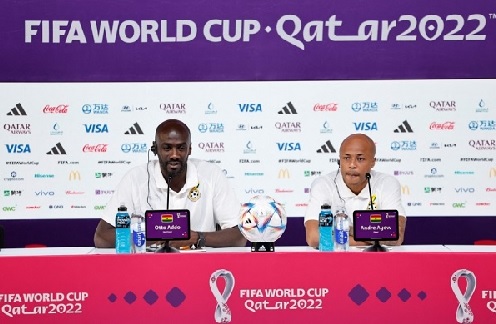
Former Ghana captain Andre Ayew believes Ghana did not get the decision to sack Otto Addo wrong, but rather the Ghana Football Association (GFA) got the timing badly wrong.
The experienced midfielder said the FA should have acted when the coach failed to qualify Ghana for the 2027 Africa Cup of Nations, rather than back him through that failure, watch him recover to secure a place at the 2026 FIFA World Cup, and then dismiss him barely two months before the tournament.
Ayew insists Otto Addo’s failure to qualify Ghana for the 2027 AFCON should have been the decisive moment, arguing that once the coach subsequently recovered to secure World Cup qualification, the FA had weakened the case for removing him so close to football’s biggest tournament.
“It was a call [Otto Addo’s dismissal] that should have happened, maybe, long before,” Ayew told former Nigeria and Chelsea midfielder John Mikel Obi on The Obi One Podcast yesterday. “I think after Ghana failed to qualify for the AFCON, it’s not good enough, and you can’t go further. That’s my opinion.”
That AFCON fiasco, Ayew believes, was the point at which the Ghana FA should have concluded that the project had run its course. Instead,
Otto Addo survived. The FA retained the coach who turned Ghana’s fortunes around and qualified the Black Stars for the World Cup.
But another damaging sequence of results, including Ghana’s failure to win their subsequent international friendlies, ensured his dismissal after Ghana lost 1-2 to Germany in Stuttgart on March 30.
Experienced Portuguese coach Carlos Queiroz was appointed as his replacement barely two months before the tournament in North Africa.
For Ayew, it was a missed opportunity and a problem of timing and decision-making. He said the calls for Otto Addo’s dismissal were understandable, but he argued that the FA acted so late and left Queiroz with precious little time to impose his ideas, establish combinations and prepare a settled side for a World Cup.
Ayew’s assessment carries added weight because few players are better placed to understand the complexities surrounding Otto Addo’s two spells in charge.
The midfielder played under him when Ghana qualified for the 2022 World Cup in Qatar, but during the coach’s second spell between 2025 and 2026, Ayew was dropped from the national team and lost the captain’s armband.
The 36-year-old, who made 120 appearances for Ghana between 2007 and 2024 and represented the country at the 2010, 2014 and 2022 World Cups, nevertheless resisted publicly attacking either the coach or the FA.
That silence, he revealed in yesterday’s interview, concealed considerable pain. Ayew said he was playing regularly for Dutchside NAC Breda before the World Cup and knew there was significant public support for his recall, particularly when some players selected for the tournament had struggled for regular club football.
“I was playing regularly for NAC Breda, and I know some people were calling for me to be part,” he said. “To be fair, some of the players who went to the World Cup, they didn’t have a lot of game time in the season.
“People said a lot of things.”
What hurt more, Ayew suggested, was his treatment by individuals within Ghanaian football.
“A lot of people in the [GFA, media and elsewhere] did me a lot of wrong. I felt it. But I did not say one word [because] I cannot spit on my country because of certain people. Ghana is more important.”
From outside the squad, Ayew watched Ghana produce what he considered a respectable World Cup under Queiroz. He praised the players’ determination and tactical discipline as the Black Stars negotiated the group stage and reached the second round despite the disruption surrounding the coaching change.
His own international future remains uncertain, but Ayew has emphatically shut down suggestions that his playing career is over. The veteran revealed he was in discussions with three clubs and intends to return to competitive football next season. He remains open-minded about his next destination, with retirement not yet part of his immediate plans.
Increasingly, however, Ayew is also looking beyond his playing days. He revealed that he has effectively served as chief executive of Nania FC — the Division One club founded by his father and Ghana legend Abedi ‘Pele’ Ayew — for the past few years, giving him practical experience in football administration and player development behind the scenes.
That involvement has coincided with approaches from figures who want him to play a wider role in addressing Ghana football’s problems.
“Yes, I’ve been having phone calls from football people [to get involved in fixing Ghana football],” Ayew said. “But that’s not important now. What I want is for football to grow.”
His vision also extends to the continuing debate around foreign-born Ghanaian players. Ayew believes players developed abroad should be welcomed into the Black Stars provided their commitment to Ghana is genuine.
He remains equally invested in the generation carrying the team forward. Ayew believes poster boy Mohammed Kudus possesses the talent to reach the highest level and potentially establish himself among Africa’s elite performers, citing Mohamed Salah as the benchmark.
In his view, Kudus has the quality to represent clubs of the stature of Manchester City, Liverpool or Arsenal, but must prioritise his fitness, recovery and long-term physical health.
Ayew was just as candid about his younger brother Jordan, Ghana’s current captain and most-capped international with 134 appearances since his 2010 debut.
He accepted that Jordan did not enjoy a good World Cup and said criticism was inevitable, particularly because the captaincy magnifies responsibility.
But he also revealed the personal cost: while other players left for holidays after the tournament, Jordan returned home and withdrew from public view amid the backlash.
“Jordan Ayew is underrated for what he has achieved in Ghana football,” he said.
