
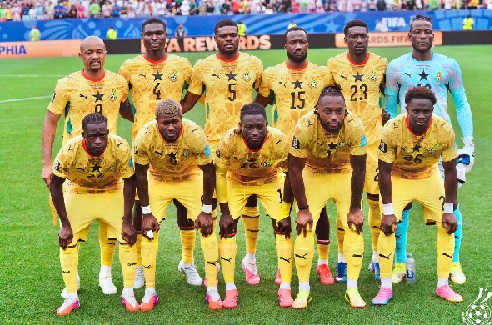
Ghana’s Africa Cup of Nations rescue cannot begin with another explanation for failure. It must begin with victory over Somalia at Essipong on Thursday, followed by another on Monday.
Six points are the minimum acceptable return for a Black Stars side whose qualification campaign is already in danger.
The figures permit no complacency. Defeats to Côte d’Ivoire and The Gambia have left Ghana bottom of Group C without a point, six behind both leaders. Only the top two qualify. Beating Somalia twice would take Ghana to six points after four matches, not secure qualification.
With the Ivorians and Gambians meeting twice this month, one or both will collect more points. Ghana would still face those rivals in March.
A clean sweep merely keeps the escape route open.
The deeper concern is how Ghana reached this position. A 2-0 defeat to Côte d’Ivoire exposed defensive weaknesses; the 4-2 home loss to
The Gambia, after Ghana led by two goals, exposed something more alarming: an inability to manage advantage.
Six goals conceded in two games suggest that the breakdown is collective, not simply the fault of individual defenders.
That is why interim coach Kim Lars Björkegren must be judged on more than the scoreline. His immediate task is to restore a side’s capacity to control a match from a position of strength.
Can Ghana sustain compact defensive distances, protect midfield when possession changes, recognise when to press and when to slow proceedings? When the Black Stars lead, do they command events or invite another collapse?
Björkegren deserves a fair assessment. His work with the Black Queens demonstrated organisational ability and an understanding of collective responsibility. Yet success in women’s football cannot automatically guarantee an instant remedy for the senior men’s side.
Alongside experienced lieutenants Ibrahim Tanko and Godwin Attram, the Swede has days, not months, to establish simple, enforceable principles. Expect structure and composure, not a complete tactical reinvention.
The players, particularly the seniors, cannot transfer all responsibility to the technical bench. Jordan Ayew must set standards of leadership; Mohammed Kudus, if available, must offer imagination with discipline; Mohammed Salisu, if fit, must reinforce defensive authority.
Every experienced international has an obligation to communicate, concentrate and respond when momentum turns.
Talent without accountability has already proved insufficient. Antoine Semenyo’s absence also makes it imperative that Ghana create and defend as a unit rather than depend on individual brilliance.
Nor should Somalia be treated as convenient opposition. They also began with two defeats, but pushed The Gambia in a 2-1 loss and were beaten 2-0 by Côte d’Ivoire. Both fixtures will be played at Essipong, although the return encounter is officially Somalia’s home match.
Familiar ground and Ghanaian support are advantages to exploit, never substitutes for preparation or respect.
The Ghana Football Association must also answer for the wider decline. Missing the previous AFCON should have triggered lasting corrective action; instead Ghana are already scrambling again.
Under Kurt Simeon-Okraku’s leadership, the FA must secure player availability, medical and logistical readiness, coherent technical support and a clear plan beyond this interim appointment.
Public patience is not limitless, and accountability cannot end with the coach. Every responsible institution must pull in the same direction.
Win twice, certainly. But win with the authority, concentration and game intelligence that make further recovery believable. Six points would repair some damage. Control would signal that Ghana are finally learning from it.
