


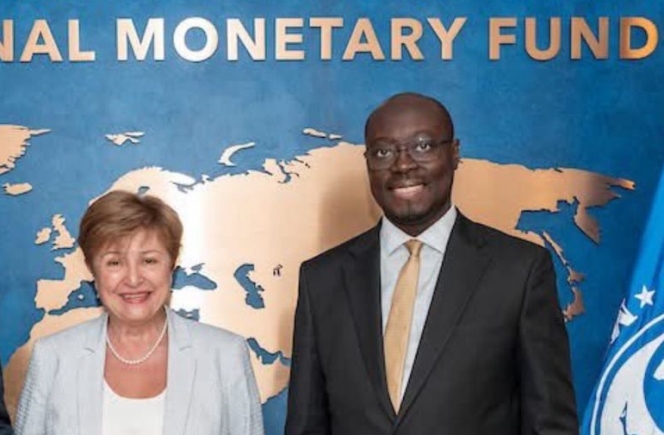
Ghana's economy is projected to grow by 5.2 per cent in 2026 and 5.7 per cent in 2027, according to the International Monetary Fund's (IMF) latest World Economic Outlook, even as global growth holds steady at 3.1 per cent for 2026 and 3.4 per cent for 2027.
The October 2026 report, titled "Resilience Under Strain, Urgent Choices," shows Ghana's growth trajectory moderating from 6.0 per cent in 2025 but remaining among the stronger performers in sub-Saharan Africa, where growth is expected to hold steady at 4.5 per cent in 2026.
The IMF projects Ghana's consumer price inflation will decline sharply to 4.8 per cent in 2026 from 14.2 per cent in 2025, before rising to 7.8 per cent in 2027.
The country's current account surplus is projected at 6.0 per cent of GDP in 2026 and 5.6 per cent in 2027, reflecting favourable terms of trade from elevated gold prices, with gold accounting for 67 per cent of total goods exports in 2025.
Ghana is classified among middle-income countries in the region, alongside South Africa, Kenya, Côte d'Ivoire, Cameroon and Senegal. Nigeria, the region's largest economy, is projected to grow at 4.2 per cent in 2026, while South Africa is expected to grow at 1.0 per cent.
Global backdrop
The IMF said the global economy has demonstrated resilience despite a sequence of shocks, including the pandemic, the wars in Ukraine and the Middle East, and significant changes in trade barriers. Global headline inflation is projected to rise to 4.7 per cent in 2026 before easing to 4.1 per cent in 2027, driven mainly by higher energy and food prices.
The report noted that the global outlook masks a reallocation of growth, with countries with limited direct exposure to the war and strong participation in the technology upturn seeing activity hold up. By contrast, energy-importing economies with little connection to the technology value chain face higher import costs, weaker real incomes and more constrained fiscal space.
For sub-Saharan Africa, the IMF said oil-importing, non-resource-intensive economies are more adversely affected by higher energy and food prices, while larger economies continue to benefit from earlier stabilisation and reform efforts. It noted that Nigeria is supported by improved macroeconomic stability and favourable terms of trade, though higher prices for essentials are expected to further aggravate poverty and food insecurity.
Policy recommendations
The IMF called for a renewed focus on rebuilding fiscal space, given elevated debt, rising borrowing costs and multiplying demands on public budgets. It said any support to ease the impact of higher energy and food prices should be temporary, targeted and non-distortionary, and should not jeopardise fiscal sustainability goals.
The report also emphasised the importance of structural reforms to strengthen energy security, improve artificial intelligence readiness and maintain open channels for trade and cooperation, which it described as essential to raising resilience in a world where shocks are increasingly frequent.
The IMF's projections for Ghana align with recent assessments by Moody's Ratings, which upgraded the country's credit rating to B3 from Caa1 on October 9, 2026, citing improved debt affordability and sustained fiscal discipline.