
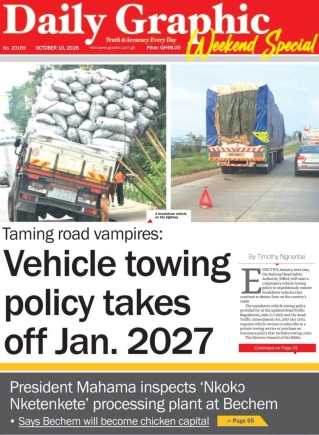
For more than two years, this newspaper has followed a dangerous pattern on our highways.
On the Eastern Corridor Road, from Tema to Bawku.
On the Accra-Cape Coast road. On the Accra-Aflao road. On the Takoradi-Elubo road. On the Kumasi-Techiman road and the Kumasi-Tamale road.
Broken down trucks, tankers and buses park in the middle of the road or on the shoulder for days, weeks and sometimes months.
No reflectors.
No warning triangles.
Sometimes just a vehicle or truck tyre or a heap of branches.
These abandoned vehicles are road vampires.
They suck blood at night.
They kill without moving.
We, therefore, welcome the announcement by the National Road Safety Authority (NAARA) that effective January 2027, a compulsory vehicle towing policy will take off.
The Director-General of the NORSE, Abraham Amalita, told the Daily Graphic last Wednesday that the mandatory vehicle towing policy provided for in the updated Road Traffic Regulations, 2026 (L.I 2519) and the Road Traffic (Amendment) Act, 2025 (Act 1153), require vehicle owners to subscribe to a private towing service or purchase an insurance policy that includes towing cover.
This is long overdue.
And if it is implemented with transparency, it can save thousands of lives.
Regulation 214(2) requires a driver to display at least one emergency warning sign when his vehicle is stationary on the roadway or shoulder.
But these regulations are honoured more in the breach.
Vehicles break down, drivers leave them, and disappear to look for a spare part in Accra.
The police do not enforce.
The owner does not tow. And another family member dies.
The numbers are chilling.
Over the past 35 years, from 1991 to 2025, 63,599 persons died from reported road crashes in Ghana.
An analysis of a 10-year period from 2012 to 2022 shows that out of 23,490 people killed, 687 deaths were directly linked to abandoned vehicles on the road.
That is nearly three percent of all road deaths.
Extrapolated over 35 years, it means about 1,908 Ghanaians could have been saved if disabled vehicles were promptly towed.
Behind these figures are gory stories the Daily Graphic has documented.
These are not accidents.
They are preventable murders by negligence.
In October 2016, government, acting through the NORSE, signed an agreement with the Road Safety Management Services Limited for towing.
It was announced that from July 1, 2017, vehicle owners would pay a mandatory road safety fee each time they renewed their roadworthy certificates at DOLAN.
That policy was resisted and collapsed — for lack of adequate engagement, lack of transparency in the selection of the single contractor, and lack of trust.
We must not repeat that failure. Vehicle owners already complain about high insurance premiums, roadworthy fees and fuel costs.
If they are to subscribe to a towing service or buy insurance that includes towing, the cost must be modest and clearly explained.
The towing policy must be accompanied by strict enforcement of Regulation 214(2) on warning triangles and by driver education.
The Motor Traffic and Transport Department of the Ghana Police Service must be empowered and equipped to remove vehicles that are not towed within one hour in towns and two hours outside towns, and to surcharge the owners.
Towing is the cure
The prevention is good roads, driver training, and vehicle maintenance.
Many trucks break down because they are old, overloaded and poorly maintained.
Many break down because the Eastern Corridor and others are in a deplorable condition.
Government must fix roads and enforce axle load limits.
Ghana cannot continue to allow stationary vehicles to kill more people than moving ones.January 2027 is three months away.
The NORSE must use this window for intensive public education, publish the list of approved towing companies, unveil the app, and explain the fee structure.
The insurance industry must be brought on board.
We have lost 63,599 lives in 35 years.
We cannot afford to lose another 1,900 to vampires we can tow away.
