
A three-bedroom apartment, built for a clinic in my hometown, was left unoccupied for several years.
It had been tiled, roofed, ceiled, painted and fitted with doors, windows and ceiling fans, and it was connected to an electricity source.
The beautiful apartment, a fine structure for a rural community, was left unoccupied, left to deteriorate.
To say “unoccupied” is not quite accurate. Rather, it was occupied by snakes, lizards, mice, ants, scorpions and spiders that had woven their webs from wall to wall.
Why this waste?
“Why?” I asked an official of the clinic, who told me without any emotion—as if nothing was wrong—“We are waiting for it to be commissioned before anybody can occupy it.”
While they waited, the insects, rodents and decay were relentlessly destroying the apartment.
I was so annoyed that I went away without a word.
Since then, I have not stopped bemoaning such reckless abandonment.
But that decaying apartment was just a drop in the ocean.
One day, I went to look for someone at the Institute of Local Government Studies at Madina, Accra, and came upon another kind of abandonment that broke my heart.
Left to the elements of sunshine, rainfall and windstorms for over a decade, 86 brand-new vehicles had been left rusting in the yard.
As I touched the bonnets of some of the vehicles, the rust smeared my palm.
When I inquired, I learned that the cars were meant to be used by district chief executives in the country.
But there they sat, deteriorating due to procurement and contractual disputes wrangled over by the government and the importer.
The fact that the vehicles were later auctioned (cheaply, certainly) does not answer why and how such national assets could be subjected to such abandonment.
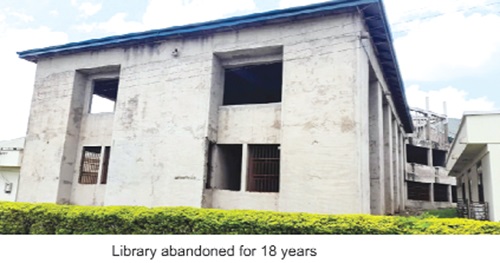
Library abandoned
Because of my love for libraries and the benefits I have derived from reading and borrowing books from libraries, the news report from the Bono Region about an abandoned regional library caught me on the wrong foot.
The Bono Regional Library complex in Sunyani was abandoned for 18 years.
The report said, “Due to severe funding shortages, delayed government disbursements, and alleged contract diversions, the facility had deteriorated into an overgrown, hazardous eyesore, largely taken over by weeds, reptiles and squatters.”
That was another multi-million-dollar national project abandoned to rot for almost two decades.
The current state is that, due to persistent advocacy, the project is “being repackaged to finalise construction”.
I wish an educational journalist would investigate the meaning of this ambiguous phrase—“being repackaged to finalise construction”—and what has happened in practical terms since the issuance of that statement.
Nation of abandonments
We lack the space to cite other abandoned projects, such as the massive military hospital complex at Afari in the Ashanti Region that is left to deteriorate.
How about the Saglemi Housing Project and hundreds of other abandoned structures dotted around the country—including school buildings, private and corporate housing projects, hospitals, roads, factories, bridges, markets and even farms?
Therefore, would we be wrong if we said that we were a nation that enjoyed abandonment? Why should a highly indebted developing country like ours allow billions of Ghana cedis to go down the drain while seeking more resources?
Spiritual abandonment
This penchant for abandoning what we embark upon has eaten into the fabric of our Christian life. Many church members have abandoned going to church, citing flimsy excuses such as, “When I needed help, no one helped me.”
Someone said goodbye to her church because when she fell ill, church members did not visit her, let alone give her money to pay hospital bills.
From Scripture and from our contemporary life, people have abandoned their faith because they got offended by biblical teachings. Lacking commitment and the call to loyalty and devotion to God, they walked away.
A typical example was a Christian worker called Demas. Paul described him as a trusted “fellow worker” who served the Lord.
But Demas, in love with the pleasures of this world, later deserted the mission.
The cares and lust for the flesh and the world cause many to abandon their faith.
Another ill-famed example was Judas, who got so offended by Jesus’s modus operandi and his own desire for wealth that he abandoned his calling as a disciple of Christ.
Backsliding
The name of such faith abandonment is “backsliding”—a term that refers to drifting away from being a committed Christian to living in pursuance of one’s former wild lifestyle.
When that happens, the study of God’s Word and participation in Christian fellowship become things of the past. This is followed by reckless living and a disregard for uprightness and decency, and life becomes empty.
Whether it is infrastructure that is abandoned to rot by governments and individuals, or a backslidden Christian life that is neglected and deserted, the waste is massive, and the repercussions are unimaginable.
