

For many years, a spoonful of agushie (melon seeds) in soup, a little groundnut paste in a pot for ‘nkatenkwan’, or a dash of powdered pepper in stew was enough to transform an ordinary meal into a memorable one.
Today, many consumers say something has changed.
From homes to chop bars and market stalls, complaints about the quality of powdered pepper, agushie and groundnut paste are becoming common.
Some consumers claim the products no longer have their original taste and aroma, while others say they have suffered stomach upset after consuming meals prepared with them.
Allegations of adulteration
The concerns have become so widespread that allegations of adulteration have emerged, with claims that some traders mix agushie, powdered pepper and groundnut paste with cheaper substances to increase volume and maximise profits.
Last Tuesday at the Okaishie Market in Accra, some traders who have sold these products for decades acknowledged hearing such allegations but denied engaging in the practice themselves.
One of them, Nana Ama, who has sold agushie for about 30 years, attributed the allegations partly to the rising cost of the item.
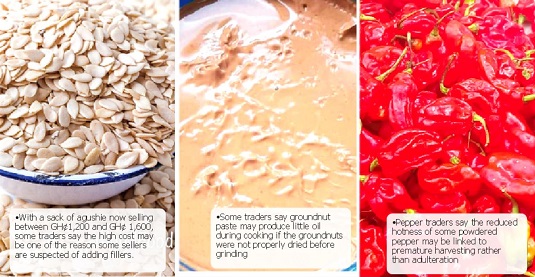
According to her, a sack of agushie, which sold for about GH¢700 two years ago, now sold between GH¢1,200 and GH¢1,600, depending on the size.
"And because of the price now, that is why some people may be adding things to it," she said.
For weeks, The Mirror has received complaints from consumers that they suspect some powdered pepper, agushie and groundnut paste sold on the market may have been mixed with other substances.
A trader at Makola, Joyce Konadu, claimed that some traders of groundnut paste mixed defatted peanut residue (tunkusa) or ‘konkonte’ flour, with groundnut paste to increase the volume and profit.
She alleged that some powdered pepper on the market contained similar fillers.
"If you are very observant, you will notice tiny white particles in some pepper powder," she said.
According to her, some of the products do not retain their quality when stored.
"When you open it, the next time you want to use it, the texture looks like dust, and it becomes tasteless," she claimed.
To identify adulterated powdered pepper, she said consumers should be wary of products that appear unusually fine in texture.
“Those that look too fine, when you see
that the powdered pepper they have bagged looks very fine, it is likely adulterated,” she claimed.
Groundnut paste concerns
Miss Konadu alleged that some groundnut paste sold on the market no longer produced the layer of oil consumers typically expected to see on top of groundnut soup.
She claimed that some traders removed the oil before packaging the paste for sale.
"And so you will buy it, use it for soup, and it will be on fire for a long time, and there won't be any oil on top," she said.
Market queen
Speaking to The Mirror last Wednesday, the CMB Market Queen, Naa Kwanuaa, said she had heard allegations that some traders adulterated powdered pepper, agushie and groundnut paste.
She said she had also come across similar claims on social media, particularly on TikTok.
However, she stressed that she had never personally witnessed such practices.
The market queen explained that pepper was currently out of season and suggested that if adulteration occurred, it was more likely during periods when the commodity was scarce.
She was, however, confident that such practices were not occurring at the CMB market.
According to her, the market was largely known for fresh farm produce such as cassava, plantain, garden eggs, kontomire, sweet potatoes, onions, oranges and pineapples.
"For us here, traders cannot bring a different leaf and sell it as kontomire, nor can they do it with garden eggs because garden eggs are garden eggs. The traders bring their produce directly from the villages, and the foodstuff is neat," she said.
Naa Kwanuaa explained that it would be economically wasteful for traders to adulterate products such as cassava dough because patronage had reduced significantly.
She noted that many traders disposed of unsold dough and therefore had no incentive to add other substances to it.
Personal experience
Although she dismissed allegations concerning traders at the market, the market queen expressed concern about the quality of some powdered pepper and groundnut paste sold elsewhere.
She said that she had stopped buying powdered pepper for her own chop bar because she was uncertain about its quality.
She also raised concerns about the quality of some groundnut paste on the market.
According to her, some processors used old or spoiled groundnuts they had to throw away.
"And so when you make soup with it, there is no oil on top because the nuts used were old ones. You smell the bad nut and not the original aroma of groundnut soup," she alleged.
Traders blame farmers
When The Mirror interacted with traders who had sold agushie, groundnut paste and powdered pepper at the Okaishie Market for many years, they all denied adulterating their
products.
However, many admitted hearing reports that some traders mixed food products with fillers such as konkonte flour.
A powdered pepper trader, Mama Yaa, who has sold the product for 14 years, blamed quality concerns on harvesting practices rather than adulteration.
"The problem is that farmers do not allow the pepper to mature before harvesting it. The seeds are small, and pepper is only very hot when it has plenty of seeds. We don't add anything to it," she said.
For groundnut paste seller Ama Maafoah, the issue had more to do with the quality of groundnuts supplied by farmers.
She explained that some farmers harvested the nuts and bagged them before they were properly dried.
"If the groundnuts are not well dried before grinding, the oil will not come out well. But if they are properly dried, then you get a quality product," she explained.
Dietitian's advice
A dietitian, Wise Chukwudi Letsa, said the addition of fillers to food products diminished their nutritional value and could potentially expose consumers to health risks.
According to him, mixing substances such as ‘tunkuusa or other fillers with groundnut paste reduced the nutritional integrity of the product.
"This practice demonstrably diminishes the nutritional integrity of the groundnut paste. Consequently, the intrinsic value of the groundnut paste is compromised by the inclusion of additional components," the dietitian explained.
On claims that powdered pepper may be mixed with dyes or other fillers, the expert warned that such practices could be dangerous.
"This presents a significant risk, particularly if the dyes employed are not food-grade, as they could introduce chemical contaminants into the powdered pepper," the dietitian said.
Writer’s email address:
