
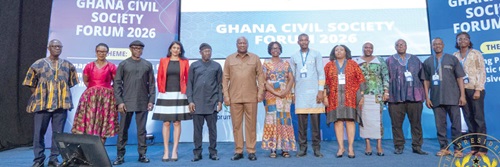
President John Dramani Mahama has called for a fundamental reimagining of the country’s development partnerships, urging a shift from dependency on external aid to domestic resource mobilisation and national ownership.
He consequently outlined a new development compact grounded in four key principles: greater domestic resource mobilisation, stronger institutions of state as anchors of democracy, greater accountability for development outcomes, and stronger partnerships across society with local ownership of development processes.
Delivering the keynote address at the Ghana Civil Society Forum 2026 yesterday at the University of Ghana on the theme: "Reimagining Partnerships for Democratic Consolidation and Inclusive Development", the President declared that the changing global development finance architecture demanded that Ghana ask "a completely different question: what can we do for ourselves?"
The Ghana Civil Society Forum (GCSF), the national convening platform for CSOs, NGOs, and academia to deliberate on democratic governance and inclusive development, is convened by Ibrahim-Tanko Amidu, who also serves as Executive Director of STAR-Ghana.
The forum brought together diverse voices from across the country to examine challenges and to chart pathways for national progress.
"The future of Ghana's development must increasingly be financed by Ghanaian ingenuity, Ghanaian enterprise, Ghanaian innovation and Ghanaian institutions," President Mahama told the gathering of CSOs, development partners, and stakeholders.
The President emphasised that while development partners remained valued contributors, the era of relying primarily on traditional aid flows was passing, citing declining donor resources, shifting priorities and geopolitical tensions reshaping global cooperation.
"For too long, Africa's development conversation has often been framed around what our external partners can do for us.
The changing global environment challenges us to ask a completely different question: what can we do for ourselves?" President Mahama said.
He stressed that this position did not diminish the importance of development partners nor promote isolationism.
Rather, it reflects a determination to build a more resilient development model anchored in domestic capacity and national ownership.
Constitutional review
The President provided significant updates on the ongoing constitutional review process.
Among the key proposals by the Constitution Review Committee currently before Cabinet, he said, were amendments to Article 71 to establish an independent emoluments commission, changes to the appointment of ministers from Parliament, extension of presidential, parliamentary, and assembly terms from four to five years, fixed terms for the Chief Justice and Electoral Commissioner, and the election of District Chief Executives.
"These proposals are quite interesting and will deepen our democratic consolidation," President Mahama stated.
Accountability measures
The President announced that Cabinet had approved the new National Ethics and Anti-Corruption Action Plan 2026-2030 for onward transmission to Parliament.
He also revealed a new directive for the Attorney-General to draft a State Assets Protection Bill, to provide guidelines for the disposal of state assets, including lands, buildings, factories, and industries, to prevent capricious disposal by governments.
Domestic financing
The President highlighted his administration's achievement in transferring at least 80 per cent of the District Assemblies Common Fund directly to the districts, up from less than 42 per cent before the administration took office.
"Now, everyone can testify to the kinds of development taking place in their various districts," he said.
President Mahama called for the accommodation of new development financing models, including encouraging local philanthropy, leveraging technology to mobilise resources, strengthening social enterprises and impact investment ecosystems, unlocking the potential of the Ghanaian diaspora and encouraging responsible private-sector participation in development.
Democracy
Reflecting on Ghana's democratic journey, President Mahama said more than three decades after the birth of the Fourth Republic, the nation had witnessed peaceful transfers of power, strengthened institutions, an increasingly vibrant media landscape and growing citizens' participation in public life.
"These achievements should never be taken for granted. Continuous renewal is an essential component of democratic consolidation," he said.
He added that "the true test of democracy is not only whether citizens vote every four years. It is whether citizens feel heard.
It is whether institutions remain accountable. It is whether public policy responds to the aspirations of ordinary citizens.
It is whether development reaches every community and whether every Ghanaian believes they have a stake in our collective national future".
The President acknowledged global challenges facing democracies, including declining public trust, misinformation, social polarisation, economic inequality, and climate-related disruptions, stressing that Ghana's response must be to deepen democracy and strengthen institutions.
Civil Society
President Mahama described civil society as "one of the most important pillars of our democracy" and a "strategic partner in nation building", rather than an adversary.
He highlighted the administration's commitment to participatory governance, including the national economic dialogue that brought together citizens, labour, business leaders, academics, civil society, and development partners.
The President recounted an earlier meeting with a broad coalition of civil society organisations at the Presidency, describing the discussions as "frank, constructive, and deeply insightful".
"They reinforced my belief that civil society is not simply an observer of national development, but an indispensable partner in shaping it," he said.
He further emphasised that an enabling environment for civic action is not a favour granted by government but a right and an essential requirement for democratic governance.
