
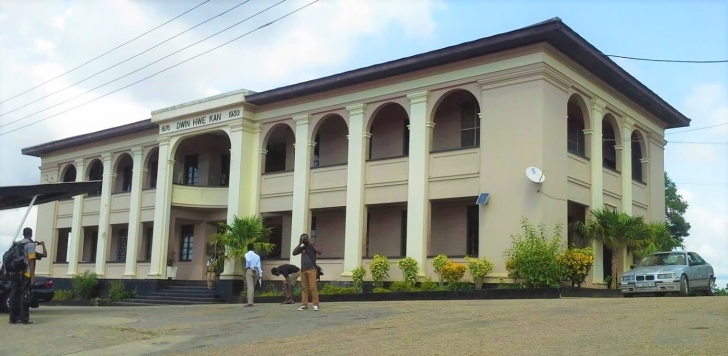
My second shock when I entered school in September 1987 was not academic. It was culinary.
Read also: Mfantsipim School @ 150 and Creech’s Mfantsipim Diaries: My First Shock
At Mfantsipim School, meals did not arrive with their official names. They arrived renamed, filtered through wit, exaggeration, and the inventive survival language of Kwabotwe boys.
Food, like masters, passed through an unofficial registry before it was accepted into student consciousness.
We spoke of:
Yorks - gari and beans sold across the so-called “Berlin Wall.”
The serving counter became a geopolitical frontier. Crossing it with your bowl felt like a diplomatic exercise in patience and positioning.
Abebe — gari soakings without milk.
Austerity in its purest form. No “Liquid.” Just water and willpower.
Abebe on Rocks — gari soakings with groundnuts. An upgrade. The groundnuts added texture and dignity. The name borrowed the language of a bar order, as though we were connoisseurs rather than hungry adolescents.
GAS — gari and shito without sardine or mackerel. Fuel without reinforcement. It filled space but made no promises.
Abrewa — waakye. “Old woman.” A nod to the archetypal street vendor whose ladle dispensed both generosity and authority.
Contains — the stew that accompanied Abrewa. A label of possibility rather than certainty. It might contain fish. It might contain hope. The ambiguity was the joke.
Baby Shit — cocoyam leaves stew served with kenkey. Boarding school humour is not delicate. Colour determined terminology.
Khaki Soup — groundnut soup served with rice or kenkey. Named for its unmistakable hue. When paired with kenkey, it was respectable. When served with rice, it was my favourite. The rice absorbed the soup completely, turning a routine meal into something close to comfort.
Eggy Brodos — toasted bread with fried egg. Unlike the dining hall staples, Eggy Brodos was an evening privilege. It was sold on campus after preps by the wife of Mr. Yamoah—known to us as “Otwe Bin,” the Technical Drawing master. After hours of supervised study, the aroma of frying eggs drifting through the compound felt almost subversive. It was enterprise meeting appetite. A quiet economy operating within institutional order.
Liquid — a tin of milk.
Solid — a tin of sardine or mackerel.
Nutrition reduced to physics. If you had both Liquid and Solid, you had achieved dietary equilibrium.
At first glance, the names seemed irreverent. In reality, they were adaptive.
In a regimented boarding environment, repetition can dull the spirit. Renaming restored agency. It softened monotony. It disguised inequality. It strengthened bonds.
Who had Liquid mattered. Who survived on Gas was visible. But humour equalised what economics sometimes divided.
These were not careless labels. They were observational, efficient, and socially functional. They encoded commentary on quality, scarcity, aspiration, and resilience.
Institutions endure not only because they feed generations, but because generations learn how to reinterpret what they are fed. The dining hall lexicon of 1987 was part of that hidden curriculum.
We were not merely eating.
We were translating experience into folklore.
By the time you understood the difference between Abebe and Abebe-on-Rocks, between GAS and Solid, between Khaki Soup with kenkey and Khaki Soup with rice, you had crossed another invisible threshold.
You were no longer just a Greenhorn. You spoke the language.
To be continued.
The writer is Philip Creech-Jones of MOBA 1992 (Mfantsipim Old Boys Association).
